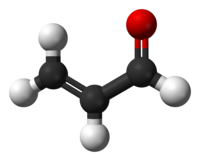
Acrolein ( Latin acris - spicy, caustic + oleum - oil) (propenal) - H 2 C = CH-CHO, acrylic acid aldehyde , the simplest unsaturated aldehyde . Colorless volatile tear liquid with a pungent odor, strong lacrimator .
| Acrolein | |
|---|---|
 | |
 | |
| Are common | |
| Systematic name | Prop-2-en-1-al |
| Traditional names | Acrolein, Propenal, Acrylaldehyde |
| Chem. formula | C 3 H 4 O |
| Physical properties | |
| Molar mass | 56.0633 ± 0.003 g / mol |
| Density | 0.843 g / cm³ |
| Ionization energy | 974.7911 kJ / mol |
| Thermal properties | |
| T. melt. | −87 ° C |
| T. bale. | 52.7 ° C |
| T. aux. | -26 ° C |
| T. svpl. | 234 ° C |
| Etc. blast | 2.8–31%% |
| Cr. point | 232.85 ° C |
| Steam pressure | 29 kPa (20 ° C) |
| Chemical properties | |
| Solubility in water | 200 g / 100 ml |
| Structure | |
| Dipole moment | 2,552 ± 0,003 (cis position), 3.117 ± 0.004 (trans position) |
| Classification | |
| Reg. CAS number | 107-02-8 |
| PubChem | |
| Reg. EINECS number | 203-453-4 |
| Smiles | |
| Inchi | |
| RTECS | |
| Chebi | |
| UN number | |
| ChemSpider | |
| Security | |
| MPC | 0.03 mg / m 3 |
| LD 50 | 46 mg / kg (white rats, oral); 7 mg / kg (rabbits, oral); 28 mg / kg (mice, oral) |
| Toxicity | highly toxic, its vapors are especially dangerous, strong irritant, lacrimator  |


Content
Reactivity
Acrolein, being a unsaturated aldehyde, exhibits the reactivity inherent to both olefins and aldehydes. So, acrolein forms acetals :
its aldehyde group is easily oxidized to carboxyl:
and reduced to hydroxyl:
The carbonyl group of acrolein is conjugated with a double bond , which leads to its high reactivity with respect to nucleophiles, while the addition proceeds at the β-carbon atom:
Halogens are attached to acrolein in a double bond to form a dihalogen derivative, which further cleaves the hydrogen halide to form α-halogenacrolein:
Due to the presence of an electron-withdrawing aldehyde group conjugated to a double bond, acrolein is a dienophile and reacts with dienes with the formation of cycloaddition products ( Diels-Alder reaction ):
Synthesis
In the laboratory, acrolein is obtained by dehydration of glycerol in the presence of potassium hydrosulfate .
In industry, acrolein is produced by catalytic oxidation of propylene over bismuth oxide - molybdenum catalysts or copper oxide. Previously, the process of vapor-phase croton condensation of acetaldehyde with formaldehyde (an outdated method) was common in industry:
Toxicity
Due to its high reactivity, acrolein is a toxic, highly irritating compound to the mucous membranes of the eyes and respiratory tract, a strong lacrimator . Maximum single maximum permissible concentration in the air 0.03 mg / m³; Average daily maximum permissible concentration in the air is 0.01 mg / m³ (MP list GN 2.1.6 1338-03). It causes mutagenesis in bacteria and yeast, exhibits mutagenic properties in mammalian cell cultures [1] .
Belongs to hazard class I (extremely hazardous substances).
Acrolein is one of the products of thermal decomposition of glycerol and glyceride fats, which explains the irritating mucous membranes properties of smoke of burnt fat.
Application
Used for the synthesis of acrylonitrile , glycerol , pyridine , β-picoline, amino acids ( methionine ), ethyl vinyl ethers, glutaraldehyde, polyacrolein. Also used in the manufacture of medicines. During the First World War it was used as a chemical weapon.
Literature
- Chemical Encyclopedia / Editorial Board: Knunyants I.L. et al. - M .: Soviet Encyclopedia, 1988. - T. 1 (Abl-Dar). - 623 p.
Notes
- ↑ Acrolein MSDS unopened (inaccessible link) . Date of treatment March 26, 2012. Archived February 14, 2012.