The reservoir in the National Park of Uzbekistan (formerly the Komsomol Lake ) is the second largest artificial reservoir created within the city limits of Tashkent on the Ankhor Canal and the first mass recreational reservoir of the city created according to the general plan. Currently, the lake includes within its territory the National Park named after A. Navoi . A small lake stretches from southwest to northeast. It has two relatively large islands that connect bridges to the shores [1] . The pit has an area of about 9 hectares and a depth of 1.5 - 6 meters. After Uzbekistan gained independence , the name "Komsomolskoye" came out of official use, but continues to be maintained in everyday life.
| Reservoir in the National Park of Uzbekistan | |
|---|---|
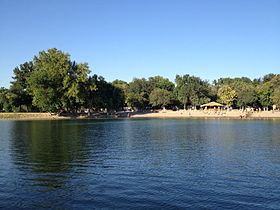 view of the reservoir from the west bank | |
| Morphometry | |
| Dimensions | 1 × 0.075 km |
| Area | 0.09 km² |
| Deepest | 6 m |
| Characteristics | |
| Year of filling | 1940 |
| Location | |
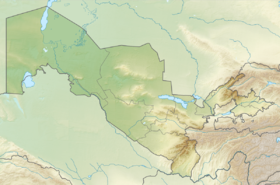
| A country |
|
| City | Tashkent |



Creation History
Until the end of the 20s of the 20th century , there were no large public reservoirs for the summer holidays of citizens, including bathing and boating in Tashkent . In the early thirties in the city appeared the first reservoir for such purposes. It was the reservoir that arose over the dam under construction at the Bozsui hydroelectric station, which in turn was the first hydroelectric power station in the Chirchik-Bozsui cascade of hydroelectric power stations. The first boat station of Tashkent was built on this reservoir, nicknamed Hydra . However, after that, a water intake station of the Tashkent water supply appeared on this reservoir, its waters were closed for public recreation of citizens. As a result, a need arose for a new recreational reservoir. In the second half of the 1940s, two artificial lakes were created (dug) in Tashkent for bathing and summer holidays for citizens - Victory Park on the Bozsu Canal and Komsomolskoye Lake, which feed the waters of the Ankhor Canal. When creating a reservoir in the late 30s of the last century, prisoners , Komsomol members , as well as other residents of the city (for example, non-working housewives) were actively involved in their free time.
Hydrography
According to some sources, the bed for creating the “Komsomolskoye Lake” was the old quarry , from which in earlier periods of the history of Tashkent (in the XVIII - early XIX centuries) they took building material (mainly clay ) for brick production in nearby brick workshops.
At the end of the swimming season, water from the lake is traditionally lowered to clean its bottom, which covers the sludge , from various debris left by vacationers. Over the summer, algae develop in the lake, as well as colonies of freshwater bivalves, the largest specimens of which reach a size of thirty centimeters. Some bivalves die, but some winter in puddles that persist in the deepest places at the bottom of the lake [2] .