Count Karl Ivanovich Opperman ( Karl Ludwig Wilhelm Opperman , German: Karl Ludwig Wilhelm Oppermann ; November 12 (23), 1766 , Darmstadt - July 2 (14), 1831 , Vyborg ) - a well-known Russian engineer, cartographer and fortifier , military officer participating in the Napoleonic Wars.
| Karl Ivanovich Opperman | |||||||||||||||||||
|---|---|---|---|---|---|---|---|---|---|---|---|---|---|---|---|---|---|---|---|
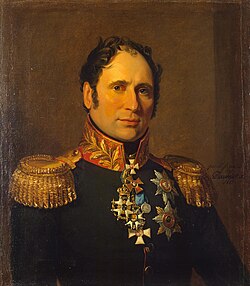 Portrait of Karl Ivanovich Opperman work [1] by George Dow . Military Gallery of the Winter Palace , State Hermitage Museum ( St. Petersburg ) | |||||||||||||||||||
| Date of Birth | November 12, 1766 | ||||||||||||||||||
| Place of Birth | Darmstadt | ||||||||||||||||||
| Date of death | July 2, 1831 ( 64) | ||||||||||||||||||
| A place of death | Vyborg | ||||||||||||||||||
| Affiliation |  Russian empire Russian empire | ||||||||||||||||||
| Type of army | engineering troops | ||||||||||||||||||
| Years of service | 1783-1831 | ||||||||||||||||||
| Rank | general engineer | ||||||||||||||||||
| Commanded | Mikhailovsky Artillery School | ||||||||||||||||||
| Battles / wars |
| ||||||||||||||||||
| Awards and prizes |
| ||||||||||||||||||
| Communications | sons Alexander , Leonty | ||||||||||||||||||


Member of the State Council , Director of the Engineering and Construction Departments, Head of the Engineering and Artillery Schools and the School of Guards Liaison Officers and Cavalry Junkers , Director of the Depot of Maps and the Hydrographic Depot , Honorary Member of the Imperial Academy of Sciences .
Content
- 1 Start of service
- 2 Napoleonic Wars
- 3 Post-war service
- 4 Awards
- 5 notes
- 6 Literature
- 7 References
Start of Service
Karl Ivanovich Opperman, who came from the noble family of the Duchy of Hesse-Darmstadt , was born in Darmstadt . His father was a secret adviser and a major dignitary at the Duke’s court, and his mother, as the researchers suggest, was the half-sister of Ludwig Heinrich Nikolai (1737-1820), whose fate by that time already had a distinct “Russian trace”. Thanks to his father, Karl Opperman receives an excellent engineering and mathematical education, coupled with languages - French, Latin and Greek.
In 1779 he entered the Hessian army and in 1783 received the rank of engineer-captain. In the same year, he plans to move to Russia. This decision is not accidental. The fact is that at this time, the uncle of Karl Opperman, the aforementioned Ludwig Heinrich Nikolai, has long and thoroughly lived in Russia, occupying high positions at the court of the heir Pavel Petrovich and enjoying the extraordinary trust of him and his wife Maria Fedorovna .
Empress Catherine II answered the request of Karl Opperman to accept him into Russian citizenship, and on October 12, 1783 he entered the service with the rank of lieutenant of the Engineering Corps. In Russia, Opperman first of all assiduously takes up the study of the Russian language, which he subsequently masters to perfection.
Member of the Russian-Swedish war of 1788-1790 . He participated in almost all naval battles, including the famous Vyborg naval battle of 1790. Contributed to the defeat of the Swedish fleet in the battle of Rochensalm in 1789, building in several hours the strengthening of coastal batteries. For differences in the battle at Björkezund, he was awarded the Order of St. George of the 4th degree and the rank of engineer-captain.
The Swedish campaign of 1788-1790 ended for Karl Opperman with wounds and captivity, from which he returned only in 1791. After spending some time in Riga , Opperman in 1792 “was sent to Moscow with an emergency assignment, from where he returned ... to be sent to our army in Poland, which he was delighted with” (from a letter from Baroness Nikolai 1792). In Poland, Opperman takes part in several battles with the Polish Confederates. Member of the suppression of the Polish uprising of Tadeusz Kosciuszko in 1794.
In 1795, he was promoted to major engineer, developing a project to strengthen the western borders of the Russian Empire. In 1797 he was appointed by Emperor Paul I to be a member of His Majesty's Depot of Cards . In the same year he was enrolled in the Engineering expedition of the Military College and on March 6, 1798 promoted to colonel. On October 3, 1799, he retired with production as an engineer major general . December 5, 1800 he was accepted into the service in the Engineering Corps with a determination in the Department of Water Communications .
Upon the accession to the throne of Emperor Alexander I , Opperman was transferred to the Depot of Kart on April 15, 1801, with His Imperial Majesty being added to the retinue , as a result of which Emperor Alexander I became more acquainted with Opperman and fully appreciated his deep knowledge and experience. In March 1803 he was sent to Finland to improve the defense capabilities of border fortresses. As the Manager of the Card Depot (since 1812 - the Military Topographic Depot) [2] he supervised the compilation of the “ Stolistovoy map ” [3] of the Russian Empire. For this work, as well as for compiling a complete atlas of Russian fortresses, Opperman received the Order of St. Annas 1st grade.
Napoleonic Wars
January 6, 1805, in view of the impending war with Napoleon , at the highest command of Opperman sent to Italy with a secret mission to inspect the French fortresses. He officially corrected the position of the quartermaster general of the Russian, English and Neapolitan troops operating in Italy against the French. In 1806-1807 he participated in the war with the French in Poland and East Prussia, as part of General Essen's corps, he participated in battles at the Island and near Ostroleka . For the differences shown in these matters, he was awarded the Order of St. Vladimir 3rd degree.
In 1806 he was on the island of Corfu during the operations of the Russian fleet under the command of Vice Admiral D.N. Senyavin in the Adriatic Sea and then in November returned through Russia to Constantinople . In 1807, due to a break with England , he was entrusted with the task of bringing Kronstadt into a defensive state.
During the Russo-Swedish War of 1808-09, he led the renovation of the fortifications of Vyborg, Neyshlot and Tavastgust .
Having become an inspector in the Engineering Department of the War Ministry in 1809, Opperman with ordinary energy set about inspecting and correcting fortresses located along the western border, including the Kiev one . He supervised the construction of the Bobruisk (1810) and Dinaburg fortresses. Later, the fortress in Bobruisk withstood the siege of the Dombrowski corps until the end of hostilities. Napoleon’s army overlaid and kept Bobruisk under siege for several months, but thanks to the skillful actions of the Russian garrison, it could not prevent Prince Bagration from uniting with units of the 1st Western Army.
In 1810 he created the Engineering School on the basis of the school of engineering conductors created in 1804 in St. Petersburg , which in 1819 was transformed into the Main Engineering School . For useful activities in the field of fortification, Opperman is awarded the Order of St. Vladimir of the 2nd degree of the big cross and was promoted to engineer-lieutenant general on August 30, 1811.
Since February 28, 1812, Director of the Engineering Department. In March 1812 he was appointed head of the engineering service of the 1st Western Army. In 1812 he was engaged in armament of fortresses from Riga to Kiev . In October 1812, he was also appointed to be part of the Main Apartment of the Russian Army, and in fact controlled the engineering troops (and their supplies) of the army . He participated in the battles of October 28, 1812 near Vyazma and November 5-6 at the Red [4] . For the differences in these battles he was awarded the Order of St. Alexander Nevsky.
Since March 1813, he led the engineering work during the siege of the Thorn fortress , after its surrender he was awarded the Order of St. George of the 3rd degree. After that, he was the chief of the General Staff of the Polish Army Bennigsen . He commanded troops during the blockade of Modlin Fortress .
Since July 1813, the chief of the General Staff of the field army. He took part in the battles of Dresden , Pirn , in the battle of Leipzig , in the siege of Magdeburg and Hamburg . For numerous merits during this period he is awarded with diamond marks of the Order of St. Alexander Nevsky and several foreign orders.
Post-War Service
At the end of the war, he was engaged in the construction of the Engineering Department, the formation of engineer and pioneer troops, and managed the construction unit for all Russian fortresses.
Since 1818, Karl Opperman became an active assistant to the Grand Duke Nikolai Pavlovich to manage the engineering part. On January 20, 1818, the Inspector General for Engineering, took a large part in the establishment of the Main Engineering School .
Under Nicholas I was a member of the committee for organizing the construction unit and chairman of the committee for improving the educational unit in the cadet corps ; He also headed the Maritime Construction Department and the artillery school. December 12, 1823 promoted to general engineer . In 1826 he was appointed to the Supreme Criminal Court in the case of the Decembrists .
December 20, 1826 became an honorary member of the Russian Academy of Sciences , was an honorary member of the Russian Mineralogical Society . As chairman of the commission for the construction of St. Isaac's Cathedral, he oversees its construction. In 1827, Opperman was the main trustee of the Evangelical Peter and Paul Church in St. Petersburg . In this title, he transforms the St. Peter's College located at the church. In the same 1827, Opperman became the chief of the Artillery School .
Since 1827, member of the Council of State. July 1, 1829 received the count title . In the same year, he developed a project for the reconstruction of the Brest Fortress , the construction of which ended in 1842 [5] . During the siege of this fortress in June - July 1941, German troops had to use 1800-kg bombs to destroy it. On August 24, 1941, the fortress was visited by Hitler and Mussolini [6] . As a mentor to Nicholas I in engineering and military sciences, he maintained an excellent relationship with him, which, however, did not prevent the emperor from recovering a fine from K.I. Opperman for submitting to him for approval the draft barracks in the Bobruisk fortress, which collapsed shortly after construction. The emperor himself, as the project manager, also fined himself 580 rubles 60 kopecks. In 1850, the emperor appropriated the name of Opperman to a new defensive tower on the Bobruisk River [7] .
From 1827 to 1831 - Head of the Construction Department for the marine part, member of the Board of Trustees of Petrishule . Since 1829, an honorary member of the St. Petersburg Academy of Sciences. The next award received by Count Opperman was the Order of St. Andrew the First-Called, assigned to him on July 25, 1830.
In 1830 he was commissioned to draw up a project for the reconstruction of the Sveaborg fortress, the count is actively taking up work, but in 1831 he falls ill with cholera, an epidemic of which flares up in St. Petersburg, and dies in his 65th year of life. He was buried in St. Petersburg at the Vyborg cholera cemetery located on the Kulikovo field.
On June 6, 1833, according to the plans of Karl Ivanovich Opperman, the construction of the Brest Fortress was begun.
For special merits, his surname is stamped on the medal "In memory of the 50th anniversary of the Corps of Military Topographers ."
His eldest son, Alexander Karlovich Opperman , was also a general in the Russian army and fought in the Caucasus with honors; the youngest son, Leonty Karlovich Opperman , participated in the Crimean War with honors. Justin Karlovich Opperman was a professor at the University of Gottingen .
Rewards
- Order of the Holy Apostle Andrew the First-Called (06/25/1830)
- Order of St. George 3rd degree (04/26/1813)
- Order of St. George 4th degree (08.22.1789)
- Order of St. Vladimir 1st degree (01/29/1821)
- Order of St. Vladimir, 2nd degree (07.25.1810)
- Order of St. Vladimir 3rd degree (12.31.1807)
- Order of St. Alexander Nevsky (12/29/1812)
- Diamond signs for the Order of St. Alexander Nevsky (11.11.1814)
- Order of St. Anne 1st Class (03/19/805)
- Diamond signs for the Order of St. Anne of the 1st degree (10.23.1807)
- Order of St. Anne of the 2nd degree (04/14/1799)
- Diamond signs for the Order of St. Anne of the 2nd degree (05.26.1803)
- Order of St. John of Jerusalem , Honorary Commander (09/23/1799)
- Golden sword “For courage” with diamonds
- Silver medal "In memory of the Patriotic War of 1812"
- Medal "For the Capture of Paris" (03/19/1826)
- Insignia "For XL Years of Immaculate Service" (08/22/1828)
- Order of Danebrog , commander (Denmark, 1815)
- Order of the Red Eagle of the 1st degree (Prussia, 1814)
- Legion of Honor , Grand Cross (France, 01/25/1827)
- Legion of Honor, commander (France, 1815)
- Order of the Sword , big cross (Sweden, 1813)
Notes
- ↑ State Hermitage Museum. Western European painting. Catalog / Ed. V. F. Levinson-Lessing; ed. A. E. Krol , K. M. Semenova. - 2nd edition, revised and supplemented. - L .: Art, 1981. - T. 2. - P. 254, cat. No. 7847. - 360 p.
- ↑ Rychkov S. Yu. “Card Depot and Quartermaster Unit on the Eve of the War of 1812” // Military History Journal, No. 4, 2006
- ↑ Litvin A. A. The Stolistovaya map of Russia. // Encyclopedia "The Patriotic War of 1812". M., 2004, p. 681.
- ↑ S.V. Sergeev, E.I. Dolgov. "Military topographers of the Russian Army." M .: CJSC SiDiPress, 2001, P.510. ISBN 5-8443-0006-8
- ↑ Brest. Brest Fortress. Story. V.V.Beshanov
- ↑ MUSSOLINI IN BREST - Information and problem weekly weekly 7 days (inaccessible link)
- ↑ Generals, military leaders and military figures of Russia in the “Military Encyclopedia” by I. D. Sytin. Reprint edition of 1997, Petersburg. Page 266.
Literature
- Patriotic War of 1812. Encyclopedia. - M .: ROSSPEN, 2004, p. 532-524.
- Dictionary of Russian generals, participants in the hostilities against the army of Napoleon Bonaparte in 1812-1815. // Russian archive. T.VII. - M .: studio "TRITE" N. Mikhalkov, 1996, p.
- Zalessky K.A. Napoleonic Wars. 1799-1815. Biographical Encyclopedic Dictionary. - M.: Publishing House of AST, 2003, p.335-336.
- Litvin A.A. Karl Ivanovich Opperman and the creation of the first special military archive of the Russian Empire. Materials for the biography // Vestn. Archivist, M., 4/5, 1999, pp. 232-237.
- Yakovlev V.V. History of fortresses.
- Blaramberg I.F.
- Tynianov Yuri. The death of Wazir Mukhtar.
- S.V. Sergeev, E.M. Dolgov. “Military Topographers of the Russian Army”, TS RF Armed Forces, Moscow, 2001, S. S. 509-510.
- Karmanenkov A. Yu., Kuis V.N. Provision of cartographic materials for the Russian Army on the eve of the war of 1812.
Links
- Opperman Karl Ivanovich
- Bolgov V. A. Family Relations Oppermanov and Nikolai
- Opperman, Karl Ivanovich // Brockhaus and Efron Encyclopedic Dictionary : in 86 volumes (82 volumes and 4 additional). - SPb. , 1890-1907.
- Dictionary of Russian generals, participants in the hostilities against the army of Napoleon Bonaparte in 1812-1815. // Russian archive. The history of the Fatherland in the evidence and documents of the XVIII — XX centuries. : Collection. - M .: TRITE studio N. Mikhalkova , 1996. - T. VII . - S. 499 . - ISSN 0869-20011 . (Comm. A. A. Podmazo )
- Russian generals
- Military Gallery of the Winter Palace
- An article from Zalessky’s book Napoleonic Wars
- Profile of Count Karl Ivanovich Opperman on the official website of the RAS
- Formal list for 1827
- Rod Head of School No. 2 (1827-1832) Karl Ivanovich Opperman
- Fortification of Kam'yantsya-Podilsky for the plan of K. Opperman 1794r.
- Both Destroyer and Creator
- Name History and Origin for Oppermann
- Dinaburg fortress
- Descendants of Karl Ivanovich Opperman
- Dolgorukov P.V. Russian genealogy book . - SPb. : Type. E. Weimar, 1855. - T. 2. - S. 244.