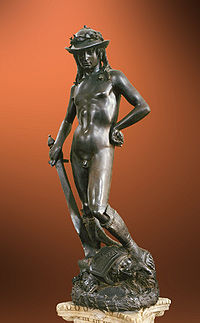
" David " - a bronze statue by Donatello ; the first image of a free-standing nude from antiquity [2] .
| ||
| Donatello | ||
| David . about 1440 | ||
| ital. David | ||
| Bronze Height 1.58 m | ||
| National Museum of Bargello , Florence | ||
| ( inv. ) | ||
Content
- 1 History
- 2 Description
- 3 Interpretations
- 4 See also
- 5 notes
- 6 Literature
- 7 References
History
The exact date of the creation of the sculpture is unknown. Most researchers attribute it to the period between 1430 and 1440. [3] , although later dating is not excluded, up to the 1460s [4] . The first documented mention of David dates back to 1469: this year, Lorenzo the Magnificent was married to Clarice Orsini , and at that time the statue was in the courtyard of the Palazzo Medici [5] . It is assumed, however, that she got there a few years earlier, in the 1450s or 1460s [6] .
According to J. Vasari , the statue of David was created by order of Cosimo Medici , but this information cannot be considered reliable [7] . Vasari also gives a description of the unsaved pedestal on which the statue was located. The pedestal was created by Desiderio da Settignano :
| “In his youth, he made for Donato the pedestal of David, who is in the palace of the Duke of Florence; on this pedestal he perfectly made several harpies of marble, and several vines of bronze, very elegant and well conceived ” [8] . |
In 1495, after the Medici was expelled from Florence, the statue was transferred to the Palazzo Vecchio . Since 1738 (some historians call 1777), it was in the Uffizi Gallery [7] . The Bargello National Museum was founded in 1865, and in the second half of the 19th century, David took a place among its exhibits.
Description
David Donatello does not look like traditional images of a biblical hero . It differs from an earlier statue of the work of Donatello himself, made of marble ( see ill. ). Bronze David is almost a boy with a flexible, youthful body and long hair. He is completely naked, except for a wide-brimmed shepherd's hat topped with a laurel wreath, and sandals with greaves . The free pose of the hero is an example of a post : the weight of the body rests on the right foot, while the left, half-bent, he tramples on the head of the defeated Goliath . The body of the young man is slightly deviated from the central axis; the diagonal of the sword, on which the winner rests, emphasizes the instability and internal dynamics of the figure [9] . In his left hand he holds a stone from the sling - a weapon of victory. The statue is designed to walk around and inspect from all points of view; while light flares on the bronze surface focus on one or another bend of this graceful body, emphasizing the spatial nature of the composition [10] .
A.K. Dzhivelegov in his work "Creators of the Italian Renaissance" gives the statue of David the following characteristics:
| “David is beautiful. <...> A calm triumph is written on the face, but some thoughtfulness ennobles the whole image through a smile of joy. In all the splendor of his naked, not fully formed body, he stands in front of the viewer, open from all sides, not constrained by a niche, nor a cornice, nor a tabernacle. David not only crushed Goliath. He freed sculpture from centuries of slavery. Now she is no longer a servant of architecture: a wide free path has opened before her ” [11] . |
Interpretations
David Donatello is a work of art with many interpretations.
One way or another, all researchers note the unusual femininity of the youth’s appearance and his “non-heroic” posture: “Donatello portrayed a charming young man, who in a peculiar way combines the angularity of youth with the roundness of several feminine forms, breathing sensual charm” [10] ; “A strong, although still very young winner boy looks thoughtfully and even a little embarrassed down at the head of the defeated giant severed by him, supporting the small sword with a cunning and tired movement of his right hand” [12] ; “David’s nudity, shaded by sandals and a hat, is emphasized by the expression on the face and the whole appearance of the young man, talking about narcissism and narcissistic self-centeredness” [3] . Obviously, the statue not only conveys to the viewer the greatness of David’s feat, but makes him admire the beauty of a naked youthful body. This gave grounds to see homoerotic motifs in Donatello's work [2] [3] and to look for numerous hints in it for the reliability of just such a reading [13] .
However, there is a completely different explanation for the fragility and femininity of David. When looking at him, it is difficult to imagine that he is able to cope with a warlike giant - but the role of divine intervention, which determined the outcome of this battle, becomes more pronounced. Therefore, a statue depicting a weak youth standing above a defeated enemy speaks of the invisible presence of God in this scene [13] .
For understanding Donatello’s intent, the historical and political context is also important. The image of David is extremely popular in the Renaissance : David appears to be a true hero, a native of the people who saved the people from enslavement and later became the king of the Jews [14] . The fact that the statue was in the courtyard of the Palazzo Medici (and may have been created by their order) suggests that the Medici family wanted to be perceived as champions of freedom. It is no coincidence that the statue of David was adjacent to another famous work of Donatello: the sculpture group Judith and Holofernes. Judith and David are the saviors of the people, tyrannical murderers who could serve as the perfect embodiment of the ideals of the Florentine Republic . Having placed this symbol of freedom in the courtyard of their own palace, the Medici wanted their name not to be associated with tyranny and usurpation of power, but, on the contrary, with republican values [15] .
The noncanonical appearance of the biblical character led some researchers to suggest that the statue in general does not depict David, but someone else, for example, Mercury [16] . However, all sources, starting from the 15th century, confidently identify the statue as an image of David. In addition, there is documented evidence that the following inscription was located on the statue’s unsaved pedestal: “The one who fights for the fatherland wins. The Lord crushes the wrath of a powerful enemy. The boy defeated the terrible tyrant. Triumph, citizens! ” [17] .
See also
- David (Bernini)
- David (Verocchio)
- David (Michelangelo)
Notes
- ↑ 1 2 http://www.bargellomusei.beniculturali.it/opere/bargello/96/david/
- ↑ 1 2 Frederic Hartt. History of Italian Renaissance Art: Painting, Sculpture, Architecture. Prentice-Hall, Inc., and Harry N. Abrams Inc., New York. - P. 202
- ↑ 1 2 3 Laurie Schneider. Donatello's Bronze David. // The Art Bulletin. - 1973. - Vol. 55, No. 2. - P. 213
- ↑ Sarah Blake McHam. Donatello's Bronze David and Judith as Metaphors of Medici Rule in Florence. // The Art Bulletin. - 2001. - Vol. 83, No. 1. - P. 32.
- ↑ Luciano Berti, Alessandro Cecchi, Antonio Natali. Donatello. Art Dossier No. 3. Giunti Editore, 1986. - P. 57.
- ↑ Janson, 1963 , p. 79.
- ↑ 1 2 Janson, 1963 , p. 80.
- ↑ Vasari D. Biographies of the most famous painters, sculptors and architects. - M .: "Publishing house ALFA-BOOK", 2008. - S. 358. - ISBN 978-5-9922-0101-7 . "
- ↑ Argan J.K. History of Italian art. In 2 vols. T. 1. - M .: Rainbow, 1990. - S. 224
- ↑ 1 2 Lazarev V.N. Beginning of the Early Renaissance in Italian art . - M.: Art, 1979.
- ↑ Dzhivelegov A.K. Creators of the Italian Renaissance: In 2 book. Prince 1. - M .: TERRA Book Club; Republic, 1998. - P. 123. - ISBN 5-300-02049-4 . "
- ↑ Gukovsky M.A. Italian Renaissance. 2nd ed., Rev. and add. - Leningrad: Publishing house of the Leningrad University, 1990. - P.566.
- ↑ 1 2 Robert Williams. Virtus Perficitur: on the Meaning of Donatello's Bronze David. // Mitteilungen des Kunsthistorischen Institutes in Florenz. - 2009. - Bd. 53, H. 2/3. - P. 217.
- ↑ Wipper B. R. Italian Renaissance of the 13th — 16th Centuries. - M.: Art, 1977. - C. 136.
- ↑ Robert Williams. Virtus Perficitur: on the Meaning of Donatello's Bronze David. // Mitteilungen des Kunsthistorischen Institutes in Florenz. - 2009. - Bd. 53, H. 2/3. - P. 228.
- ↑ Luciano Berti, Alessandro Cecchi, Antonio Natali. Donatello. Art Dossier No. 3. Giunti Editore, 1986. - P. 58.
- ↑ Robert Williams. Virtus Perficitur: on the Meaning of Donatello's Bronze David. // Mitteilungen des Kunsthistorischen Institutes in Florenz. - 2009. - Bd. 53, H. 2/3. - P. 218, 225.
Literature
- Argan J.K. History of Italian art. In 2 vols. T. 1. - M .: Rainbow, 1990 .-- S. 224.
- Vipper B. R. Italian Renaissance of the XIII — XVI Century. - M.: Art, 1977. - C. 136.
- Gukovsky M.A. Italian Renaissance. 2nd ed., Rev. and add. - Leningrad: Publishing house of the Leningrad University, 1990. - P.566. - ISBN 5-288-00163-4
- Dzhivelegov A. K. Creators of the Italian Renaissance: In 2 book. Prince 1. - M .: TERRA Book Club; Republic, 1998. - S. 123. - ISBN 5-300-02049-4 .
- S. Zuffy. Rebirth. XV century: Quattrocento. - M .: Omega, 2008 .-- S. 269. - ISBN 978-5-465-01772-5 .
- Lazarev V.N. Beginning of the Early Renaissance in Italian art . - M.: Art, 1979.
- Baskins, Cristelle L. - Donatello's Bronze David: Grillanda, Goliath, Groom? // Studies In Iconography, 1993. - No. 15. - pp. 113-34
- Berti, Luciano, Cecchi, Alessandro, Natali, Antonio. Donatello. Art Dossier No. 3. Giunti Editore, 1986. - pp. 57-60. (ital.)
- HW Janson. The Sculpture of Donatello. - Princeton. New Jersey: Princeton University Press, 1963. - S. 77-86. (eng.)
- McHam, Sarah Blake. Donatello's Bronze David and Judith as Metaphors of Medici Rule in Florence . // The Art Bulletin. - 2001. - Vol. 83, No. 1. - pp. 32-47. (eng.)
- Hartt, Frederic. History of Italian Renaissance Art: Painting, Sculpture, Architecture. Prentice-Hall, Inc., and Harry N. Abrams Inc., New York. - pp. 202–203
- Schneider, Laurie. Donatello's Bronze David . // The Art Bulletin. - 1973. - Vol. 55, No. 2. - pp. 213-216. (eng.)
- Williams, Robert. Virtus Perficitur: on the Meaning of Donatello's Bronze David . // Mitteilungen des Kunsthistorischen Institutes in Florenz. - 2009. - Bd. 53, H. 2/3. - pp. 217-228. (eng.)