
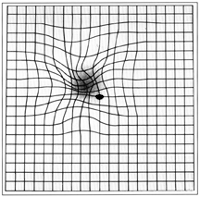
Epiretinal membrane - an eye disease as a result of disorders in the vitreous body , or, much less commonly, diabetes . Otherwise, it is called the macular fold . Sometimes, as a result of the immune system’s actions to protect the retina, the cells converge in the macular region, since the vitreous body ages and moves outward, forming a detachment of the vitreous body (PVD) [1]. PVD can slightly damage the retina, stimulating exudate, inflammatory and, like consequence, leukocytosis processes. These cells can form a transparent layer gradually, dragging on and creating tension on the retina, causing it to protrude into folds (macular folds, for example) or even cause bloating or swelling of the macula . This often leads to distortions in the field of view, which appear as strings with blur when looking at lines on a sheet of paper (or the Amsler grid ) within the macular region or in the center of the visual arch with coordinates 1.0. This usually happens first in one eye and can lead to binocular diplopia or double vision if the image from one eye is very different from the other. Distortions can make objects different in size (usually enlarged ( macroscopy )), especially in the central part of the field of view, creating localized fields affected by aniseikonia that cannot be completely corrected optically with glasses, although even partial correction can significantly improve binocularity. In youth (up to 50 years), such cells can pull unbound and disintegrate on their own; but in most patients (over 60), their condition remains constant. Since the main cells of photoreceptors , rods and cones , as a rule, are not damaged, if the membrane does not become too rigid and hard, this situation usually does not lead to macular degeneration .
Content
Epiretinal Membrane Surgery
Surgeons can remove the membrane peel through the sclera , improving visual acuity by two or more lines of the Snellen table. Usually the vitreous body is replaced for the purpose of cleaning in the procedure of vitroectomy . If distortions do not pose serious obstacles to everyday life, then surgery is usually not recommended, since it is associated with the possibility of complications, such as infections and the possibility of retinal detachment . More common complications of surgical vitroectomy are increased intraocular pressure, eye bleeding, and cataracts . Many patients develop cataracts during the first few years after surgery. Sometimes visual distortions and double vision in the eyes caused by cataracts are confused with the epiretinal membrane.
Prevention
There is no convincing evidence of the benefits of any preventative measures, as this seems to be a natural reaction to age-related changes in the vitreous. Vitreous posterior detachment (PVD) is estimated to occur in 75 percent of the population over 65 years of age, which does not cause particular harm (but is an alarming symptom) and usually does not threaten vision. However, since the epiretinal membrane appears to be the result of a protective reaction against PVD, which causes inflammation , the formation of exudative fluid and scar tissue , it is possible that NSAIDs can slow down the inflammatory process. Usually, when blinking light or floating points in the eyes are observed, this is more a sign of problems in the vitreous body than the formation of an epiretinal membrane.
Scientific rationale
This eye pathology was first described by Ivanov (Iwanoff) in 1865 and it occurred in 7 percent of the population. It occurred more often in older age groups, as shown by the results of prosection - in 2 percent of the population aged 50 years and in 20 percent of the population in the age group of 75 years.
Sources of epiretinal membrane cells (ERM) have been found to be in varying proportions of glial cells, retinal pigment epithelium (RPE) cells [2] , macrophages , fibrocytes, and collagen cells. Cells from retinal ruptures, former detachments or cryopexy consist mainly of dispersed RPE cells, while cells of glial origin predominate in idiopathic pathology. Laminocytes are the main type of cell in ERM. These cells are often found in small and dispersed amounts in the eyes with PVD. The presence of retinal pigment cells invariably indicates proliferative retinopathy and is noticeable only in connection with ruptures and detachment of the retina.
The incidence of PVD is between 75 and 93 percent, and PVD is present in almost all eyes with damage or detachment of the retina and subsequent formation of ERM.PVD can lead to retinal rupture, which in turn can lead to the release of RPE cells, which initiate membrane formation. Minor damage to the internal limiting membrane (ILM) after PVD facilitates the entry of astrocytes into the vitreous, where they can proliferate. Many ERMs also contain ILM fragments that can be purified separately. [3] Ultimately, vitreous hemorrhage , inflammation, or both, are associated with PVD and can stimulate ERM formation.
Apparently, the frequency of manifestations is not dependent on gender.
Synonyms
Macular fold, epimacular membrane, preretinal membrane, cellophane maculopathy, retinal fold, fold surface retinopathy, premacular fibrosis, and internal bounding membrane disease.
Cultural Links
In 1996, Spalding Gray (June 5, 1941 - approx. January 10, 2004), an American actor, screenwriter and playwright, released Gray's Anatomy, a monologue film describing his experiences as a person suffering from macular folds and his decision to have surgery.
In 2011, in the film "Sex", Ruth had an epiretinal membrane complicated by macular edema in her left vitreous cavity.
Notes
- ↑ PVD = Posterior vitreous detachment
- ↑ RPE = retinal pigment epithelial
- ↑ Gibran SK, B Flemming, T Stappler, I Pearce, C Groenewald, H Heimann, P Hiscott, D Wong. Peel and peel again (English) // British Journal of Ophthalmology : journal. - 2008. - Vol. 92 , no. 3 . - P. 373-377 . - DOI : 10.1136 / bjo.2007.129965 . - PMID 18055573 .
Literature
- de Wit GC Retinally-induced aniseikonia (neopr.) // Binocul Vis Strabismus Q. - 2007.- T. 22 , No. 2 . - S. 96-101 . - PMID 17688418 .
- Benson WE, Brown GC, Tasman W., McNamara JA Complications of vitrectomy for non-clearing vitreous hemorrhage in diabetic patients (Eng.) // Ophthalmic Surg: journal. - 1988. - Vol. 19 , no. 12 . - P. 862-864 . - PMID 3231410 .
- Suami M., Mizota A., Hotta Y., Tanaka M. Pattern VEPs before and after idiopathic epiretinal membrane removal (English) // Doc Ophthalmol: journal. - 2007. - Vol. 114 , no. 2 . - P. 67-73 . - DOI : 10.1007 / s10633-006-9039-4 . - PMID 17216518 .
- Dev S., Mieler WF, Pulido JS, Mittra RA Visual outcomes after pars plana vitrectomy for epiretinal membranes associated with pars planitis (English) // Ophthalmology: journal. - 1999. - Vol. 106 , no. 6 . - P. 1086-1090 . - DOI : 10.1016 / S0161-6420 (99) 90247-6 . - PMID 10366075 .
- Johnson MW Perifoveal vitreous detachment and its macular complications (English) // Trans Am Ophthalmol Soc: journal. - 2005. - Vol. 103 . - P. 537-567 . - PMID 17057817 .