The early general parliamentary elections in Japan were held on December 14, 2014 [1] . These were the 47th elections to the House of Representatives (lower house of parliament) of Japan since 1890.
← 2012  2017 → 2017 → | |||
| Legislative Election in Japan (2014) | |||
|---|---|---|---|
| December 14, 2014 | |||
| Voter turnout | |||
 |  | 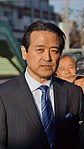 | |
| Candidate | Shinzo Abe | Banry Kayeda | Kenji eda |
| The consignment | Liberal Democratic Party | Democratic Party | Innovation party |
| Seats received | 291 | 73 | 41 |
| Votes | 25 461 427 + 17,658,916 (in block) (48.1% and 33.11% in the block) | 11 916 838 + 9 775 991 (in block) (22.5% and 18.33% in the block) | 4 319 645 + 8 382 699 (in block) (8.2% and 15.72% in the block) |
 | 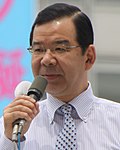 |  | |
| Candidate | Natsuo Yamaguchi | Kazuo Shii | Takeo Hiranuma |
| The consignment | Komeito | Communist | Future Generations Party |
| Seats received | 35 | 21 | 2 |
| Votes | 765 390 + 7 314 236 (in block) (1.5% and 13.71% in the block) | 7 040 130 + 6 062 962 (in the block) (13.3% and 11.37% in the block) | 947 395 + 1,414,919 (in block) (1.8% and 2.65% in the block) |
| 150x150px |  | ||
| Candidate | Tadatomo Yoshida | Itiro Ozawa | |
| The consignment | Social democratic | Party life | |
| Seats received | 2 | 2 | |
| Votes | 419 347 + 1,314,441 (in block) (0.8% and 2.46% in the block) | 514 575 + 1,028,721 (in block) (1.0% and 1.93% in the block) | |
| Other parties | Social Democratic Party (2 seats), Party of Popular Life (2 places) | ||
 Results of direct voting and results of proportional blocks | |||
Situation before the election
Japan’s GDP was declining for the second quarter in a row, for example, on November 17, it became known that the country's GDP for the third quarter of 2014 decreased by 1.6% compared to the same period last year. The recession was officially recorded [2] .
Prime Minister Shinzo Abe postponed the increase in consumer tax, which was planned to be introduced in 2015. Now, the Japanese authorities will resort to this measure only in April 2017.
November 21 officially announced the dissolution of the lower house of parliament [3] .
As the “Financial View” noted in mid-November, “polls also indicate that voters do not understand why they are called to vote” [4] .
Survey Results
Recent polls [5] :
| date | LDP | Dp | Komeito | KP | PI | PSD | Nbsp | Other | Neither side | Not decided |
|---|---|---|---|---|---|---|---|---|---|---|
| November 7–9, 2014 | 36.6% | 7.9% | 2.2% | 3.5% | 1.2% | 0.6% | 0.2% | 0.1% | 40.0% | 7.7% |
| December 5-7, 2014 | 38.1% | 11.7% | 5.9% | 4.3% | 3.7% | 0.9% | 0.1% | 0.1% | 26.3% | 8.5% |
Election Results
Elections were held at the lowest turnout in post-war history. The problems caused by the large weight of votes from sparsely populated regions led to criticism of the election and appeal to the Supreme Court of the country [6] .
Notes
- ↑ The ruling bloc received an absolute majority in the elections to the lower house of the Japanese parliament.
- ↑ Politcom.ru. - “Abenomika” pushed for early elections
- ↑ NTV. - In Japan, dissolve the parliament and call early elections.
- ↑ New Elections in Japan (inaccessible link) . “Financial View” (November 18, 2014). Date of treatment November 3, 2018. Archived December 10, 2014.
- ↑ NHK
- ↑ Japanese Supreme Court: 2014 elections were not constitutional