Akhmet Kuanovich Zhubanov ( Kazakh. Zhubanov Akhmet Kuanuly ; 1906 - 1968 ) - Soviet musicologist , composer , conductor , people's artist of the Kazakh SSR (1944), academician of the Academy of Sciences of the Kazakh SSR (1946), professor (1948). The younger brother of the Soviet Kazakhstan philologist, Turkologist and Professor Kudaibergen Zhubanov .
| Ahmet Zhubanov Ahmet Huanuly Zhubanov | ||
|---|---|---|
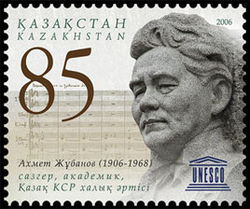 Postage stamp of Kazakhstan dedicated to Akhmet Zhubanov | ||
| basic information | ||
| Full name | Akhmet Kuanovich Zhubanov | |
| Date of Birth | April 29, 1906 | |
| Place of Birth | Kosuaktam tract, (now Aktobe region ), Russian Empire | |
| Date of death | May 30, 1968 (62 years) | |
| Place of death | Alma-Ata , Kazakh SSR , SSR | |
| A country |  the USSR the USSR | |
| Professions | composer , musicologist , conductor | |
| Genres | opera suite | |
| Collectives | Orchestra them. Kurmangazy; Philharmonic them. Jambul | |
| Awards |
| |


Content
Biography
Born on April 29, 1906, in the Kosuaktam tract, now in the Aktobe region . Died May 30, 1968 in Almaty .
In 1932 he graduated from the historical-theoretical faculty of the Leningrad Conservatory .
In 1934 he created the Kazakh State Academic Orchestra of Folk Instruments named after Kurmangazy and was its conductor until 1945 . 1935 - 1937 - artistic director of the Philharmonic. Jambul
From 1961 he headed the department of musical art at the Institute of Literature and Art. Auezov.
The author of books, essays and articles about the Kazakh folk music .
Composer Akhmet Kuanovich Zhubanov is an original and brightly national artist. He walked the way to the academician, people's artist of the Kazakh SSR . “On a barren takyr, no grass will grow,” say the Kazakhs. These words can be fully attributed to professional music, which is born and develops on the basis of folk.
The father of the future composer Kuan was an enlightened man in the village. In addition, communicating with the Russian peasants from Voronezh , Kursk , Tambov , Kharkov , who from 1870 began to settle permanently under Aktobe , he learned to speak and read Russian. Zhubanov’s father dreamed of educating his children. A lot of effort was made by him to open in his village a school, where he took a seven-year-old Ahmet. In 1918, Zhubanov graduated from a two-year Russian school in Zhuryn and then, after studying teacher training courses, he worked in the city of Temir. But for a minute the young man does not forget about music, independently studies theory and musical literacy, plays in the amateur orchestra of folk instruments.
The years spent by Zhubanov in Aktyubinsk were especially important in his life. Here he learns to play the violin from the exiled music teacher from Voskresensk Peter Georgievich Chernyuk .
The book by A.V. Zataevich “1000 songs of the Kazakh people”, which was published then by A.V. “I learned many legends about the songs collected by Zataevich, and about a person who could read these mouse-like tracks, traces of sounds and had a burning desire to become a music expert like Zataevich. Chernyuk warmly and sincerely supported this my aspiration. My absentee acquaintance with A.V. Zataevich through his collection of Kazakh songs ninety percent decided the direction of my further fate, ”the composer later recalled.
In 1928, Ahmet becomes a student of the musical college. M. I. Glinka in Leningrad , where he is engaged in violin from an experienced teacher A. A. Etigon. The time of intensive study began, but the young man was not limited to the program of the secondary school, making a lot of effort to enroll in the conservatory.
Within the walls of the technical school, Akhmet meets the writings of Russians ( Myaskovsky , Asafiev and others) and foreign classics. Subsequently, a talented musician enrolled in the Leningrad Conservatory class oboe .
In 1932, Zhubanov became a graduate student at the Academy of Art History in Leningrad, and a year later the People's Commissariat of Education of Kazakhstan was recalled to work in Almaty . His entire subsequent creative life turned out to be closely connected with the birth, formation and development of new forms of musical culture in Kazakhstan . Organizational and pedagogical activity of Zhubanov began in the 30s, when the first musical educational institution was opened in the republic - the musical-drama technical school . On the initiative of Zhubanov, a scientific study was organized under him, as well as an experimental workshop for the improvement of folk instruments. E. Brusilovsky from Leningrad , L. Mukhitov from the Ural Region , M. Bukeikhanov from Kyzyl-Orda , Romanenko brothers and others who made musical instruments were invited to work here.
At the technical school Zhubanov created a student ensemble of dombrists , who at the First All-Kazakhstan meeting of national talents in 1934 demonstrated his art. Soon, the Presidium of KazCIC adopted a resolution on the creation of the Kazakh national instruments orchestra based on the ensemble of dombrists . Thus was born the world-famous Kazakh State Orchestra of Folk Instruments named after Kurmangazy , whose conductor and artistic director was Ahmet Zhubanov.
An important aspect of the fruitful work of Zhubanov is his organizational work in training national personnel. For many years he headed the department of Kazakh folk instruments of the Alma-Ata State Conservatory , where he developed a special course on the history of Kazakh folk music. Many of the now famous musicians are pupils of Ahmet Zhubanov. These are Nurgisa Tlendiev , Shamgon Kazhgaliyev , Rustembek Omarov and others.
Zhubanov successfully combined research, music and public pedagogical activities with active creativity, making a great contribution to the Kazakh professional music. He is the author of many works of various genres that have received recognition from the people. Among them are symphonic works and operas, chamber-instrumental and choral works, songs and romances, music for dramatic performances and films. Akhmet Zhubanov has been engaged in composing activities since 1938 .
The young composer was not limited to the processing of Kazakh folk songs. He transferred to the orchestra of Kazakh folk instruments compositions of Russian and foreign classical composers. In 1943, the Kazakh Orchestra of Folk Instruments played Chernomore’s march from Glinka ’s opera Ruslan and Lyudmila , Schubert ’s Musical Moment in Zhubanov’s instrumentation. Later, the orchestration of fragments of Tchaikovsky 's opera The Queen of Spades , Rimsky-Korsakov 's The Tsar's Bride , Preludes and Crimean Sketches by Spendiyarov were created. For the orchestra, Zhubanov also arranged instrumental compositions, songs and choirs of Koval , Pokrass , Chishko, Revutsky and other Russian and Ukrainian composers of the Soviet period. All this contributed to the improvement and improvement of the performing skills of the musicians of the orchestra. The further growth of this group, the wide propaganda of the works of classical composers are inseparable from the activities and experience of Zhubanov. His traditions became an example for subsequent generations of composers and conductors.
Zhubanov’s composing activities in 1938–40 developed in two directions: he worked on the processing of folk songs and kyuis and wrote his works. In 1939, he creates music for the play by Koz-Korpesh - Bayan-Sulu by G. M. Musrepov . Together with the composer M. F. Gnesin, he is working on the music for the film Amangeldy . Then he composes music for M. Akinzhanov's “Isatai-Makhambet” to the dramatic performances, “Abai” by M. O. Auezov . One of the most significant works of these years is the musical play “Sary” about the life and work of the folk composer.
Zhubanov came to writing major musical compositions already with a lot of creative baggage, drawing from the treasury of national heritage those works that, in his opinion, sounded the most successful in the orchestra, without losing their colors. So the music written for the tragedy “Abai” by Mukhtar Auezov , the symphonic poem “Abai” were the preparatory stage for writing an opera on this topic. The opera “Abai”, written by Zhubanov in collaboration with the composer Latyf Hamidi in 1944, became the first attempt at writing in this genre. The opera “Abai”, written for the 100th anniversary of the birth of Abay Kunanbayev and timed to the 10th anniversary of the opening of the Kazakh Opera and Ballet Theater , has become a new word in Kazakh music.
It is enough to try only to imagine the whole creative life of Akhmet Zhubanov, how he involuntarily embraces surprise in front of his tremendous efficiency and diligence. He has written hundreds of research papers, articles, and essays on national musical culture. Such works by Zhubanov as “Strings of the Centuries”, “Nightingales of the Centuries”, “Kurmangazy”, “Life and Work of Kazakh Folk Composers”, “The Musical Culture of the Kazakh People”, “An kyuy sapary” (“Journey through songs and kyyuyams”) can be to meet in the home library of any researcher who is interested in questions of folk music. The works of Zhubanov have long been a necessary source for literary work. Ahmet Zhubanov, jealously guarding the legacy of folk music, until the very last day of his life did not for a moment stop thinking about its fate, the fate of music, which became the ideal of his life. He was buried in the central cemetery of the city of Almaty.
Family
- Wife: Nawat
- Older brother: Zhubanov, Kudaibergen Kuanovich
Children:
- Zhubanov, Bulat Akhmetovich - a chemist.
- Zhubanova, Gaziza Akhmetovna - composer.
- Zhubanova Roza Akhmetovna - pianist, teacher.
- Zhubanov Kair Akhmetovich - a chemist.
- Zhubanova Azhar Akhmetovna - biochemist.
Memory
- The gravestone of A. K. Zhubanov by E. Vuchetich , marble, 1957.
- Street in Almaty since March 1969.
- The museum in the Almaty apartment where Zhubanov lived, Karasai Batyr St. 61/67.
- By decision of UNESCO, 2006 was declared the year of Ahmet Zhubanov, and on October 17, a solemn evening was held at UNESCO headquarters in Paris with the participation of leading masters of art of Kazakhstan.
- In honor of Zhubanov A. K. in Kazakhstan were issued a postage stamp and a commemorative coin.
Movies
- 2006 - “Ahmet Zhubanov” Documentary film. director of the film Kalila Umarov . Production " Kazakhfilm ".
Works
Operas
- 1944 - “Abay” wrote jointly with Latyf Hamidi
- 1947 - “Tulegen Tokhtarov” wrote together with Latyf Hamidi;
For orchestra
- 1940 - March of memory of Kurmangazy (also for the orchestra of Kazakh instruments)
- 1941 - Abai's poem (also for the orchestra of Kazakh folk instruments)
- 1943 - Suite on the themes of Kazakh folk songs
- 1944 - Overture-fantasy
- 1945 - Poem of Batyr Tulegen
- 1945 - Fantasia on the themes of the opera “Abai” (also for the orchestra of Kazakh folk instruments)
- 1945 - for Kazakh instruments orchestra - 4 suites
- 1945 - suite (with singing) on the themes of Kazakh folk songs
- 1949 - Suite on the themes of the opera “Tulegen Tokhtarov”
- 1952 - 2 Tajik suites
- 1953 - Kazakh dance suite
For piano
- 1941-1945 - Kazakh dances
- 1943,1951 - Tajik dance
- 1943 - Kazakh dance Saranzhap
- 1943 - Kazakh dance Korogly
Processing Piano Works
- 2006 - 2016 - eight Kazakh dances
- 2006 - 2016 - ten Tajik dances
For violin or kobyz and piano
- 1945 - Aria
For kobyz and piano
- 1951 - kyuy
- 1951 - Spring
- 1952 - A Play on a Folk Theme
For choir
- 4 songs
For voice and piano
- songs
- music for theater and cinema
Literary writings
- Kazakh national composer Kurmangazy. Life and art. 1818-1893. Kzyl-Orda, 1936;
- To the question of the origin of the Kazakh musical genre kuy. Historical and linguistic essay. Kzyl-Orda, 1936;
- The life and work of Kazakh folk composers of the 19th and early 20th century (in Kazakh. language). Alma-Ata, 1950;
- Tajik dances. Alma-Ata, 1955;
- Strings of the centuries. Essays on the life and creative activity of Kazakh folk composers. Alma-Ata, 1958;
- Nightingales of the Century (in Kazakh.). Alma-Ata, 1963 (Russian translation. - Alma-Ata, 1967);
- Mukan Tulebaev. Alma-Ata, 1963.