| independent state | |||||
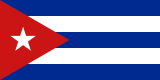
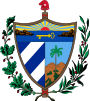
| Republic of Cuba | |||||
|---|---|---|---|---|---|
| Spanish República de Cuba | |||||
| |||||
| Motto : “Fatherland or Death ( Spanish: Patria o Muerte ) » | |||||
| Hymn : La bayamesa "Anthem of Bayamo" | |||||
 Cuba on a world map | |||||
←  ←   → →1902 - 1959 | |||||
| Capital | Havana | ||||
| Largest cities | Havana , Santiago de Cuba | ||||
| Languages) | Spanish | ||||
| Religion | Catholicism | ||||
| Currency unit | pesos | ||||
| Square | 110 860 | ||||
| Form of government | republic | ||||
| Heads of state | |||||
| The president | |||||
| • 1902-1906 | Thomas Estrada Palma | ||||
| • 1952-1959 | Fulgencio Batista | ||||
| Governor General | |||||
| • 1906 | William Howard Taft | ||||
| • 1906-1909 | Charles Edward Magoon | ||||
| Prime Minister | |||||
| • 1940-1942 | Carlos Saladrigas Sayas | ||||
| • 1958-1959 | Gonzalo Guell | ||||
| Story | |||||
| • March 2, 1901 | adoption of the Platt Amendment | ||||
| • May 20, 1902 | adoption of the constitution of Cuba | ||||
| • February 17, 1903 | signing a Cuban-American treaty | ||||
| • May 29, 1934 | signing a Cuban-American relationship treaty | ||||
| • January 1, 1959 | Cuban revolution | ||||
Content
Establishment of the Republic
The Republic of Cuba was formed on May 20, 1902, when its first elected president, Thomas Estrada Palma , took office. The purpose of the first government was to strengthen ties with the United States. Despite the fact that the pro-American policy of Palma was criticized in the country, he achieved re-election for a second term. This provoked a rebellion of the opposition Liberal Party, which led to the next introduction of American troops on the island, and subsequently to the creation of a permanent US military base in Cuba in Guantanamo Bay . Palm was forced to resign.
In the first two decades of the 20th century, the Cuban economy grew at an accelerated pace due to the favorable situation that developed after the First World War . The economic boom came during the reign of Mario Garcia Menokal . However, this growth was extremely one-sided, because it was based solely on sugar trade and relations with the United States. However, American capital flowing into the island at an ever-increasing rate was the only beneficiary of growth, as the Americans controlled significant volumes of sugar production, except for the corresponding infrastructure and side business [1] . The economic well-being caused by this process was extremely fragile, which was discovered in 1920. A sharp drop in speculative sugar prices led to a bank crash and bankrupted Cuban financial institutions.
The labor movement, which began to rise in the last decades of the 19th century, continued to grow and later turned into a real wave of protests caused by inflation due to the First World War. The first Congress of Independent Workers, held in 1920, united workers with different political convictions. However, they all agreed on the need to create a Federation of Workers of Cuba. This was an important organizational and ideological step. The leader was Alfredo Lopez, who in 1925 founded the National Union of Workers of Cuba. The Union became the first national labor organization to set out to wage an economic struggle for the rights of workers, organize their movement, and develop workers' self-awareness.
Along with the associations of workers, but on a much larger scale, the movement of students and intelligentsia developed, the beginning of which was laid on December 20, 1922 by the foundation of the Student University Federation. One of its founders, Julio Antonio Mella, who rose from the post of secretary to the president of the Federation, was a leading political figure in this historical period.
In March 1923, an intellectual group led by Ruben Martinez Villena openly protested the government’s fraudulent sale of St. Clara’s monastery. This event, known as the “Protest of Thirteen,” marked the beginning of the intellectual movement in Cuba, which participated in the political struggle in the country.
Dictatorship of Gerardo Machado
The coming to power of Gerardo Machado in 1925 became an alternative to the oligarchy before a potential crisis. The new regime in its economic program tried to harmonize the interests of the various layers of the Cuban bourgeoisie and American capital, offering guarantees of stability to the middle class and new jobs for the people, all this combined with selective but brutal repressions against political rivals and opposition movements.
The government tried to put an end to the differences between the traditional parties, but subsequently the discontent only increased. Having reached an initial consensus on this issue, Machado decided to amend the Constitution and be in power for six years.
Machado's policy was repressive, which was expressed in the detention and torture of all opponents of the regime. The killings began, including the famous political leaders Alfredo Lopez and Julio Antonio Melli. The National Union of Workers of Cuba was declared illegal; other revolutionary movements were persecuted.
Against the background of these events, the general crisis in the country deepened, especially after the Great Depression of 1929-1933, which significantly worsened the situation in the country and led to revolutionary sentiments. Almost all public organizations and movements came together to oppose Machado’s policies.
On March 20, 1930, a general strike began, in which, under the slogan “Overthrow the Machado!” Two hundred thousand workers took part. This strike is considered the beginning of an active revolutionary movement against Machado along with student riots in September 1933. As a result of these actions, on August 12, 1933, Machado was forced to flee the country and hide in the United States until the end of his life.
The Rise of Thirty and a Return to Democracy
The mediation of the American ambassador Sumner Veles could not prevent the overthrow of Machado, but he managed to nullify the opposition of the people. He successfully fought the ABC strike and secret political group and promoted President Carlos Manuel de Cespedes (son), who was in power from August 13, 1933 to September 4, 1933. Cespedes was overthrown in a coup led by Sergeant Fulgencio Batista. This uprising was supported by the Student Office, and soon Batista was appointed commander of the Cuban army with the rank of colonel. The coup led to the creation of a government that lasted only 6 days from September 4 to 10, 1933. Under the leadership of Student Management and Batista, it was transformed into a One Hundred Government. The one-day government, led by President Ramon Grau San Martín and Secretary Antonio Gutierrez, opposed the so-called “Platt Amendment” and fought for recognition among the masses. Despite great popular support, the one-hundred-day government was not recognized by the United States and was abolished under the influence of the Socialist People’s Party. During 1935-1936, the political situation in Cuba became less and less stable due to the constant change of presidents, as well as because of Batista’s military policy, which intensified repression . In particular, the general strike in March 1935 was brutally crushed by the military.
1940 Constitution
The period 1937-1945 in Cuba was marked by political stability and major democratic changes. Among them is the general amnesty of political prisoners, during which about 3,000 people were released in 1937, the legalization of opposition parties, the restoration of university autonomy, and most importantly, the convening of the Constituent Assembly in 1939, which drafted and approved the 1940 Constitution. The Constitution entered into force on October 10, 1940, finalized under the control of all political groups in the country. The Constituent Assembly included 76 delegates from 9 political parties. This Constitution united the most important demands of the people and opened a new period of the legality of power. The Cuban Constitution was one of the most advanced of its time. The first government at this stage was led by Fulgencio Batista, whose candidacy was supported by a coalition of military forces, as well as by the Communists. When Batista was in power, Cuba's economy experienced a flourishing that was facilitated by the outbreak of World War II. However, the prevailing situation brought the Batista’s successor as president, Ramon Grau San Martin, who won the 1944 election and received the support of the people. The reign of Grau, as well as his successor Carlos Prio Socarras (1948-1952), was characterized by political repression, the killing of opposition leaders, the introduction of extensive censorship in the press, and assistance in the formation of gang groups that controlled drug trafficking, prostitution and gambling. Some members of the Cuban Revolutionary Party (“Authentics”), dissatisfied with the actions of the government, formed the Party of the Cuban People (“Orthodox”) in 1947, led by Eduard Chibas. The party of orthodox promises to fulfill the promises that the government did not fulfill, and the personal charisma of Chibas played the final role in recognizing the party as Cubans.
Board of Fulgencio Batista
Fulgencio Batista organized a coup on March 10, 1952, a few months before the elections, which, apparently, Roberto Agramonte, candidate from the Orthodox party, should have won. The US Embassy reported to the State Department that the coup was a big surprise. However, the ambassador later admitted that he knew about this plan. At seven in the morning on March 10, Batista, in a conversation with Colonel Hook, the chief of the Air Force mission in Cuba, asked the American ambassador to be informed that all military agreements would remain in force. Prio, the current president, did not resist the coup, although some students immediately offered to take him under their protection.
Batista explained the need to overthrow the government with increased crime and widespread corruption. An article in the New York Daily News newspaper entitled Gangsters' Money — Prosperity in Cuba, published in 1958, described Batista’s plans to create a hotel and casino network along with the American mafia throughout the Havana embankment in exchange for millions of bribes. In addition, it became known about the investments of Americans in the mines of Moa, which were closed by the previous president. Batista headed for a decline in sugarcane production, which led to a drop in capital inflows to the country, which, in turn, caused an increase in unemployment, a decrease in wages and purchasing power of the population. About a quarter of Cubans were illiterate, as many had no work, almost half of children aged 6-14 did not attend school. Only 10% of suburban households were electrified. Two hundred thousand peasants had no land, while more than 300,000 hectares were owned by foreigners and Cuban landowners and were not used. Batista also planned to improve relations with the United States, the construction of public buildings designed to decorate the main cities of Cuba and attract tourists from North America. During the reign of Batista, cases of brutality among the population practically ceased, but violence by military and illegal armed groups reached incredible proportions. Hunger, prostitution and gambling flourished in the country.
The military government replaced Congress with an Advisory Council, repealed the 1940 Constitution, and introduced a new constitutional law. Freedom of speech, assembly, and strike were banned, the death penalty was introduced, and university autonomy was abolished. In 1954, pseudo-elections were held, the winner of which, of course, was Batista.
In response to the overthrow of the government by Fidel Castro, a group of more than one hundred young people was created, which moved away from the ideology of the Orthodox party and leaned toward the idea of an armed struggle against the Batista regime. In 1953, Castro developed a new plan of rebellion, consisting in an attack on the Barracks of Moncada.
June 26, 1953 a group led by Castro attacked the barracks of Moncada, but was repelled, the participants were arrested. A trial was held in which participants in the attack on the barracks were convicted. After an amnesty in 1956, they emigrated to Mexico. On December 2, a group of several dozen people landed on the east coast of the island and embarked on a guerrilla struggle. On January 1, 1959, partisan units entered Havana. Batista fled.
Notes
- ↑ Great Soviet Encyclopedia / redkoll., Ch. ed. O.Yu. Schmidt. - 1st ed .. - M., State Institute "Soviet Encyclopedia", OGIZ RSFSR, 1937. - S. 347-358.