Plesiotrygon (lat.) - a genus of stingrays of the family of river stingrays from the order of stingrays , their representatives live exclusively in the tropical fresh waters of South America . The name of the genus comes from the words dr. πλησίον - “close” and other Greek. τρίγων is the “ stingray " [1] . These slopes reach a length of 58 cm. They have a rounded body shape, dorsal fins and caudal fin absent. The tail has the shape of a whip, with a poisonous sting at the end. Behind the eyes are sprays . On the ventral side of the disc are 5 pairs of gill slits and nostrils. The dorsal surface of the disc is covered with scales . Probably, like the other caudate-like, they reproduce by oviposition [2] [3] . From other genera belonging to the family of river stingray Plesiotrygon differ in the following characteristics: the posterior edges of the ventral fins strongly protrude beyond the edge of the disc; the length of the whip-like tail is almost 2 times longer than the length of the disk and even in large individuals it rarely breaks off; the spine is well developed and shifted backward relative to the base of the tail; a relatively small number of pectoral fin rays (75–91) [4] .
| Plesiotrygon |
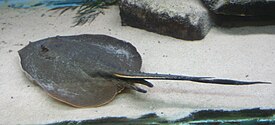
Plesiotrygon iwamae |
| Scientific classification |
|---|
| No rank : | Bilateral symmetrical |
|
| International scientific name |
|---|
Plesiotrygon Rosa , Castello & Thorson , 1987 |
|
The genus currently includes 2 species:
- Plesiotrygon iwamae Rosa , Castello & Thorson , 1987
- Plesiotrygon nana Carvalho & Ragno , 2011
