Hura ( lat. Hura ) - a genus of woody plants of the family Euphorbiaceae ( Euphorbiaceae ). Representatives of the genus are common in the Americas. Inflorescences of some species can be eaten, while juice and seeds contain strong toxins.
| Hura | |||||||||||||||||||||||
|---|---|---|---|---|---|---|---|---|---|---|---|---|---|---|---|---|---|---|---|---|---|---|---|
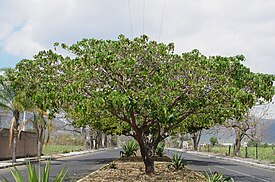 Hura multi-stamen | |||||||||||||||||||||||
| Scientific classification | |||||||||||||||||||||||
| |||||||||||||||||||||||
| International scientific name | |||||||||||||||||||||||
Hura [ C.Commelijn ] L. , 1753 | |||||||||||||||||||||||
| Type view | |||||||||||||||||||||||
Hura crepitans L., 1753 - Cracking Hura | |||||||||||||||||||||||
Content
- 1 Title and description history
- 2 Botanical Description
- 3 Toxicity
- 4 Area
- 5 Taxonomy
- 5.1 Views
- 6 notes
- 7 Literature
Title and Description History
The scientific name of the genus, first actually published by Carl Linnaeus in 1753 in Species plantarum , comes from the words "poisonous juice" in the language of one of the Indian tribes of Guiana .
The plant was first grown and described in Europe by Caspar Kommelin in 1699 from seeds transferred to him by Gerard Rover.
Botanical Description
Spiral-shaped monoecious trees with a spiked trunk and branches with a whitish or yellowish clear milky sap. Leaves on petioles, with feathery venation, with whole or notched-dentate margin.
Inflorescences axillary or apical. Stamen flowers are collected in the apical earring, with a plastic cup, with 10-20 stamens, without the primordium of a pestle. Pestal flowers are single, axillary, with a leathery calyx, ovaries 5–20-nest, stigmas fused to the disk.
The fruit is a ligneous schizocarpius . The seeds are flattened, smooth.
An interesting mechanism for the distribution of hura seeds. The ripened fruits open with an explosion, throwing out seeds at a speed of up to 70 m per second at a distance of about 14 m (a maximum distance of 45 m was noted).
Toxicity
Juice of hura cracking causes severe irritation of the skin, in contact with eyes there is a strong burning sensation, temporary blindness is possible. Sawdust and smoke from the hura cause irritation to the eyes and respiratory organs. Entering into the gastrointestinal tract of half of the hura seed will cause (sometimes the next day) colic, vomiting and diarrhea, then - palpitations and blurred vision. Eating more than two seeds of a plant can lead to hallucinations, convulsions and death. Khura wood jewelry also causes skin irritation. For birds, khura seeds are apparently non-toxic.
The juice was used by Native American hunters to grease arrowheads.
Juice contains toxic proteins hurin and crepitin . Huratoxin , a tricyclic diterpene daphnan , is ten times more toxic to fish than rotenone .
Range
A typical species , cracking hura, is common in Mexico , Central America and the tropics of South America . Introduced to Southern Europe , Africa and China . Multi-stalked jura grows from Mexico to Costa Rica .
Taxonomy
Views
- Hura crepitans L. , 1753 - Cracking hura , or Hura exploding
- Hura polyandra Baill. , 1858 - Khura multi-stamen
Notes
- ↑ For the conventionality of indicating the class of dicotyledons as a superior taxon for the plant group described in this article, see the APG Systems section of the Dicotyledonous article .
Literature
- Li BT, Esser HJ 73. Hura Linnaeus // Flora of China. - Beijing, 2008. - Vol. 11. - P. 287-288. - 622 p. - ISBN 1-930723-73-3 .
- Nellis DW Poisonous Plants and Animals of Florida and the Caribbean. - Sarasota, Fla., 1997 .-- P. 174-175. - 315 p. - ISBN 1-56164-111-1 .