James Frances (Frank) Hurley ( born James Francis Hurley , 1885-1962) is an Australian photographer [1] , a military photographer of World War I , a documentary director, and a traveler, a member of several ethnographic and three expeditions to Antarctica .
| James Francis Hurley | ||||||
|---|---|---|---|---|---|---|
| James Francis Hurley | ||||||
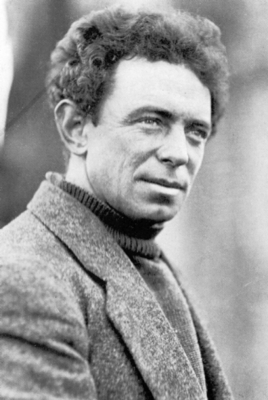 Frank Hurley | ||||||
| Date of Birth | October 15, 1885 | |||||
| Place of Birth | Sydney Australia | |||||
| Date of death | January 16, 1962 (aged 76) | |||||
| A place of death | Sydney Australia | |||||
| Citizenship |  Australia Australia | |||||
| Occupation | photographer , traveler , director | |||||
| Awards and prizes |
| |||||


Content
- 1 Early life
- 2 First Antarctic expeditions
- 2.1 1911-1913
- 2.2 1914-1916
- 3 Service as a military photographer
- 4 Subsequent years of life
- 5 Awards
- 6 Some of the Most Famous Photos
- 7 Brief filmography
- 8 Notes
- 9 References
Early life
Frank Hurley was born on October 15, 1885 in the suburbs of Sydney , Australia , in the family of Edward and Margate Hurley. The third of five children in the family. At the age of 13, Frank dropped out of school and got a job at the Esk Bank Ironworks steel mill in the town of Lithgow. An interest in photography was instilled in young Hurley by his master at the factory [1] , who was passionately passionate about this rather new art form, and who often took him with him to “photo walks” to the Blue Mountains , in the vicinity of which the town is located [2 ] .
Two years later, Frank Hurley returned home. In the evenings, he continued his education at a local technical school, listened to lectures at the University of Sydney [3] , and in the afternoon worked in a telegraph office, where, with the help of his colleagues, he became more familiar with the technical side of photography. At the same time, he acquired his first Kodak camera. Frank received his first fee for the photographs from the Edison Phonograph Company [2] .
In 1905, Hurley got a job as a photographer at the Sydney postal company Harry Cave, which made postcards, and soon gained fame as a professional in his field, as well as for a number of outstanding photos for his time, in particular for a photograph of an approaching train taken directly from the railway track. In 1910 he held the first exhibition of his works [1] [3] . Due to the economic crisis in 1910, Harry Cave went bankrupt, and Frank Hurley was left without work [1] .
First Antarctic Expeditions
1911-1913
In 1911, Dr. Douglas Mawson invited Frank Hurley to take part as a photographer on the first Australian Antarctic expedition. Hurley accepted the offer, and from December 1911 to March 1913 he shot her work in the photo and movie camera. In addition to his main responsibilities, Hurley took an active part in solving everyday expeditionary tasks, and also became a member of the Southern Party campaign led by astronomer Edward Badge, whose goal was to observe Earth's magnetism in the immediate vicinity of the earth’s south magnetic pole . From November 10, 1912 to January 11, 1913, the party, in severe weather conditions, traveled more than 600 miles across Antarctica [4] .
The most famous photographs of Frank Hurley from this expedition were “Ice Mushroom” [5] , “Storm on Cape Denison” [6] , “In the Ice Cave” [7] and others. Hurley returned to Sydney in the fall of 1913 and already in August presented to the public his film “ Home of the Blizzard ”, which brought him worldwide fame [3] . However, all the money and fees earned from renting the film, in accordance with the terms of the Hurley contract, went to pay off the expedition's debts [2] .
1914-1916
In October 1914, Frank Hurley, as a photographer, joined the Imperial Transantarctic Expedition led by Ernest Shackleton . This time, under the terms of the contract, Hurley relied on a salary of £ 6 per week and 25% of the rights to publish captured photos and videos, however, according to historians, the terms of the contract are unlikely to have been fulfilled [2] .
The purpose of the Shackleton expedition was to cross the Antarctica from the Weddell Sea to the Ross Sea . However, in February 1915, the Shackleton Endurance Expeditionary Ship was sandwiched by pack ice in the Weddell Sea and sank after a long drift . The polar explorers had to spend considerable time on a drifting ice floe, and after that, in the open stormy sea, they reached life on lifeboats to the nearest land, Elephant Island , from where they were evacuated by Shackleton in August 1916, after the latter’s famous trip to South Georgia Island. As a photographer for the expedition, Hurley carefully shot all its stages - the path to the south, wintering on the drifting Endurance, the heroic struggle of the crew for life after the death of the ship. During the expedition, its members had the opinion of Frank Hurley as a man “made of iron” ( English hard as nails ) for his outstanding ability to withstand any most severe trials and ready to make any sacrifices for the sake of a successful picture [8] . From Shackleton's description of the death of the Endurance:
In the meantime, Hurley set up his movie camera and shot the dying Endurance. In the process of shooting, the ice with a roar demolished the rigging of the rigging fock, mainsail and mizzen-mast. For-Mars and the Brahm mast fell down and hung on the wreckage of the foremast with the fok-ray. After them the main mast crashed, breaking off
10 feet above the main deck. The Crow’s Nest fell 10 feet from Hurley’s camera twisting handle, but he didn’t even move and captured a unique, albeit sad picture [9] .
On the other hand, for his certain “arrogance” and “arrogance” he received the nickname “Prince” [8] .
In addition to the duties of the photographer, Hurley was responsible for training, training and feeding his dog harness. On June 17, 1915, Hurley's team won the so-called “Antarctic Derby,” a Shackleton dog sledding competition to celebrate mid-winter and spent in the darkness of the polar night. On a polar night, Hurley took one of his most famous photographs of the Endurance ice-surrounded environment. As a "jack of all trades" in May 1915, Hurley was able to launch a small electrical installation, available at the Endurance, he placed lighting lamps in the observatory, weather station and other places. In addition, he also installed two powerful luminaires on the masts, illuminating the ship from side to side. These lamps were invaluable in the event of the possible destruction of the ice surrounding the ship. Hurley’s hands also made a fat oven, which the polar explorers used during the drift on the ice and during the winter on the island of Elephant [2] .
In total, before the beginning of November 1915, Hurley filmed more than 500 negatives , but, unfortunately, most of them were destroyed by Shackleton’s decision, only 120 were left, twenty of them were color, as well as an album with already printed photos [10] . The remaining few, but world-famous photographs, such as, for example, “Salvation” [11] , were taken by Hurley on a Kodak pocket camera. Of those photos and cinema materials that were saved, in 1919 Hurley edited the film "South!" ( Eng. South!, Another name - "In the arms of the polar ice" ( Eng. In The Grip of The Polar Pack Ice )), which was a huge success [2] . In the 21st century, several documentaries dedicated to the expedition [12] [13] were created on the basis of these materials.
Military Photographer Service
In August 1917, Frank Hurley joined the Australian Armed Forces (AIF) and was promoted to the western front as an official AIF photographer, where he served with Hubert Wilkins . For his reckless courage shown when taking photos, Hurley received the nickname "Mad" ( "Mad Photographer" ) [14] . Among the most famous are photographs taken by Hurley during the third battle of Iprom , also known as the Battle of Paschendal . This is, first of all, “Morning in Paschendal” , “A look through the window of the cathedral at the cemetery, which has become a battlefield” [15] , “Chateau Forest near Iprom” and others. The historical value of some photographs, however, was subjected to serious criticism (or even called a fake with a ban on publication) by the war correspondent and official historian of AIF [1] - Hurley was a staunch supporter of pictorialism , he believed that and military photographs should tell a story and evoke emotions, and therefore often resorted to photomontage by creating photographs by composite overlay of several photographic plates [14] . The conflict with Bean led to the fact that at the end of 1917, Hurley resigned, but was sent to the Middle East , where he served until the end of the war [1] .
Subsequent years of life
During a service in Cairo, Frank Hurley met a young opera singer Antoinette Rosalyn Leighton, the daughter of an Indian Army officer, and after a ten-day romance, married her on April 11, 1918, and returned to Sydney with her after the war. The next four decades, Frank Hurley continued to do what he loved to do - make films. In the early 1920s, he took part in expeditions to the Torres Strait Islands and Papua New Guinea , in 1929-1931 in the British-Australian-New Zealand Antarctic Research Expedition of Dr. Mawson (BANZARE). In the 1930s, he worked for Cinesound Movietone Productions, making films glorifying Australian accomplishments such as Symphony of Steel (1932) and A Nation Is Built (1938). ) During World War II, he worked as a military photographer in the Middle East, preparing more than 60 video reviews of current events and making 11 films for the British . After the war in 1946, he finally settled in Australia and spent most of his time lecturing, publishing photographs, and journalism. In 1948, his book Shackleton's Argonauts ( English Shackleton's Argonauts ) was published, and in 1955, “Australia with a camera” ( English Australia: A Camera Study ) [1] .
Frank Hurley died at his home on the Collara Plateau (Sydney’s northern suburbs) from a heart attack on January 16, 1962. He left a son and three daughters [3] .
The most capacious description of Frank Hurley, a professional in his field, was given by Lionel Greenstreet, First Assistant Captain of the Endurance :
Hurley is a warrior with his camera, ready to go anywhere or do whatever, for the sake of a photo [16] .
Rewards
- Polar Medal (1914) - for participating in the Australian Antarctic Expedition [17] .
- Polar Medal (1916) - for participating in the Imperial Transantarctic Expedition [17] .
- Military Medal (1918) - for courage and devotion to duty [17] .
- Polar Medal (1934) - for participation in the British-Australian-New Zealand Antarctic research expedition [17] .
- Order of the British Empire (1941) - for his service as an AIF military photographer [17] .
Some of the Most Famous Photos
Endurance in Pack Ice (1915)
Endurance
Frank Hurley and Ernest Shackleton at Ocean Camp
Chateau Forest near Iprom, 1917
1st Australian Division near Hoge, 1917
Short Filmography
- Home of the Blizzard (1913) (documentary)
- Into the Unknown (1914) (documentary)
- " South! ” (English) on the Internet Movie Database (1919) (documentary) - cameraman, director
- (1921) (documentary) - director
- " The Juggle Woman ” (English) on the Internet Movie Database (1926) - writer, director
- (1926) - scriptwriter, director
- The Squatter's Daughter on the Internet Movie Database (1933) - operator
- The Silence of Dean Maitland on the Internet Movie Database (1934) - operator
- Grandad Rudd ( Internet ) on the Internet Movie Database (1935) - operator
Notes
- ↑ 1 2 3 4 5 6 7 Frank Hurley (English) (link not available) . Australian government. Date of treatment February 18, 2015. Archived February 18, 2015.
- ↑ 1 2 3 4 5 6 John F. Mann. James Francis Hurley THE ENDURANCE OBITUARIES. Date of treatment February 14, 2015.
- ↑ 1 2 3 4 AF Pike. Hurley, James Francis (Frank) (1885–1962 ) . Australian Dictionary of Biography. Date of treatment February 14, 2015.
- ↑ Douglas Mawson. The Home of the Blizzard . - PROJECT GUTENBERG. - ISBN 978-0-307-55594-6 .
- ↑ Ice mushroom, Mackellar Islets, Australasian Antarctic Expedition, 1911-1914 . National Library Australia. Date of treatment February 17, 2015.
- ↑ Out in the blizzard at Cape Denison adjacent to winter quarters 1912 . National Gallery of Australia. Date of treatment February 17, 2015.
- ↑ A cavern beneath the coastal ice-cliffs with Whetter standing near entrance . National Library Australia. Date of treatment February 17, 2015.
- ↑ 1 2 Caroline Alexander. The Endurance: Shackleton's legendary Antarctic expedition. - BY ALFRED A. KNOPF, INC. 1998 .-- S. 34 .-- 229 p. - ISBN 978-0-307-55594-6 .
- ↑ Shackleton, Ernest. South! The story of Shackleton's last expedition (1914-1917) . - eBook, 2014 .-- S. 178. - 763 p. - ISBN none.
- ↑ Caroline Alexander. The Endurance: Shackleton's legendary Antarctic expedition. - BY ALFRED A. KNOPF, INC, 1998 .-- S. 105. - 229 p. - ISBN 978-0-307-55594-6 .
- ↑ Imperial Trans-Antarctic Expedition 1914-1916 (Weddell Sea Party) . Royal Geographical Society. Date of treatment February 19, 2015.
- ↑ "Endurance: Shackleton's Legendary Antarctic Expedition"
- ↑ Shackleton Antarctic Odyssey ( IMAX )
- ↑ 1 2 Rob Ruggenberg. Frank Hurley, “the mad photographer” . The Heritage of the Great War. Date of treatment February 19, 2015.
- ↑ Looking through a ruined cathedral window on to a battlefield cemetery . National Library of Australia. Date of treatment February 19, 2015.
- ↑ Beyond 'Endurance': The life of 'Mad' Frank Hurley, Australian photographer . Imaging Resource © 1998 - 2014. Date of access October 27, 2014.
- ↑ 1 2 3 4 5 Awards . AUSTRALIAN HONORS. Date of treatment February 20, 2015.
Links
- Frank Hurley (1885–1962 ) . IMDB.com. Released February 17, 2015. The complete collection of Frank Hurley films on IMDB.com
- Hurley negative collection . National Library of Australia. Date accessed October 17, 2014. A collection of photographs of Frank Hurley
- Imperial Trans-Antarctic Expedition 1914-1916 Images . Royal Geographical Society. Date accessed October 17, 2014. Hurley Collection of Antarctic Photos
- BANZ Antarctic Research Expedition 1929-31, photographs [picture ] . National Library of Australia. Date of treatment October 17, 2014. A selection of photographs from the Antarctic expedition 1929-1931
- Frank Hurley ( inaccessible link) . Australian government. Date of treatment October 17, 2014. Archived October 27, 2014. Hurley's most complete biography on the Australian Government website
- Frank Hurley Kodak. Date of treatment February 20, 2015. Frank Hurley's biography on the Kodak site