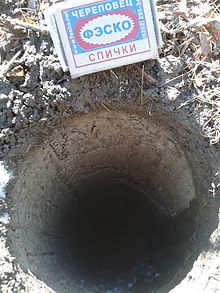
A well is a round-cut mining , drilled from the surface of the earth or from underground workings without human access to the bottom at any angle to the horizon , the diameter of which is much less than its depth. Drilling of wells is carried out using special drilling equipment .
Distinguish between vertical, horizontal, deviated wells [1] . The beginning of the well is called its mouth, the bottom is the bottom, the inner side surface is called the walls. The diameters of the wells range from 25 mm to 3 meters. Wells can have sidetracks (BS), including horizontal (BGS).
Some types of wells:
- Gas
- Oil
- Mining
- Discharge
- Special
- Auxiliary
- Exploration
Content
Superdeep wells
- The Kola Superdeep Well (SG-3) is the world's deepest borehole, located in the Murmansk Region , 10 km west of the city of Zapolyarny. It is located within the Baltic shield . Years of drilling 1970-1990. Depth 12262 m. Plan 15000 m.
- KTB-Oberpfalz , Bavaria, Germany. Years of drilling 1990-1994. Depth 9900 m [2] .
- Berta Rogers , USA. Years of drilling 1973-1974. Depth 9583 m.
- KTB-Hauptboring , Germany. Depth 9100 m.
- University , USA. Depth 8686 m.
- Zisterdorf , Austria. Depth 8553 m.
- The En-Yakhinsky super-deep well (SG-7) is located in Western Siberia - 70 km east of the city of Novy Urengoy , between the Pestsov and En-Yakhinsky gas condensate fields. Years of drilling 2000-2006. Depth 8250 m. Plan 6900 m. It was the last active superdeep well in Russia.
Average well depth
The average depth of production wells at the moment in various oil and gas provinces of the Russian Federation is 1,500–3,000 m; in the future, due to the depletion of the existing resource base of hydrocarbons in Russia, it grows [3] and can reach 4,000-6,000 m . At the end of 2017, the average depth of new wells was approaching 3 km [4] . With increasing depth, the cost of drilling them and the cost of oil and gas production increase.
In the Russian Federation, wells with a barrel length of more than 12 km, but with less vertical depth, are drilled — these are wells with horizontal completion. To date, the longest well with a horizontal completion has a length of more than 13 km ( Chayvo field , Sakhalin-1 project).
The depth of drilling of wells in the oceanic interior can reach 10,000 m and is located at a depth of up to 2,000 m under water.
The wells used for water intake are an underground intake structure, consisting of cased mining and equipment for the extraction of underground water .
Hydrogeological well
A hydrogeological well is used to determine the filtration properties of rocks, observe the regime of groundwater, and conduct geophysical studies. Kinds:
- passed through the entire thickness of an aquifer (inflow of water from the entire water column)
- incomplete, the slaughter of which is not brought to the bottom of the aquifer.
The depth of the wells is from 1 meter to 1000 meters or more. The design provides for the placement of water-lifting equipment and includes the first casing string isolating the top of the well from loose rocks, a number of casing strings (conductor, intermediate strings), a filter (sometimes with oil seals), and a sump. Steel casing pipes with a diameter of 73-146 mm and 114-508 mm are used as casing strings. The filter is designed to fix the walls of the water intake part of the wells in loose aquifers, to retain particles of the aquifer and to let water pass into the well. It consists of a frame (a pipe with round or slotted perforation, a plastic pipe or a core frame) and a filter sheath (wire winding, wire mesh, sometimes gravel). Prior to conducting hydrogeological studies, the borehole zone of the aquifer is reduced to conditions close to natural by intensive preliminary pumping. After carrying out hydrogeological studies, wells are liquidated by plugging or transferred to the service of enterprises to continue hydro-mode observations [5] .
See also
- Artesian well
- Oil well
- Water intake facilities
Notes
- ↑ Types of wells . The oilwoman .
- ↑ Deep and superdeep scientific drilling on continents
- ↑ Russian Drill Map - Siberian Oil Magazine - Gazprom Neft PJSC
- ↑ Fuel and Energy Complex of Russia | Oil condensate gas production in Russia in 2017
- ↑ Bashkatov D.N., Pankov A.V., Kolomiets A.M. Progressive technology for drilling hydrogeological wells // M .: Nedra. - 1992 .-- T. 286.
Literature
- Geological dictionary. - M .: Nedra, 1978. - T. 2. - 227 p.
- Korshak A. A., Shammazov A. M. 9. Super-deep wells / Fundamentals of oil and gas business. Textbook for high schools. 2nd ed., Ext. and rev. Ufa .: DesignPolygraphService LLC, 2002, 554 p.
- Krivtsov, A.I., Migachev, I.F., Ruchkina, G.V. Superdeep and deep wells. Chapter 2.1 in the book: Geological service and the development of the mineral resource base. M .: TSNIGRI, 1993, p. 20-32.
- Well - an article from the Great Soviet Encyclopedia . Udyansky S.N.