

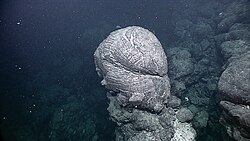
Pillow lava ( ball , ellipsoidal , globular lava , pillow lava ) [1] [2] [3] [4] - lava , frozen in the form of pillow-shaped bodies. It is formed during submarine and under-ice [5] [6] eruptions (as a rule, at a low outflow velocity) [7] [8] [9] . Probably the most common type of solidified lava on Earth [10] [11] [12] [5] .
The size, shape and structure of the "pillows" are very diverse [11] [13] . They can resemble amoeba, loaves, loaves, cylinders, mattresses, balls, flat-convex lenses [8] [9] [14] and are usually connected by jumpers, forming chains and piles [9] [1] . The size of the "pillows", as a rule, lies in the range from tens of centimeters to several meters [13] [15] [2] [16] . The characteristic features of cushion lava are a dark glassy crust covered with grooves, splitting along radial cracks and a tendency to form piles with steep slopes [14] [13] [16] [17] .
Content
- 1 Education
- 1.1 Appearance
- 1.2 Growth
- 1.3 Collapse
- 1.4 Laying
- 2 Destruction
- 3 Building
- 3.1 Size and shape
- 3.2 surface relief
- 3.3 Layer peel
- 3.4 Cavities
- 3.5 Bubbles
- 3.6 Crystal structure
- 4 Composition
- 5 prevalence
- 6 Atypical and false “pillows”
- 6.1 "Megapillows"
- 6.2 "Parapillows"
- 6.3 “Pseudo-pillows”
- 6.4 lobular lava
- 6.5 Pahoehoe
- 7 Research
- 8 Notes
- 9 Literature
- 10 Links
Education
Appearance


The peculiar form of pillow lava is a consequence of its solidification under water. Firstly, in water the force of gravity is partially compensated by the force of Archimedes and does not flatten out the lava flow so much [5] . Secondly, in water this stream is quickly cooled and covered with a hard crust, which prevents it from merging with other streams. The pressure of the lava can soon break this crust, and then a new “pillow” is squeezed out of the break - sometimes connected to the mother only by a narrow neck. Thus, branched and interwoven chains of “pillows” can arise [12] [7] [15] [18] [9] .
The formation of “pillows” is promoted by the low rate of outflow of lava, its moderately [19] high viscosity and low terrain slope [9] [13] . In other conditions, lava solidifies in the form of continuous integuments or lobular flows[16] [13] . With an increase in the outflow rate, inclination of the surface, and also with a decrease in viscosity, the “pillows” are replaced by more flat shapes [16] [13] [9] . The increase in viscosity and, according to some data [13] [6] [20] , the outflow rate contributes to the change of conventional "pillows" "megapillows" or solid masses of lava [11] . All these forms can appear during the same eruption: with moving away from the source of lava (to the side or up), solid masses are usually replaced by “megapillows”, and then by ordinary “pillows” [13] [11] [14] .
Growth
A new “pillow” can grow in just a few seconds, but sometimes large specimens continue to grow for hours or even days [11] . Growth is possible until the outer layer of the cushion becomes too strong. The smallest specimens can have time to grow before the appearance of a hard crust, and large ones increase due to its cracking. In this case, the lava protruding outward quickly (an order of magnitude faster than in air [12] ) cools down and grows to the edges of the crack (to one or both) [11] [13] [20] . But the pressure of the lava pushes these edges and can keep the crack active for several minutes. At the same time, its width remains approximately constant: the spreading is compensated by the growth of a new crust. According to measurements made near the Hawaiian Islands , the crust of “pillows” can be moved apart at a speed of 0.05 to 20 cm / s , and the width of active cracks usually lies in the range 0.2–20 cm [12] .
On the surface of the lava pouring into the water, a rather strong chilled layer immediately forms, which gives the impression of an elastic “skin” preventing the lava from spreading. While the pressure of the lava is large enough, this shell is uniformly stretched, and later turns into a hard crust [21] [20] .
Due to the very high temperature of the pouring lava, a film of water vapor envelops it, which greatly slows down cooling ( Leidenfrost effect ). According to some reports, water penetrates into the surface layer of lava and significantly reduces its viscosity [22] .
Collapse
Sometimes growing “pillows” shrink sharply, reducing their volume by 10–40% [17] . After this, growth continues, and so it can be repeated several times at intervals of the order of 5 seconds [12] . These “explosions inward" create sharp pressure surges that can be painful for divers at distances up to 3 meters [12] . The crust of the “pillow” at the same time partially collapses, and part of the debris flies away, and part, probably, plunges under the surface of the lava. According to one version, this explains why the crust of “pillows” sometimes happens in some places as multilayer [17] .
The reason for this phenomenon is the release of gases (in particular, water vapor) from the lava, which form bubbles inside it. Upon cooling, the vapor condenses and the pressure in the bubbles drops. In addition, the pressure inside the “cushion” may decrease due to the flow of lava into neighboring specimens. When the internal pressure becomes too small, the external breaks the wall of the "pillow". Collapse is typical for large specimens formed at a shallow depth (up to 1–2 km ; gas bubbles almost do not form deeper due to high pressure) [17] [12] . Most often, newly formed “pillows” collapse - with an age of several seconds and a crust thickness of 2–5 mm [12] . A thinner shell breaks too easily and imperceptibly, and a thicker shell usually does not break at all [12] .
Stacking
“Pillows” can bud from both other “pillows” and from a continuous mass of lava, and often give rise to one or more new “pillows” [19] . They can be stacked quite tightly: sometimes only a few percent of the volume remains on the gap span [9] . They are not inclined to cover the bottom with an even layer of “pillow”: growing on top of each other, they form a lot of piles several meters high [9] , and often steep slides or ridges tens of meters high. There are "pillows" in the composition of large seamounts [7] [13] [14] .
At the bottom of the oceans there are often conical piles of “pillows” 5–20 m high - “stacks” ( English haystacks ). Such hills and ridges can be arranged in chains - possibly because the lava that feeds them flows through long cracks [13] . Sometimes the height of piles of "pillows" reaches 100-200 m . These hills, known as pillow volcanoes ( pillow volcanoes ), were found both in the ocean (on the axis of the Mid-Atlantic Ridge ) and on the continents (as part of the raised oceanic crust fragments - ophiolites ) [13] . The layers of “pillows” in the composition of seamounts reach two hundred meters thickness [14] .
In addition, cushion lava is part of a pile of another type. These are clusters of “pillows” and their fragments, which extend to the sides of the places of eruptions and break off in front by a steep slope. Lava flows in the upper layers of such formations; on the front edge, it flows down and forms hanging “pillows” [13] .
Layers of solidified lava can consist of “pillows” both in whole and in part. Layers with cushion separately can pass into continuous integuments and alternate with them, as well as with deposits of hyaloclastite [21] [19] .
If “pillows” are formed on a steep slope, they can come off from each other, slide down, losing a crust along the road, and accumulate there mixed with its fragments [23] .
Destruction
The cushion lava is rather fragile, because with sudden cooling many cracks appear in it [13] . Even when hardening, its crust partially collapses, and its fragments form deposits of hyaloclastite . "Pillows" rolled down from the slope of a volcano can turn into fragments in large part or even in whole; the layers of these fragments in places reach a multimeter thickness [23] .
Although the “pillows” consist of concentric layers [24] [1] , they usually do not split into layers, but into radially directed prisms or pyramids [13] [5] . This is explained by the radial direction of cracks arising upon cooling [13] [5] . Large specimens can decay into long polyhedral columns with a thickness of about 10 cm , diverging from the center to the outside [11] [25] [21] . This is due to slow cooling, which leads to the correct pattern of cracks. But the surface and central zone of the “pillows” in this case do not split into regular columns, but into pieces of irregular shape or concentric layers [25] [11] . Other “pillows”, including “para-pillows,” sometimes break up along concentric cracks. This is due to the numerous gas bubbles collected in concentric layers. Such layers are weak spots [11] .
It happens that the wall of the not yet frozen “pillow” breaks from the inside - lava pushes it and flows out, leaving an empty crust. If this happens with a “pillow” located on a cliff, the flowing lava can form thin hanging cords up to several meters long [13] .
Cracking of a newly frozen large “pillow” may result in “pseudopillows” (see below). ) [11] .
Building
Size and shape
The size of typical “pillows” is 0.5–1 m ; there are specimens ranging in size from several tens of centimeters to several meters [13] [15] [2] [16] . Larger bodies - “megapillows” - lie on the border between ordinary “pillows” and solid covers [11] . Sometimes “mega-pillows” are even called bodies measuring 150 m or more [25] . The lower part of the size range of “pillows” is occupied by bodies 5–15 cm in size, which often bud from typical “pillows” and differ from them by a smooth surface [13] .
“Pillows” have a rounded or elongated shape [13] : their width is slightly larger than the height, and the length can be significantly larger than the width [19] . The upper side of the "pillows" is convex, and the bottom reflects the shape of the bottom irregularities (including other "pillows") and can be different [15] [8] [20] . Describing the shape of the “pillows”, they are compared with loaves, loaves, balloons, mattresses, balls, amoebas and flat-convex lenses [8] [9] [21] . On the outcrops of piles, they resemble the actual pillows [14] . The smaller they are, the closer their shape to the ball [2] [11] . There are intermediate variants between pillow lava, lava covers and lobed lava (these forms form a continuous row) [26] .
The “pillow” is obtained the greater, the higher the viscosity [6] [11] [19] and, according to some data [6] [20] , the rate of outflow of lava. But at too large or small values of these parameters, “pillows” do not form at all [9] [11] . The bottom slope also affects their morphology: on steep slopes, growing “pillows” stretch down and branch. Their average size there is smaller than usual, because they often break away from the source of lava and stop growing. The horizontal surface is characterized by more rounded and larger specimens [16] [20] [27] .
Usually “pillows” are connected by more or less thick jumpers, forming chains and piles [9] [1] . Single specimens are rare (except in the case of formation on a steep slope, where they can break away from others under the influence of gravity) [16] . New "pillows" budding from the old from all sides, even from above [12] . Often on “pillows” mini-pillows grow - outgrowths of 5-15 cm in size with a smooth surface. They can surround the “pillow” on the sides or even cover most of its surface [13] .
Surface Relief
Usually "pillows" are covered with many parallel grooves. Some of them stretch along the chain of "pillows", and some across. Sometimes both are present, covering the “pillow” with a rectangular grid. The distance between adjacent grooves is usually 0.5–10 cm , and their depth is approximately five times less. These grooves appear for several reasons, and differ greatly not only in direction, but also in shape [12] .
Fissures elongated along the chain of “pillows” (at least some [12] ) are traces squeezed out on the daughter “pillow” by the irregularities of the edges of the break in the mother [7] [11] . Such grooves are perpendicular to the edge of this gap. In addition, with the growth of a new surface, traces parallel to its edge appear on it. They arise, in particular, due to uneven growth. If growth occurs on both sides of a crack in the crust, such traces are located symmetrically on both sides. The surface of their rich “pillow” resembles a washboard [12] . With a quick opening of the crack (about 5 cm / s ), mainly grooves are formed, perpendicular to its edge, and with a slow (about 0.2 cm / s ) - parallel. At an average speed, both appear [12] [11] .
The surface of small ( 5-15 cm ) processes of the "pillows" is smooth. This is a consequence of their very rapid formation: the process reaches its maximum size even before the crust hardens, and its extension proceeds evenly [20] . It is possible that the surface tension of the melt also makes some contribution to surface smoothing [13] .
Layered Peel
Sometimes at the break of the "pillows" pieces of crust are visible, immersed in depth. They are parallel to the surface of the “pillow”, and the outer crust above them is always damaged (although the gap may be smaller than the immersed fragment). There can be several such layers of peel located one under the other. Usually they are no more than 2–4 , but 13 were also observed [17] . Layering does not cover the entire crust, but only individual sections [17] [11] . The size of a submerged piece can exceed a meter (in “pillows” several meters in size) [17] Even a very thick crust (with a single layer 9–12 cm thick ) can be multilayer; in such cases, up to 5 layers were observed [11] .
This feature is usually found in large "pillows" [17] [11] . According to some reports, it is more characteristic of specimens formed at a shallow depth (up to 1–2 km ) [17] , although it is also found at depths of 2.5–3 km [11] . The study of the multilayer crust is complicated by the fact that it is usually observed only on separate two-dimensional fractures. Its appearance is explained in different ways; it cannot be ruled out that in different cases different causes act [17] [11] [20] .
According to one version, fragments of the crust fall deep into the “pillow” when it collapses (which, as is known from observations [12] , can occur several times). In this case, one edge of the peel can move on to the other. This hypothesis explains that a multilayer crust is more characteristic of a lava that has poured out not deep - according to calculations, “pillows” should not collapse deeper than 1-2 km (although this value strongly depends on the content of dissolved gases in the lava) [17] . According to another version, these fragments are formed already inside the “pillow”, and do not get there from the surface. When the outer crust cracks due to the pressure of the lava, water gets inside, which cools the lava and creates a new crust. Since this can happen more than once, this version also easily explains a large number of layers [11] . According to the third hypothesis, in some cases, the cause of multilayering may be repeated emptying of the “pillow” and re-filling it with lava [17] .
Cavity
Usually “pillows” are solid [7] , but hollow specimens are often found. The cavity can be quite small (then it lies in the upper part of the “pillow” [9] ), or it can occupy almost its entire volume [13] . The wall thickness of the hollow “pillows” usually lies in the range of 1–15 cm [17] . The bottom of the voids is usually flat [9] ; sometimes it is wrinkled in folds [13] [11] . In the "pillow" there may be several cavities separated by horizontal partitions [9] . The upper side of the partitions, unlike the lower, is usually covered with glass . In the cavities there are “cords” of frozen lava, which arise when a viscous melt drips from the ceiling [13] [27] . In fossil “pillows”, cavities can be filled with various minerals [28] .
The cavities in the “pillows” are similar to lava tubes : they are left behind by the lava, which flows under the influence of gravity into the daughter “pillow”, when the influx of lava from the mother has already dried up [12] [17] . The bottom of the cavity may harden even before all the lava flows out of the “pillow”.If water penetrates into the cavity, the bottom hardens so quickly that its upper part becomes glass. The next time the lava level drops, a new cavity appears from below, and the process repeats. Thus, a whole stack of cavities can be formed [9] [13] .
Bubbles
Обычно «подушки» содержат газовые пузырьки разного размера и формы (в зависимости от условий образования) [6] . Объём, занимаемый пузырьками, сильно отличается в зависимости от глубины извержения (то есть давления при затвердевании) и состава лавы: иногда их почти нет, а иногда они занимают десятки процентов объёма [17] [27] . Обычно пузырьки собраны в «подушке» концентрическими слоями [13] [29] , по которым «подушка» впоследствии может раскалываться [11] . Как и крупные полости, пузырьки могут со временем заполняться различными минералами и превращаться в миндалины [8] [9] [30] .
Часто в «подушках» встречаются пузырьки в виде радиально вытянутых палочек толщиной до сантиметра и длиной до 10, а иногда и до 15 см [17] . Они образуются во внешнем слое толщиной около 20 см [17] — иногда под всей поверхностью «подушки», иногда только в нижней части [11] . Вытягиваться пузырьки могут по двум причинам — благодаря всплытию и благодаря подталкиванию фронтом затвердевания. В первом случае появляются крупные пузырьки в нижней части «подушки», вытянутые снизу вверх, во втором — меньшие пузырьки со всех сторон «подушки», вытянутые снаружи внутрь [11] . Если лава быстро течёт сквозь «подушку», длинные пузырьки формироваться не могут, и поэтому их наличие указывает на то, что лава застыла на примерно горизонтальной местности [6] [11] .
Кристаллическая структура
«Подушки» покрыты стеклянной или стекловатой коркой [24] [2] , а внутри состоят из кристаллической породы, причём размер кристаллов к центру увеличивается [2] [17] . Это объясняется тем, что поверхность быстро остывает, и кристаллы там не успевают вырасти [31] [6] [13] .
Толщина этой корки составляет около 1–2 см [20] . Она имеет тёмный [17] (иногда чёрный [20] ) цвет. Корка наиболее распространённых — базальтовых — «подушек» состоит из стекла двух видов: снаружи внутрь сидеромелан сменяется тахилитом [20] .
Composition
Подушечная лава приобретает свою форму не из-за особого химического состава, а из-за особых условий извержения и застывания. Поэтому своеобразием состава она не отличается. В подходящих условиях «подушки» могут образовываться из лавы разного состава, а в других условиях такая же лава застывает в других формах [13] [16] .
Обычно подушечная лава имеет основный состав ( базальтовый , реже андезитовый ) [24] [3] [2] [9] [32] , поскольку именно эти породы обычно извергаются на дне океанов [13] . В архее образовывались и «подушки» из ультраосновных пород — коматиитов (несмотря на то, что коматиитовая лава исключительно текучая). Позже эта порода почти не извергалась, поскольку её температура плавления очень велика, а мантия Земли остывает со временем. На суше изредка встречаются «подушки» кислого состава — дацитовые и риолитовые . Они образовались в древние времена, когда уровень моря был выше и оно покрывало большие площади континентов. На современном морском дне такие «подушки» не обнаружены (но известны кислые лавы, застывшие сплошной массой) [13] .
Состав лавы существенно влияет на её вязкость и, как следствие, на форму и размер «подушек». При кислом составе (высокой вязкости) лава склонна образовывать более округлые «подушки», и они могут достигать большего размера. Очень кислая лава образует не типичные «подушки», а лопастевидные тела размером в десятки метров [19] .
The gaps between the “pillows” are usually filled with hyaloclastite - fragments of a glass peel that occur when the lava cools down [5] [6] [23] [8] . There may be jasperoids [8] (including chalcedony ) [2] , as well as limestone , mudstone and other sedimentary rocks [2] [9] [20] [32] [28] . Cracks in ancient “pillows” are often filled with secondary minerals [11] [20] , for example, calcite , chlorites , prenite and pumpellite [20] . This also applies to voids formed during the flow of lava, as well as gas bubbles. In particular, zeolites [28] and opal [30] are found there .
Prevalence
Pillow lava is formed both in the oceans and in continental water bodies, and even on the tops of volcanoes covered with ice [6] (for example, 10,000 years ago such a lava formed on the top of the Hawaiian volcano Mauna Kea ) [5] . It can appear not only during an eruption directly into the water (or in the thickness of bottom sediments), but also when the lava flows off the coast [12] [13] [19] .
Pillow lavas are often found in volcanic underwater sediments of any age [1] [2] [6] . Their formation is also observed with modern eruptions [1] [12] . Apparently, this is the most common form of lava on Earth, since it is mainly it that forms in the rifts of mid-ocean ridges and on underwater volcanoes [12] [5] [9] [13] . Owing to tectonic processes, pillow lava poured in the ocean can also appear on the continents as part of ophiolite complexes [3] [33] .
During underwater eruptions, not only “pillows” appear, but also continuous covers , as well as lobed lava flows. “Pillows” prevail in places of low-intensity eruptions - in particular, on mid-ocean ridges with a low spreading rate [16] . For example, on the Mid-Atlantic ridge in this form almost all lava solidifies [12] . In the zones of fast spreading, not “pillows”, but covers [16] prevail, which is explained by the high outflow rate. In the rapidly expanding ridges of cushion lava, most of all, not along the axis of the rift , but at a distance of several kilometers - apparently because it is formed during low-intensity outflows away from the main activity zone [13] .
Atypical and false “pillows”
Megapillows
"Megapillows" ( English megapillows ) are "pillows" the size of tens of meters, a transitional form between the usual "pillows" and solid masses of lava. They are characteristic of the interior of piles of pillow lava (“pillow volcanoes”). Apparently, lava feeds such piles along them [13] .
Often in the “megapillows” there is a prismatic or columnar separation : they crack into multifaceted columns with a thickness of about 10 cm or more, diverging radially [25] [11] [34] . Sometimes dikes are visible in the ground outcrops, leading lava to the megapillows [34] .
Para Pillows
" Para-pillows " ( English para-pillows ) differ from ordinary "pillows" in small thickness (from a few centimeters). Moreover, their length may exceed 5 meters. Apparently, they do not gain thickness due to the too fast movement of the lava (which may be due to its low viscosity or outpouring on a steep slope). Another reason may be a sudden decrease in the rate of lava flow or an unfavorable cooling rate. "Parapillows" can form together with the usual "pillows" and also sometimes contain cavities. There are observations of the process of their formation made under water near the Kilauea volcano [11] [13] .
Pseudo Pillows
Sometimes the solidified lava mass consists of separate bodies separated by cracks and resembling “pillows” with their curved borders, cracking onto radially directed prisms, and sometimes a glassy surface. But they do not form like “pillows” - this is evident from the fact that their boundaries intersect the layers of lava and, therefore, appeared after it stopped flowing. They are known as “ pseudo-pillows ”. Sometimes real “pillows” [11] [35] [36] consist of “pseudo pillows”.
"Pseudo-pillows" appear when cracking almost frozen lava and penetrating water cracks. It quickly cools the surface of lava blocks (future “pseudo pillows”), which leads to their cracking on prisms, and sometimes to the appearance of glass on their surface [11] [35] [36] .
Lobate lava
It is not difficult to confuse cushion lava with lobate lava ( English lobate lava ) - lava, frozen in the form of amoeba-like flows spread out along the bottom (more flattened than “pillows”) [13] . There is no sharp boundary between these types of lava [26] . The main difference between lobed lava is the absence of grooves on the surface: it is either smooth or covered with a network of cracks that appeared during solidification. In terms of the internal structure, the “lobules” are very similar to the “pillows”, but more often they are hollow. They probably grow due to the uniform stretching of the shell (they manage to grow even before it hardens, which is a consequence of the high filling rate). To distinguish fossil cushion lava from lobate, good preservation and observability of the crust is necessary, which is not always the case [13] .
Pahoehoe
Fossil cushion lavas can also be difficult to distinguish from lavas such as pahoechohe - streams frozen on land with characteristic waves, folds and swellings [5] . In particular, both of them often contain cavities and concentric layers of bubbles in the upper part [19] . The main difference between pillow lava is the presence of hyaloclastite (deposits of fragments of their glass crust) between the “pillows” [5] . In addition, she has fewer jumpers between individual bodies and a larger volume of gaps between them [32] . The “pillows” are more rounded than the flows of pahoehoe (due to the action of Archimedes force, which compensates for gravity), and their crust is thicker (due to rapid cooling) and contains fewer gas bubbles (due to water pressure). Cushion lava breaks, unlike lava pahoehoehe, mainly radial cracks [5] .
Research
Although there is a lot of pillow lava on Earth, its study has been very slow for a long time, since it forms (and is mostly located) under water [12] [11] . The problem was even to determine the shape of the “pillows” and the nature of their connection, since they were mainly observed on two-dimensional outcrops of piles [11] .
Pillow lava was first noticed in the 19th century [32] [10] . In 1897, a hypothesis appeared about its underwater origin [22] . In 1909, it was confirmed by observations of lava flowing into the ocean from the volcano Matavanu ( Samoa ) [37] [29] [38] [32] , and by 1914 it became reliably established. In the 1960s, it was discovered that this lava covers most of the bottom of the oceans [10] . In the 1970s , in the waters of the Hawaiian Islands , where the lava of the Kilauea volcano flows, the formation of “pillows” was first filmed and studied in detail by divers [39] [11] [12] [22] .
The formation of pillow lava can be simulated in the laboratory. Polyethylene glycol , pouring into a cold solution of sucrose , takes the same forms as lava solidifying under water. Depending on the rate of outflow and slope of the bottom, these can be “pillows” or covers of various shapes. Such modeling makes it possible to find out under what conditions different types of solidified lava appear [13] [16] .
The study of pillow lavas can give a lot of information about the geological history of the area:
- they serve as a sign that during their formation there was a reservoir [18] [6] [32] (although they cannot always be distinguished from lavas of the type of pahoehoe , which are formed on land) [5] ;
- the shape of the “pillows” and the cavities in them makes it possible to determine whether the layer containing them has been tilted: their convex sides indicate an upward direction during their formation [27] [15] [28] (although on the steep slopes of the “pillow” each from a friend and piled up in disorder [23] ; in addition, they can be deformed by tectonic processes [40] );
- the multilayered crust indicates that the “pillow” was formed at a shallow depth of up to 1–2 km (although sometimes deep-sea lavas with this sign and shallow without it are also found) [17] [11] ;
- the presence of long elongated bubbles in the “pillow” indicates its formation on a shallow, approximately horizontal surface (with a large slope, the lava destroys them with its rapid movement) [6] [11] ;
- like other solidified lavas, “pillows” are of interest for paleomagnetic studies . They have highly stable remanent magnetization , showing the direction of the Earth’s magnetic field at the time of solidification [24] [41] (although the direction of magnetization can vary noticeably between different samples from the same location for various reasons [30] ). Cushion lava probably plays a leading role in the appearance of strip magnetic anomalies [41] .
For potassium-argon dating , cushions and other submarine lavas are much worse than terrestrial ones. First, because of the glassy crust and the large external pressure, argon does not completely evaporate from them during solidification (that is, the radioisotope “clock” does not reset to zero, which makes the measured age too high). This effect is stronger, the greater the depth of the eruption and the smaller the distance from the crust of the "pillow". Secondly, due to the interaction with sea water, the potassium content in them increases (which underestimates the measured age). Therefore, the age of oceanic lavas has to be determined by other methods — paleontological (by concomitant sedimentary rocks) and magnetostratigraphic [42] [43] .
Notes
- ↑ 1 2 3 4 5 6 Lava cushion // Geological Dictionary: in 2 volumes / K. N. Paffengoltz et al. - Edition 2, rev. - M .: Nedra, 1978. - T. 1. - S. 383.
- ↑ 1 2 3 4 5 6 7 8 9 10 Small mountain encyclopedia . In 3 t. = Mala gіrnicha encyclopedia / (In Ukrainian). Ed. V.S. Beletsky . - Donetsk: Donbass, 2004. - ISBN 966-7804-14-3 .
- ↑ 1 2 3 Ball lava - article from the Great Soviet Encyclopedia
- ↑ Pillow Lava - article from the Great Soviet Encyclopedia
- ↑ 1 2 3 4 5 6 7 8 9 10 11 12 What are the different types of basaltic lava flows and how do they form? (eng.) . Volcano World . Oregon State University. Date of treatment October 20, 2014.
- ↑ 1 2 3 4 5 6 7 8 9 10 11 12 Susan Schnur. Pillow Lavas . Walvis Ridge MV1203 Expedition Weekly Report 2 . EarthRef.org (March 9, 2012). Date of treatment October 20, 2014. Archived on June 7, 2014.
- ↑ 1 2 3 4 5 Pillow lava . Pacific Marine Environmental Laboratory. National Oceanic and Atmospheric Administration. Date of treatment October 20, 2014. Archived on June 7, 2014.
- ↑ 1 2 3 4 5 6 7 Tevelev A. V. Lecture 14. The structure of volcanic complexes . Structural geology and surveying . Geological Faculty of Moscow State University. Date of treatment October 20, 2014. Archived October 20, 2014.
- ↑ 1 2 3 4 5 6 7 8 9 10 11 12 13 14 15 16 17 18 19 Morton R. Subaqueous Volcanism . Home Page - Ron Morton . The University of Minnesota. Date of treatment October 20, 2014. Archived October 20, 2014.
- ↑ 1 2 3 Sigurdsson H. The History of Volcanology // Encyclopedia of Volcanoes / Editor-in-chief Haraldur Sigurdsson. - Academic Press, 1999. - P. 15–37. - 1417 p. - ISBN 9780080547985 .
- ↑ 1 2 3 4 5 6 7 8 9 10 11 12 13 14 15 16 17 18 19 20 21 22 23 24 25 26 27 28 29 30 31 32 33 34 35 36 37 38 Walker GPL Morphometric study of pillow-size spectrum among pillow lavas // Bulletin of Volcanology. - 1992. - Vol. 54, No. 6 . - P. 459–474. - DOI : 10.1007 / BF00301392 . - .
- ↑ 1 2 3 4 5 6 7 8 9 10 11 12 13 14 15 16 17 18 19 20 21 22 23 Moore JG Mechanism of Formation of Pillow Lava // American Scientist. - 1975 .-- Vol. 63, No. 3 . - P. 269-277. - .
- ↑ 1 2 3 4 5 6 7 8 9 10 11 12 13 14 15 16 17 18 19 20 21 22 23 24 25 26 27 28 29 30 31 32 33 34 35 36 37 38 39 Batiza R., White JDL Submarine Lavas and Hyaloclastite // Encyclopedia of Volcanoes / Editor-in-chief Haraldur Sigurdsson. - Academic Press, 1999. - P. 361–381. - 1417 p. - ISBN 9780080547985 .
- ↑ 1 2 3 4 5 6 Schmidt R., Schmincke H.-U. Seamounts and Island Building // Encyclopedia of Volcanoes / Editor-in-chief Haraldur Sigurdsson. - Academic Press, 1999. - P. 383–402. - 1417 p. - ISBN 9780080547985 .
- ↑ 1 2 3 4 5 Belousov VV Chapter 1. Primary forms of occurrence of rocks // Structural geology . - 3. - M .: Publishing house Mosk. University, 1986. - S. 14–16. - 248 p.
- ↑ 1 2 3 4 5 6 7 8 9 10 11 Kennish MJ, Lutz RA Morphology and distribution of lava flows on mid-ocean ridges: a review // Earth Science Reviews. - 1998. - Vol. 43, No. 3-4 . - P. 63–90. - DOI : 10.1016 / S0012-8252 (98) 00006-3 . - .
- ↑ 1 2 3 4 5 6 7 8 9 10 11 12 13 14 15 16 17 18 19 20 Kawachi Y., Pringle IJ Multiple-rind structure in pillow lava as an indicator of shallow water // Bulletin of Volcanology. - 1988. - Vol. 50, No. 3 . - P. 161–168. - DOI : 10.1007 / BF01079680 .
- ↑ 1 2 Pillow lava . Volcano Hazards Program Photo Glossary . United States Geological Survey (December 29, 2009). Date of treatment October 20, 2014. Archived on June 7, 2014.
- ↑ 1 2 3 4 5 6 7 8 Furnes H., Fridleifsson IB Relationship between the chemistry and axial dimensions of some shallow water pillow lavas of alkaline olivine basalt-and olivine tholeiitic composition // Bulletin Volcanologique. - 1978. - Vol. 41, No. 2 . - P. 136–146. - DOI : 10.1007 / BF02597027 . - .
- ↑ 1 2 3 4 5 6 7 8 9 10 11 12 13 14 Shaker Ardakani AR, Arvin M., Oberhänsli R., Mocek B., Moeinzadeh SH Morphology and Petrogenesis of Pillow Lavas from the Ganj Ophiolitic Complex, Southeastern Kerman, Iran : [ arch. June 7, 2014 ] // Journal of Sciences. - University of Tehran, 2009. - Vol. 20, No. 2. - P. 139–151. - ISSN 1016-1104 .
- ↑ 1 2 3 4 Snyder GL, Fraser GD Pillowed Lavas, I: Intrusive Layered Lava Pods and Pillowed Lavas, Unalaska Island, Alaska . - Washington: US Government Printing Office, 1963. - Vol. 454-B. - P. B1 – B23. - (Geological Survey Professional Paper). - ISBN 9781288964819 . - OCLC 636627779 .
- ↑ 1 2 3 Mills AA Pillow lavas and the Leidenfrost effect // Journal of the Geological Society of London. - 1984. - Vol. 141, No. 1 . - P. 183–186. - DOI : 10.1144 / gsjgs.141.1.0183 .
- ↑ 1 2 3 4 Taziev G. On volcanoes / Ed. Dr. geol.-min. Sciences M.G. Leonova . - M .: Mir, 1987 .-- S. 73 - 74 .
- ↑ 1 2 3 4 Pechersky D.M. Cushion Lava // Paleomagnetology, Petromagnetology and Geology. Dictionary dictionary for neighbors by profession . ()
- ↑ 1 2 3 4 Hamilton W., Hayes PT Type Section of the Beacon Sandstone of Antarctica . - Washington: United States Government printing Office, 1963. - P. C37 – C38. - (US Geological Survey professional paper 456-A).
- ↑ 1 2 Rubin KH, Soule SA, Chadwick Jr. WW, Fornari DJ, Clague DA, Embley RW, Baker ET, Perfit MR, Caress DW, Dziak RP Volcanic eruptions in the deep sea // Oceanography. - 2012. - Vol. 25, No. 1 . - P. 142-157. - DOI : 10.5670 / oceanog.2012.12 . Archived on October 20, 2014.
- ↑ 1 2 3 4 Wells G., Bryan WB, Pearce TH Comparative Morphology of Ancient and Modern Pillow Lavas // The Journal of Geology. - 1979. - Vol. 87, No. 4 . - P. 427-440.
- ↑ 1 2 3 4 Keith TEC, Staples LW Zeolites in Eocene basaltic pillow lavas of the Siletz River Volcanics, Central Coast Range, Oregon // Clays & Clay Minerals. - 1985. - Vol. 33, No. 2 . - P. 135–144. - DOI : 10.1346 / CCMN.1985.0330208 . - . Archived on October 20, 2014.
- ↑ 1 2 McCallien WJ Some Turkish Pillow Lavas = Türkiye'de "Pilov Lavlar" // Türkiye jeoloji kurumu bülteni. - 1950. - Vol. 2, No. 2 . - P. 1-15. Archived on October 20, 2014.
- ↑ 1 2 3 Helgason J., van Wagoner NA, Ryall PJC A study of the palaeomagnetism of subglacial basalts, SW Iceland: a comparison with oceanic crust // Geophysical Journal International. - 1990. - Vol. 103, No. 1 . - P. 13-24. - DOI : 10.1111 / j.1365-246X.1990.tb01748.x . - .
- ↑ Pechersky D.M. Crystallization // Paleomagnetology, petromagnetology and geology. Dictionary dictionary for neighbors by profession . ()
- ↑ 1 2 3 4 5 6 Snyder GL, Fraser GD Pillowed Lavas, II: A Review of Selected Recent Literature . - Washington: US Government Printing Office, 1963. - Vol. 454-C. - P. C1 – C7. - (Geological Survey Professional Paper). - ISBN 9781288964819 . - OCLC 636627779 .
- ↑ Siim Sepp. Pillow lava in Cyprus . sandatlas.org (April 26, 2012). - photo gallery of pillow lavas in ophiolites of Cyprus. Date of treatment October 20, 2014. Archived on June 7, 2014.
- ↑ 1 2 Bartrum JA Pillow-Lavas and Columnar Fan-Structures at Muriwai, Auckland, New Zealand // The Journal of Geology. - 1930. - Vol. 38, No. 5 . - P. 447–455. - DOI : 10.1086 / 623740 . - .
- ↑ 1 2 Forbes AES, Blake S., McGarvie DW, Tuffen H. Pseudopillow fracture systems in lavas: Insights into cooling mechanisms and environments from lava fl ow fractures // Journal of Volcanology and Geothermal Research. - 2012. - Vol. 245-246. - P. 68–80. - DOI : 10.1016 / j.jvolgeores.2012.07.007 . - .
- ↑ 1 2 Mee K., Tuffen H., Gilbert JS Snow-contact volcanic facies and their use in determining past eruptive environments at Nevados de Chillán volcano, Chile // Bulletin of Volcanology. - 2006. - Vol. 68, No. 4 . - P. 363–376. - DOI : 10.1007 / s00445-005-0017-6 . - .
- ↑ Anderson T. Volcanic Craters and Explosions // The Geographical Journal. - 1912. - Vol. 39, No. 2 . - P. 123–129.
- ↑ Cole GAJ Rocks and Their Origins . - Cambridge University Press, 2011 (reprint of second (1922) edition). - P. 116–118. - 184 p. - ISBN 978-1-107-40192-1 .
- ↑ Tepley L., Moore JG (1974) Fire under the sea: the origin of pillow lava (16 mm motion picture) on YouTube
- ↑ Borradaile GJ, Poulsen KH Tectonic deformation of pillow lava // Tectonophysics. - 1981. - Vol. 79, No. 1-2 . - P. T17 – T26. - DOI : 10.1016 / 0040-1951 (81) 90229-8 . - .
- ↑ 1 2 Kennette J.P. 4. Continental drift and ocean floor spreading: an introduction to plate tectonics // Marine Geology. - M .: Mir, 1987. - T. 1. - S. 121. - 397 p.
- ↑ Kenneth J.P. 3. Ocean stratigraphy, correlation and geochronology // Marine Geology. - M .: Mir, 1987. - T. 1. - S. 75–76. - 397 p.
- ↑ Dalrymple GB, Moore JG Argon-40: Excess in Submarine Pillow Basalts from Kilauea Volcano, Hawaii. // Science. - 1968. - Vol. 161, No. 3846 . - P. 1132–1135. - DOI : 10.1126 / science.161.3846.1132 . - . - PMID 17812284 .
Literature
- Batiza R., White JDL Submarine Lavas and Hyaloclastite // Encyclopedia of Volcanoes / Editor-in-chief Haraldur Sigurdsson. - Academic Press, 1999. - P. 361–381. - 1417 p. - ISBN 9780080547985 .
- Walker GPL Morphometric study of pillow-size spectrum among pillow lavas // Bulletin of Volcanology. - 1992. - Vol. 54, No. 6 . - P. 459–474. - DOI : 10.1007 / BF00301392 . - .
- Moore JG Mechanism of Formation of Pillow Lava // American Scientist. - 1975 .-- Vol. 63, No. 3 . - P. 269-277. - .
- Snyder GL, Fraser GD Pillowed Lavas, II: A Review of Selected Recent Literature . - Washington: US Government Printing Office, 1963. - Vol. 454-C. - P. C1 – C7. - (Geological Survey Professional Paper). - ISBN 9781288964819 . - OCLC 636627779 .
- Kawachi Y., Pringle IJ Multiple-rind structure in pillow lava as an indicator of shallow water // Bulletin of Volcanology. - 1988. - Vol. 50, No. 3 . - P. 161–168. - DOI : 10.1007 / BF01079680 .
Links
- Tevelev A. V. Lecture 14. The structure of volcanic complexes . Structural geology and surveying . Geological Faculty of Moscow State University. Date of treatment October 20, 2014. Archived October 20, 2014.
- Andrew Alden. Pillow Lava Pictures (inaccessible link) . geology.about.com. Date of treatment October 20, 2014. Archived on June 7, 2014.
- Susan Schnur. Pillow Lavas . Walvis Ridge MV1203 Expedition Weekly Report 2 . EarthRef.org (March 9, 2012). Date of treatment October 20, 2014. Archived on June 7, 2014.
- Siim Sepp. Pillow lava in Cyprus . sandatlas.org (April 26, 2012). - photo gallery of pillow lavas in ophiolites of Cyprus. Date of treatment October 20, 2014. Archived on June 7, 2014.
- Pillow lava . Pacific Marine Environmental Laboratory. National Oceanic and Atmospheric Administration. Date of treatment October 20, 2014. Archived on June 7, 2014.
- The formation of pillow lava (video ) . National Oceanic and Atmospheric Administration. Date of treatment October 20, 2014. Archived October 23, 2004.
- Pillow Lava Formation (Kilauea Volcano Eruption, Hawaii) on YouTube
- Ocean floor pillow lava on YouTube