Urolophus piperatus (lat.) Is a species of the genus Urolophus of the family of short-tailed stingrays of the order of tailed-like . It is endemic to the Coral Sea . It occurs at a depth of up to 370 m. The pectoral fins of these slopes form a diamond-shaped disk, the width of which exceeds the length. The dorsal surface of the disc is painted gray or brown, sometimes covered with dark spots. Between the nostrils there is a rectangular fold of skin. The thin tail ends with a leaf-like caudal fin, there are lateral folds of the skin. In the middle part of the caudal stem, behind a small dorsal fin, there is a serrated spike. The maximum recorded length is 48.4 cm. Two species of stingrays, very similar to each other, which may belong to different species, live in the range.
| Urolophus piperatus |
|---|
|
| No rank : | Bilateral symmetrical |
| Family: | Short-tailed Stingers |
|
|
Urolophus piperatus Yearsley & Last , 2006 |
|
Least ConcernedIUCN 3.1 Least Concern : 60103 |
|
Propagated by egg production . Not an object of target fishing. Commercial fishing in the range is practically absent [1] [2] .
The first specimen of a new species was obtained during a research expedition conducted jointly by French and Australian scientists in the 1980s. The name Urolophis “sp. B " , and in 2003 it was scientifically described in the issue of the magazine " Cybium " . Species epithet comes from the word lat. piper - “pepper” and is due to the spotty coloration of stingrays [3] . The holotype is an adult male 48.4 cm long, caught off the coast of Queensland ( ) at a depth of 357 m. Paratypes: female 33 cm long, caught there at a depth of 200 and males 29.7–43.6 m long, caught there at a depth of 225–370 m [4] .
Urolophus piperatus live off the coast of Queensland from Morton Island to Cairns [5] . These bottom fish are found on the outer edge of the continental shelf and in the upper part of the continental slope at a depth of 171–370 m [1] .
The wide pectoral fins of these slopes merge with the head and form a diamond-shaped disk, the width of which is 113-121% of the length. The “wings” are rounded, the front edge of the disk is almost straight, the pointed fleshy snout forms an obtuse angle and protrudes beyond the edges of the disk. Behind the rather large eyes are comma- shaped sprays . Between the nostrils lies a skin flap with a shallow-edged lower edge, passing along the edges into elongated lobes. The mouth is medium sized. 32-35 upper and 30-39 lower dentitions. Rhomboid-shaped teeth are staggered. At the bottom of the oral cavity there are 7–9 finger-shaped processes, 5–7 processes located in the middle have branched tips. On the ventral side of the disk there are 5 pairs of short gill slits . Small abdominal fins rounded. Males have blunt pterigopodia [3] [5] [6]
The length of the short tail is 76–85% of the length of the disk. On either side of the caudal peduncle, folds of skin lie. The tail narrows and turns into a low leaf-shaped caudal fin. On the dorsal surface of the tail in the central part behind the low dorsal fin there is a serrated spike. The skin is devoid of scales . The maximum recorded length is 48 cm. The stingrays living in the Coral Sea are generally gray or brown and covered with dark spots, while individuals found in Queensland's waters are dark brown without markings. Dorsal and caudal fins brown with black edges. Young individuals are more covered with spots. A dark line runs along the central axis of the tail. The ventral surface is white, sometimes the edges are edged with a dark color, and several marks are located on the tail [3] [5] .
Like other caudate-like Urolophus piperatus, they reproduce by egg-production. The length of newborns is about 12 cm. The number of litters is small. Males and females reach puberty with a length of 23 and 27 cm, respectively. The discrepancy between the maximum recorded length and the size of a mature individual is probably due to the presence in the Coral Sea of two similar species of different sizes. However, they do not differ in morphological or meristic characteristics [3] .
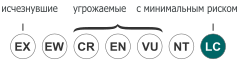
These ramps are not the target fishing target. There is no intensive fishing in the range. The International Union for Conservation of Nature has assigned this species a conservation status of “Least Concerns” [1] .
- ↑ 1 2 3 Urolophus piperatus (English) . The IUCN Red List of Threatened Species .
- ↑ Urolophus piperatus (English) in the FishBase database.
- ↑ 1 2 3 4 Séret, B. and PR Last (2003). Description of four new stingarees of the genus Urolophus (Batoidea: Urolophidae) from the Coral Sea, south-west Pacific. - Cybium, 2003. - Issue. 27 . - No. (4) . - S. 307-320 .
- ↑ Urolophus piperatus (neopr.) . Shark References. Date of treatment October 13, 2014.
- ↑ 1 2 3 Last, PR; Stevens, JD Sharks and Rays of Australia. - (second ed.). - Harvard University Press, 2009 .-- S. 423-435. - ISBN 0—674-03411—2.
- ↑ Last, PR and LJV Compagno. Myliobatiformes: Urolophidae. In Carpenter, KE and VH Niem. FAO identification guide for fishery purposes: The living marine resources of the Western Central Pacific. - Food and Agricultural Organization of the United Nations, 1999. - S. 1469-1476. - ISBN 92-5-104302-7.