Ceylon kalot [1] ( lat. Calotes ceylonensis ) is a species of large lizards from the agamic family.
| Ceylon Halot |
 |
| Scientific classification |
|---|
| No rank : | Bilateral symmetrical |
| Infraclass : | Lepidosauromorphs |
|
| International scientific name |
|---|
Calotes ceylonensis Müller , 1887 |
| Security status |
|---|
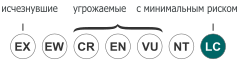
Least ConcernedIUCN 3.1 Least Concern : ??? |
|
Content
The total length reaches 40 cm. Coloring varies from grayish-brown to light blue or dark brown, the back of the head and front of the back is pale brown with more or less clear dark spots. A thin strip of white or black color extends from the upper lip to the ear, towards the neck and chest. The sides are grayish or reddish. The belly is light brown in color with more or less distinct stripes. The head is elongated, the forehead is concave; the cheeks are convex, above the tympanum there are two rows of pronounced spines. The occipital crest is developed, consisting of 10-12 spines. The trunk is compressed laterally. The limbs are of moderate length, the fourth finger is noticeably longer than the third; hind limbs reach the tympanum. The tail is long and thin.
He loves evergreen monsoon forests, plantations and home gardens. It occurs up to an altitude of 400 meters above sea level. Lives mainly on trees. Active during the day. It feeds on butterflies, bees. The natural enemies of this lizard are the already peculiar , rhinoceros birds and civet . When danger arises, this lizard instantly rises to a tree 15 meters high and then slides to another tree.
Oviparous lizard. The female digs a hole in the ground in August-October, where it lays 4-12 eggs 13.5-17.1 mm long and 7.8-8.9 mm wide. Cubs appear from November to December.
- ↑ Ananyeva N. B. , Borkin L. Ya. , Darevsky I.S. , Orlov N.L. Amphibians and reptiles. Latin, Russian, English, German, French. / edited by Acad. V. E. Sokolova . - M .: Rus. Yaz., 1988 .-- S. 160. - 10,500 copies. - ISBN 5-200-00232-X .
- Müller, 1887: Fünfter Nachtrag zum Katalog der herpetologischen Sammlung des Basler Museums . Verhandlungen der Naturforschenden Gesellschaft in Basel, vol. 8, p. 249-296 ( text ).