History of Southeast Asia
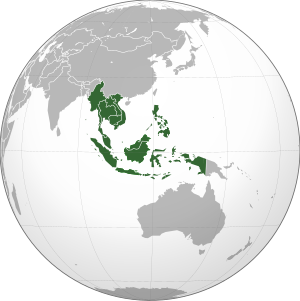
South-East Asia (Southeast Asia) is a macro - region covering continental and island territories between China , India and Australia . Includes the Indochina Peninsula and the Malay Archipelago ; part of the Asia-Pacific region .
It includes 11 of the following countries [1] : on the continental part are Vietnam , Cambodia , Laos , Myanmar , Thailand , Malaysia , and on the island - Brunei , East Timor , Indonesia , Singapore , and the Philippines .
Content
Ancient and Classical Kingdoms
Greater India is a historical region that was heavily influenced by Indian culture and Hinduism , especially from the 5th to the 15th centuries. Greater India extended far beyond the Indian subcontinent: from Afghanistan to the islands of Southeast Asia and the Far East, from Ceylon to the foothills of the Himalayas and Tibet . The spread of Hinduism in Southeast Asia and the expansion of Buddhism beyond the Indian subcontinent to Central Asia and China along the Great Silk Road are associated with Greater India.
Wanglang
Wanlang ( Vietnamese. Văn Lang , Thy-nom 文 郎 ) - the first Vietnamese state in the territory of modern Vietnam , founded in 2524 BC. e. (according to other sources, this was in the 7th century BC [2] [3] ) and lasted until 258 BC. e. [4] The rules of the country are the Hong Bang Dynasty . The inhabitants of Wanglang were called Lacquets .
Very little is known about Wanglang: the rulers of the Hungwongs and the state itself were mentioned in Qin and Tang sources [5] .
The founder of Wanglang was King Hung Lan , who declared himself the third Hungwong , the throne was inherited. The Hungwongs were both military commanders and spiritual leaders.
Wanglang Society was a slave society,
Khmer Empire
Dark Green : Lansang
Purple : Lanna
Orange : Sukhothai
Violet : Ayutthaya
Red : Khmer Empire
Yellow : Tampa
Blue : Dai-Viet
The Khmer Empire or Cambodia (the term Angkor Cambodia or the Angkor Kingdom is also used) is a Khmer feudal state that existed in the 9th - 13th centuries on the territory of modern Cambodia , Vietnam , Thailand and Laos , with its center in Angkor .
It reached its peak in the 12th century. During this period, the empire included the modern territories of Vietnam , Cambodia , Thailand and Laos .
The state was formed as a result of the decomposition of tribal relations among the Khmer tribes that inhabited the inner part of Indochina . The unification of disparate Khmer principalities was facilitated by the favorable location of Angkor in terms of agricultural development and protection from external enemies. The influence of Indian civilization, also spreading from the coastal regions deep into the peninsula, also played a role in the formation of state structures.
Jayavarman II ( 802 - 850 ) is officially considered to be the founder of the kings dynasty of Kambujadesi, however, in fact, the unification of the country occurred under Indraharman I ( 877 - 889 ) and Yashovarman I ( 889 - 900 ). In the XI-XII centuries, the country reaches its greatest prosperity and becomes one of the most powerful states in Southeast Asia . Kings Suryavarman I ( 1002 - 1050 ) and Udayadityavarman II ( 1050 - 1066 ) built a large irrigation network, fed from an artificial lake with an area of 16 km² - the Western Bar.
Under Suryavarman II, the country waged devastating wars against neighboring monk states in the Menama Valley and also against the state of Tiampa . The territory of Cambujades is the largest. Near the capital, a monument of Cambodian architecture is erected - the temple of Angkor Wat . Since the mid- 12th century, Kambujadesh, exhausted by continuous wars and the enormous scale of construction, has gradually fallen into decline. During the 2nd half of the 13th century, Thai tribes constantly crowded it from the west. By the fourteenth century, the empire of Cambujadesh ceases to exist.
Sri Vijaya
Srivijaya (Also Srivijaya , Srivijaya ) ( Chinese 三 佛 齐, 室 利 佛 逝 200 - 1400 ) is an ancient Malayan kingdom centered on the island of Sumatra , also extending to the islands of the Malay archipelago and on the coast of Southeast Asia. It originates from various sources from 200 to 500 n. e. The state ceased to exist around 1400 . The name in Sanskrit means a brilliant victory .
Vajrayana Buddhism flourished in Sri Vijay , culture and trade were developed. Buddhist universities were very authoritative.
At its peak, Srivijaya owned Sumatra , the western part of Java , part of the island of Kalimantan , the Malay Peninsula and part of modern Thailand .
Sri Vijaya was not opened to modern Western historical science until 1918 , when French historians were able to identify the Sanskrit name Sri Vijaya with the Islamic name Sribusa and the Chinese San-fo-qi.
The capital of the state was the city of Palembang on the island of Sumatra , most likely the ancient capital was in the place where the modern city is located, this is indicated by the find of a large statue of Ganesha , there are suggestions about the location of various buildings and objects, and the holy mountain Sri Vijaya most likely corresponds to the mountain Bukit Seguntang. The ruling dynasty was the Shailendra dynasty, supposedly of Javanese origin.
The state was founded before 500 , presumably on the site of the state of Kantoli (Kan-t'o-li). A hundred years later, Chinese sources mention two kingdoms in Sumatra - Jambi and Palembang , while Jambi was quite powerful and maintained relations with China. In 686, Jambi was occupied by Srivijaya, as the Buddhist pilgrim Yi Jing writes about.
Palembang's advantageous position in a convenient harbor on trade routes led to the heyday of the kingdom, through Palembang there was a trade in fabrics, precious stones, ivory, silver, camphor, precious woods, spices, elephants and incense. Ships sailed through the Malacca and Sunda straits , exchanging goods from India, China and Arabia. The Strait of Malacca was also called the Sea Silk Road.
Malacca Sultanate
Malacca Sultanate ( Malaysian. Kesultanan Melayu Melaka ) is a Muslim state in Malaysia and western Indonesia , which existed in 1400-1511 . In 1414, the ruler of Malacca converted to Islam, hoping to attract Muslim merchants to the city. In 1445, Muslims carried out a coup, killed a minor Rajah and enthroned Prince Qasim, who took the name Muzaffar Shah (1445-1459). Intensive Islamization of the state began.
Destroyed by the Portuguese in 1511.
In 1299, the Sri Vijay Prince, Sang Nile Utama founded Singapore . He retained control of the island for 48 years and was recognized as ruler by the envoy of the Yuan emperor in 1366 . Parameshwara ruled in Palembang , Bintan and Singapore . His descendants ruled Singapore for a long time: the son of Sri Tri Buana (1372–1386), his grandson Paduk Seri Ran Vira Kerma ( 1386–1399 ) and his great grandson Paduk Sri Maharaja Parameshvara (1399–1413). In the 1390s, Majapahit sent thousands of ships to attack Sri Vijay and Singapore located in Malacca. In collusion with Bendahar Tapa, Majapahit managed to conquer Singapore in 1401 and send Parameshwara.
Parameshvara fled north and founded Malacca in 1402 . In 1409 , Parameshvara assumed the title of Sultan Iskandar Shah due to his marriage to the Princess of Pasay . His marriage to a Muslim princess called on his subjects to convert to Islam.
The main population of Malacca were mostly Indians . In accordance with the Malay Chronicle, Parameshwar dreamed that Mohammed came to him, proclaiming Islam in Malacca. Parameshvara adopted an Islamic name , becoming Sultan Iskandar Shah, and a new religion quickly spread throughout the sultanate.
After Parameshvara, Sultan Ahmad Shah ruled. He was responsible for building the empire. The Malacca empire evolved from a maritime empire into a trading empire. Other eastern civilizations, such as the Ming and Ayutthaya empires and such as Gujarat , Arabs and Europeans traded with Malacca.
During the reign of Sultan Aladdin Riyat Shah, at the end of the 15th century the Portuguese arrived in Malacca for trade. In 1511, during the reign of Mahmoud Shah Malacca was captured by the Portuguese .
European colonization
On August 24, 1511, the Portuguese captured Malacca . The city became a stronghold of the Portuguese in Southeast Asia .
Immediately after the capture, the Portuguese began to build a powerful fortress called A'Famosa ("famous"). For this purpose, the captive inhabitants of the city and 1,500 slaves of the Sultan, who automatically became slaves of Manuel I, were used . The stone was broken from mosques, tombs and other urban structures.
A new administration has been created. At the head of the city was the "captain of the fortress", reporting directly to the Viceroy of India. He took turns every three to four years. The deputy “Captain of the fortress” was the “Captain of the port”. In addition, a city council was created. The chief judge and the secretary of the council were appointed by the vice-king, and six advisers in charge of urban finance, legal proceedings, etc. were elected by the local Portuguese. The leaders of the local Catholic clergy were also members of the city council. The Portuguese retained part of the old administration. Local residents Malays and other non-Christians obeyed her, she also oversaw the non-Portuguese courts.
All ships sailing through the Strait of Malacca had to call at Malacca and pay a fee. Trying to pass by were intercepted and drowned by Portuguese patrols.
Notes
- ↑ russland_vostok_28_03_12 (ed.) Archived January 16, 2014 on the Wayback Machine
- ↑ Vanlanga Kings - Monarchs. The Ancient East - Yandex. Dictionaries Archived copy of January 28, 2013 on the Wayback Machine (unavailable link from 06/14/2016 [1168 days])
- ↑ Vietnam
- ↑ Trần Trọng Kim. Việt Nam sử lược: [] . - Ho Chi Minh City General Publishing House, 2005 .-- P. 17.
- ↑ Keith Taylor, The Birth of Vietnam , Appendix A, Appendix B and C