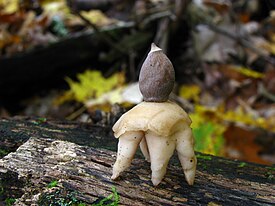
Young fruit bodies are underground, almost spherical or flattened, with ingrown particles. When exoperidia open, the star breaks into 4-5 (6) rays, 1-4 (6) cm in height. Rays are not hygroscopic, erect, “arches” raising endoperidium above the ground, wide, with edges bent inward. When straightening exoperidiums up to 9 cm in diameter. The mycelial layer of exoperidia with the growing particles of litter is whitish and durable on the inner side. The fibrous layer (between the mycelial inner) is leathery to membranous, from the endoperidium side, first covered with a pseudo-parenchymal layer, then exposed and white, from the mycelial layer whitish, shiny, then becomes off-brown-white. The inner (pseudo-parenchymal) layer (covering the exoperidia from the side hidden in young fruit bodies, then appearing) is whitish first, then darkens to brownish or grayish brownish, occasionally pinkish, and crack with age.
The endoperidium , which surrounds the hleb , is raised above the "star" on the knuckle process, spherical or flat, about 0.7-1 cm in diameter. Cirrus sharply defined, disc-shaped or conical.
The spores in the mass are dark brown, spherical in shape, with a finely borne-topped surface, 5.5-6.3 μm in diameter (including the ornament). Hyphen capillary thick-walled, 3-6 microns thick, with fine ends, yellowish-brown.
Food does not matter, it is considered an inedible mushroom.
Similar views
- Geastrum leptospermum GFAtk. & Coker , 1903 - North American species, distinguished by its even smaller size, appears in winter and spring, grows on moss-covered valezhe of coniferous and deciduous trees.
- Geastrum minimum Schwein. , 1822 - The small star -man is distinguished by a non-vaulted exoperidium with a large number of rays.
- Geastrum fornicatum ( Huds. ) Hook. , 1821 - The vaulted starfish is distinguished by its large size of fruit bodies, more clearly limited pinnacle and smaller spores.
- Geastrum dissimile Bottomley , 1948 - African species, distinguished by striated pinnacle.
- Geastrum welwitschii Mont. , 1856 - differs in ground young fruit bodies, in the outer layer of which the particles of litter do not grow, as well as in the diffusely limited cirrus.
It grows on soil in coniferous and deciduous (beech) forests, with well-drained soil.
Rare species throughout the range. Listed in the Red Books of Austria, Bulgaria, Denmark, Latvia, the Netherlands, Poland.