The Burmese Operation of 1942 - military operations in the territory of modern Myanmar from January to May 1942 (before the start of the rainy season).
| Burmese Operation 1942 | |||
|---|---|---|---|
| Main Conflict: Burmese Campaign | |||
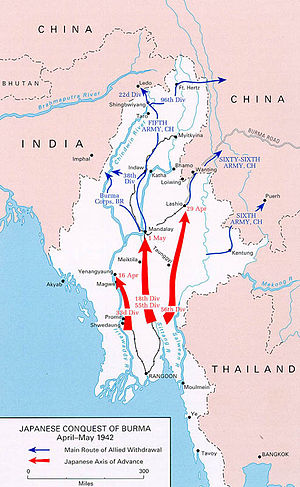 Japanese offensive in April-May 1942 | |||
| date of | January-May 1942 | ||
| A place | Myanmar | ||
| Opponents | |||
| |||
| Commanders | |||
| |||
| Losses | |||
| |||


Content
- 1 Background
- 2 Course of events
- 2.1 Japanese invasion and capture of Lower Burma
- 2.2 Japanese Capture of Middle and Upper Burma
- 3 Summary and Consequences
- 4 See also
- 5 Sources
Background
The Japanese command attached important military and political importance to Burma, located on the northern flank of the southern seas. Its seizure made it possible to cut off the supply routes of the Chiang Kai-shek China, and also created a bridgehead for the invasion of India. Before the war began, the Imperial Headquarters, in a directive to the Southern Army Group, indicated that "during offensive operations in the areas of the South Seas, air bases in South Burma are captured at a convenient time and, if the situation permits, an operation is carried out throughout Burma."
Event
Japanese invasion and capture of Lower Burma
On December 8, 1941, the Japanese 15th Army occupied Thailand .
On December 16, a Japanese battalion, following mountain trails through the Isthmus of Kra, reached Victoria Point. However, the airfield was empty - two days before the arrival of the Japanese, British personnel were evacuated by sea, since the British command believed that it would not be possible to keep the airfield.
On December 23, Japanese aviation made its first air raid on Yangon. 4 squadrons (60 aircraft) of Japanese bombers, accompanied by a fighter squadron, bombed the port and Rangoon airfield, as well as residential quarters (more than 2 thousand residents of the city died). Two fighter squadrons entered the battle against the Japanese - the 67th British Air Force and the 3rd American mercenary (Infernal Angels squadron from the US Flying Tigers mercenary regiment). The British shot down 3 Japanese bombers, the Americans - another 8 (having lost 3 of their fighters).
Lieutenant General Hatton, who had led Burma’s defense on the orders of Burma, recognized the intentions of the Japanese to strike through Tenasserim, and dispatched the 46th Indian Brigade that arrived from India to Moulmein (with the headquarters of the 17th Indian Division, the other two brigades of this division were in Singapore) and 13th Indian brigade from the Shan region. In addition, Hatton ordered the British squadron to strike at airfields in Thailand, and January 8, 1942 - a raid on Bangkok.
On January 20, the Japanese captured the city of Tavoy . There, the Japanese began to form the " Burma Independence Army " of the so-called "takins" (Burmese left nationalists).
On January 31, the 55th Japanese division, after a day-long battle against 4 Indian battalions, captured Moulmein .
On February 9, units of the 15th Japanese Army received orders to launch an offensive on Rangoon .
On February 22, a battle began over the bridge over the Sithown River - 120 km from Rangoon. On February 23, the bridge was blown up to prevent the passage of Japanese troops, and as a result, the 16th, 46th Indian brigades and half of the 48th Indian brigade remained cut off on the eastern bank of the river (more than 500 m wide). Few managed to cross the river, the rest were killed or captured. As a result, only 3.5 thousand soldiers and officers remained in the 17th Indian Division on the western shore of Seatown, without artillery and transport. They moved west to the city of Pegu , where they were joined by the British 7th Tank Brigade , which had arrived from North Africa.
On March 1, 1942, at the request of Wavell, the Chinese 5th and 6th armies entered the territory of Burma (actually approximately equal to the divisions), which began to advance south along the Burmese road.
The Japanese offensive on Yangon began on March 3. On March 5, Japanese units of the 15th Army reached Pegu and attacked the positions of the 17th Indian Division. Arriving from India, General Alexander , who replaced Hatton as commander of troops in Burma, ordered Pegu to be defended by the 17th Division, which included the 7th Panzer Brigade and the arrived 63rd Indian Brigade , and also ordered Peg 1st to go Burmese division from the north.
However, Japanese troops successfully circumvented enemy units, they retreated in order to avoid encirclement, and by the morning of March 8, the 17th division had defended 40 km from Rangoon . By that time, the capital of Burma was evacuated, port facilities and warehouses were blown up, on the morning of March 7 the Rangoon garrison, led by General Alexander and his headquarters, left the city heading north along the highway leading to Prom (Pi) .
On the afternoon of March 8, 1942, advanced Japanese units entered the deserted, almost deserted Rangoon.
Japanese Capture of Middle and Upper Burma
On March 7, 1942, the Japanese 15th Army received orders from Tokyo to launch an offensive to the north of Burma, with the aim of defeating the Chinese troops. By March 15, the commander of the 15th Army, General Yida, had developed an operation plan to capture Middle and Upper Burma. He counted on the imminent arrival in Rangoon of two more Japanese divisions - the 56th and 18th, as well as the fact that poorly armed and poorly supplied Chinese troops would not want to defend Burma, but would retreat to their border.
However, in the Taungu area (200 km north of Rangoon), the 200th Chinese division, numerically equal to the regiment, stubbornly resisted the 55th Japanese division. After 4 days of fighting, the Chinese were surrounded, then they fought another 10 days and, having suffered loss of personnel and weapons, still broke out of the encirclement to the north.
Other Chinese units really began to retreat from the beginning of April, without showing any serious resistance to the Japanese. The British units also from April 2 began to retreat from Prom to the north.
On April 10, Japanese troops entered into combat contact with the Burmese Corps (17th Indian and 1st Burmese divisions, the British 7th Panzer Brigade, under the command of Major General Slim). Together with Japanese troops, the Burmese Independence Army (NSA) entered the battle. Desertion began from the Burmese units of the British army. General Slim, on his own initiative, ordered the exploration of oil fields and oil storage facilities in Yenanjown.
On April 17, in the Enanjown area, the remains of the 1st Burmese Division were surrounded and pinned to the river. On April 19, they made a breakthrough, leaving artillery and the wounded (the Japanese did not take the wounded prisoners, just stabbed them with bayonets).
On April 18, the Japanese surrounded the 55th Chinese division. She could not escape, all the Chinese were killed or captured.
The 6th Chinese army left Burma at the end of April, returning to China. British troops began to retreat west, towards India. The 5th Chinese army - to the north, to the Chinese border.
Summary and Consequences
By the end of May 1942, British and Chinese troops left Burma, the country was completely captured by the Japanese.
See also
- Burmese operation (1942-1943)
- Burmese Operation (1944)
- Burmese operation (1944-1945)
Sources
- W. Churchill. Turn of Fate // World War II. - M .: "TERRA - Book Club", 1998. - V. 4. - ISBN 5-300-01736-1 .
- B. Liddel-Garth. The Second World War. - M .: LLC "Publishing house AST", 1999. - ISBN 5-237-03175-7 .
- Hattori Takushiro. Japan in the war. 1941-1945. - SPb. : LLC Polygon Publishing House, 2000. - ISBN 5-89173-085-5 .
- I.V. Mozheiko. West wind - clear weather. - M .: Publishing house AST, 2001. - ISBN 5-17-005862-4 .