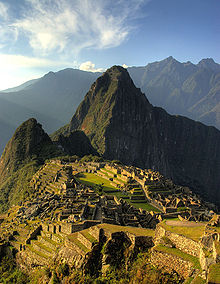
Andean civilization . There are archeological and historical cultures in the Andes.
Archaeological cultures

The pre-Columbian chronology of Peru and the Andean region is currently based on the classification proposed by Edward Lanning . An alternative dating system was proposed by Luis Lumbreras , who otherwise dates some archaeological finds. Most of the cultures of the Late Horizon and some cultures of the Late Intermediate Period were included in the Incan Empire by 1493, but the end of the period dates back to 1534, the date of the collapse of the Inca Empire as a result of the Spanish conquest . Most of the chronological boundaries between periods are associated either with the end of a severe drought, or with the beginning of a new one, the result of which was the transfer of agricultural production to the mountains or its return to the plain, and therefore the change between cultures with different lifestyles.
Historians believe that the first people appeared in Peru around the XV century BC. e. For centuries BC, the land of Peru was inhabited by peoples who created powerful civilizations, built architectural monuments that have survived to this day. It is believed that the first people in Peru were nomadic hunter-gatherers who lived in caves. The most developed cultures in the territory of present-day Peru were: Chavin cultures in the Calejon de Wailas area , flourishing in 800-300 BC. e. Nazca and Paracas in the southern part of the Peruvian coast (c. 200-500 AD); Mochika and Cimu in the north (c. 300-1400 AD), Tiauanaco on the shores of Lake Titicaca (flowering dates back to the 11th century). e. the Inca tribe settled in the Cuzco region. In the 15th century the Incas owned lands from modern southern Colombia to central Chile and created the Tauantinsuyu empire, which means "four interconnected cardinal directions." Interestingly, four roads divided the territory of the empire into four parts.
Norte Chico Culture
Norte Chico Culture or Caral Supe Culture (the second name is more often used in Spanish-language literature) is a pre-Columbian civilization in the Norte Chico region on the north-central coast of Peru . This is the oldest known pre-Columbian state of America, flourishing from the period from XXX to the XVIII century BC. e., in the so-called preceramic (preceramic) period (simultaneously with the rise of the civilizations of Ancient Egypt, Mesopotamia and the Indus Valley). The alternative name comes from the name of the locality Caral in the Soupe valley north of Lima , where a large archaeological monument of this culture was discovered. Caral was first discovered by archaeologist Ruth Shady Solis in in 1997 .
According to the archaeological nomenclature, Norte Chico is a pre-ceramic culture of the late archaic period ; pottery is completely absent; the number of works of art is extremely small. The most impressive achievement of the Norte Chico culture is its monumental architecture, which includes hill-shaped platforms and circular squares. Archaeological data suggest that this culture possessed the fabrication technology. Perhaps there was worship of the symbols of deities, which is also characteristic of other Andean pre-Columbian cultures. It is assumed that the management of the ancient Norte Chico culture required a complex management system, and questions about how it functioned remain unanswered.
Archaeologists have known about the existence of ancient settlements in these places since at least the 1940s. The earliest excavations took place in Aspero on the coast, where the remains of the settlement were discovered in 1905 [1] , and later in Caral, further from the coast. Peruvian archaeologists, led by Ruth Shady Solis, reported on the existence of an ancient civilization in the late 1990s, after excavations in Caral [2] . This culture also includes monumental structures in Bandurria ( Peru , Uacho region).
Chavin culture
Chavin culture , or Chavin culture, is a pre-Columbian civilization that existed on the northern highlands of the Andes in the territory of modern Peru from 900 to 200 BC. e. Chavin culture was located in the Mosna Valley, where the Mosna and Uacheksa rivers merge. The valley is located at an altitude of 3150 [ what? ] above sea level, the Quechua , Hulk and Pune peoples currently live in it.
The most famous archaeological site of Chavin culture are the ruins in Chavin de Ouantar , located high in the Andean mountains north of Lima . It is believed that the city was built around 900 BC. e. and was the religious center of Chavin civilization [3] . Currently, the city is declared a UNESCO World Heritage Site . There are other large monuments of this culture, for example, Kuntur-Washi fortress, Garagay temple with polychrome reliefs and others.
Several new ones appeared on the ruins of Chavin culture, in particular, Vikus and Salinar .
Valdivia Culture
The Valdivian culture is one of the oldest cultures of both Americas, which existed between 3500 - 1800 BC. e. in one of the most arid regions of the Pacific coast of Ecuador in the province of Manabi , from Puerto Cayo to the north of Santa Elena .
Radiocarbon analysis dates the emergence of artifacts of the Valdivia culture from around 3,500 BC. e. It was discovered in 1956 by an Ecuadorian archaeologist Emilio Estrada [4] , who discovered a settlement at the mouth of the Valdivia River (Ecuador).
Its origin is still a mystery. Some experts derive it from tribes from the eastern slopes of the Andes, others from the earlier culture of Las Vegas , which Valdivia resembles in some respects.
Estrada and other scholars suggested that she had contacts with the inhabitants of the islands of modern Japan , since there is a great similarity between the ceramic products of Valdivia and the Jomon ( Kyushu ) period. However, these theories are not widespread, and most archaeologists reject the existence of such a connection. “The idea of trans-Pacific diffusion (through the accidental travel of fishermen from Kyushu Island), elements of the Japanese Neolithic known as Jomon, proposed by B. Meggers, C. Evans, and E. Estrada, was rejected. Moreover, in the late 1970s, scientists abandoned the purely chronological approach to research and (based on an interdisciplinary approach) began to study the production and reproduction of Valdivian society, not only as a group of fishermen and early farmers of the coast, but as a population engaged in the exploitation of diverse flora and fauna of the equatorial coast ” [5] .
There are fundamental differences between the Valdivian culture and other Amazonian cultures, mainly hunter and gatherer groups. Nevertheless, the similarity of clay products allows us to talk about the relationship that existed between them, since Valdivian ceramics with ornaments typical of Machalilla culture were discovered , and, conversely, characteristic Valdivian ornaments on Machalilla clay products. Many innovations, especially in ceramics, quickly spread among neighboring groups.
Nazca Culture
Nazca is a pre-Columbian civilization that existed in several valleys on the southern coast of Peru , on the Nazca plateau, south of the Mochika civilization, from the 2nd century AD . BC e. on the VI century. n e. The main city is Kauachi with six pyramids from adobe . Derived presumably from the Paracas culture.
Ceramics of Nazca culture are polychrome, usually four-color: black and orange drawings on a white or red background. Images of people, animals, birds, fish and plants prevail. The forms are elongated, stylized and angular. Unlike the Mochic civilization, sculpting is virtually absent.
Similar patterns can be seen on fabric samples of llama wool, preserved due to the semi-desert climate of the plateau. The network of underground aqueducts created by them partially survived.
The culture of Nazca is often attributed to the creation of huge geoglyphs - Nazca lines , but there is no consensus among scientists about the time of their creation.
Culture Urine
Mochika , or urine, is a pre-Columbian culture in South America that existed from the 1st century to the 8th century on the coast of Peru . Like the Chimu culture, which was the successor of Mochic, its center was located in the area of the current city of Trujillo , later Pampa Grande . South of the urine lived Nazca culture carriers.
Mochica was inhabited by eleven valleys in the arid coastal zone of northern Peru. As farmers, they built an extensive network of irrigation canals, fertilized the land with guano and cultivated corn and beans . In the irrigated valleys, independent cities were formed with their own rulers and clergy. Mochica left behind the Solar Pyramid ( Huaca del Sol ) and the Moon Pyramid ( Huaca de la Luna ), the largest buildings ever built in ancient South America. Mochik did not yet have his own written language , however, preserved pictographic images allow you to restore a lively picture of their civilization. They spoke the extinct language "Mochika" of the Chimuan family . A dialect of the same language was spoken by representatives of the later Chimu culture.
Mochik had highly developed crafts, one of which was the processing of metals . In addition to gold and silver, they knew how to process copper . They knew how to make various copper alloys , including tompak . They owned the technique of applying gold to copper surfaces. In general, the technology of Mochic culture was comparable to the copper and bronze age in Europe and the Middle East . Ceramics was also a highly developed craft, characterized by products that were especially close to real forms. It is noteworthy that very often there are vessels in the form of erotic figures, many questions are caused by the frequency of the image of heterosexual anal sex .
During excavations, it is confirmed that bloody rituals existed in Mochik. After studying many skeletons, scientists came to the conclusion that they were sacrificed to the gods, apparently in order to ask them about the rains , which are extremely rare in this region. There is also evidence that women held high positions in Mochic culture. For example, on the surviving images of the cups with the blood of the victims, they are served by the ruler. The question of who the victims were is a matter of debate among scientists. According to one version, they were losers in ritual fights among the elite, according to another - prisoners in armed conflicts with neighboring tribes and city-states. There is a theory that the sunset of the Mochic culture was caused precisely by religious bitterness. Mochik put too much effort and resources into their rituals and sacrificed, as a rule, young and productive members of society.
Moon pyramid
Solar pyramid
Temple of the Moon (wall paintings)
Mask of Mochik culture (Larco Museum)
Temple of the Moon (Mural "Cutting off the head")
Tiwanaku Culture
Tiwanaku or Taipikala (sometimes Tiwanaku, Tiwanaku, Tiwanaku, from Aim. Tiwanaku ) is an ancient settlement in Bolivia , 72 km from La Paz near the eastern shore of Lake Titicaca . Based on excavation materials , this settlement dates from 1500 BC. e.
Already in the II-IX centuries, Tiwanaku - the largest city in the Central Andean region - was the center of the state of Pukin . In the language of Pukin, it was called the Typikal , that is, the "center of the world." At this time, the city occupied about 6 km², and had 40 thousand inhabitants. Around 1180, the city was abandoned by the inhabitants, after the defeat of Pukin by the stakes ( aymara ) tribes.
The stone structures of Puma Punku are 1 km from Tiwanaku.
To denote the civilization of the state of Pukin , whose center was the city of Tiwanaku, the same word is used. It is often argued that the language of Tiwanaku civilization is unknown, and its name has not been preserved. However, in ancient times, the city of Tiwanaku was the early capital of this powerful Andean state, and the language of the same name Pukin was spread in it (extinct by now). The modern name Tiwanaku is a distorted central stone in the language of Aymara (stakes).
The state of Pukin during its heyday (700-900 CE) occupied a significant part of the Andean Highlands and spread to the coast of the Pacific Ocean . This territory contains parts of several modern states: the upland west of Bolivia , the south of Peru , the north of Chile and the north-west of Argentina . Tiwanaku's trade and cultural ties extended to most of South America. Residents of Tiwanaku built a grandiose system of irrigation facilities near Lake Titicaca.
Gates of the sun
Gates and stairs of the Kalasasaya Temple
Statue in Tiwanaku
Chachapoya Culture
Chachapoya is a pre-Columbian culture that existed in Peru in about 900-1470 years. e. It was located on a plateau in the territory of the modern department of Amazonas . The Cloud Warriors called themselves.
Residents of this culture have created many monumental stone monuments: Cuellap , Gran Pahaten , Laguna de los Condores , etc., as well as a large number of sarcophagi and mausoleums in hard-to-reach places.
Written sources, such as Cieza de Leon’s report in the Chronicle of Peru , indicate that the Chachapoyans had “lighter” skin than other peoples of the region, although the Spanish word “ blanco ” probably means “clean, tidy,” because the message was about women, and they were compared not with Europeans, but with other Indian women. The origin of the Chachapoyans and their ethnicity are still the subject of debate.
According to the Antisuyo expedition from the Amazon Archaeological Institute, the Chachapoyans were not typical of the Amazonian, but rather Andean cultural traditions .
Anthropomorphic sarcophagi resemble simulated burials with wooden masks of the Middle Horizon, the dominant coastal and highland culture, also known as the Tiwanaku - Uari culture. The “ mausoleums ” may have been modified varieties of tombstones, known as “chulpa” or “pucullo,” characteristic of the cultures of Tiwanaku, Uari and their descendants.
The resettlement of peoples in the Amazonian Andes was apparently caused by a desire to expand the area of agricultural land, as can be seen from the widespread use of terraced farming in the region. Agricultural conditions in the Andes and in the coastal region were associated with general difficulties - huge desert territories and lack of soil suitable for agriculture, so these lands turned out to be insufficient for livelihoods.
According to the Inca Garcilaso de la Vega , the Inca Empire conquered the Chachapoya culture during the reign of Tupac Inca Yupanka in the second half of the 15th century.
Huari Culture
Huari (sometimes called Vari , Spanish: Huari - from “ Quechua wari “ ruins ”) - Native American culture of the pre-Indo period (“ middle horizon ”) that existed in the Central Andes on the southern and central coast of modern Peru in about 500-1000 BC. e.
The best-preserved cultural monuments of Uari are located near the cities of Quinua, Chiclayo, Pikillakta (the latter is located not far from Cuzco “on the way” to Lake Titicaca ). An interesting monument to Huari are the petroglyphs of Toro Muerto .
In December 2008, the well-preserved city of Cerro Patapo was discovered in the northern part of Peru (until that time it was believed that the kingdom of Huari occupied only the southern coastal part). Traces of human sacrifice were found in the city.
The Huari culture, whose name is referred to as Vari in some publications, should not be confused with the Vari people, who have nothing to do with it, and the similarity of names is random.
The capital of the state of Huari, also Huari, was several tens of kilometers from the modern city of Ayacucho in Peru. From the earliest times, the kingdom of Huari included the important cult center of Pachacamac , although it retained some autonomy. Later, Uari swallowed up most of the land of Moche (the former Mochik culture), and later - Chimor ( Chimu culture) and a number of small cultures ( Rekuay and others).
At the head of the power of Uari was the king ( punchau ).
Uari power coexisted with its southern neighbor - the power of Pukin . In time, the rulers of Huari correspond to the kings of the 2nd Pukin dynasty (ruled 367-869 in Tiwanaku ). However, the details of the political relationship between the powers and their dynasties are unknown.
Huari culture played an important role for its time. With the culture of Tiwanaku, Uari shared some similarities in the cultural style. Historians are still arguing about the relationship between the two cultures, and a number of them say that the similarities of styles can be traced back to the earlier Pukar style (Isbell 1991) [ specify ] .
The state of Huari established administrative centers with their own architectural differences in many of their provinces. These centers are significantly different from Tiwanaku architecture (Conklin 1991). Despite the fact that little is known about the administrative system of Uari, and the Uari culture has not left written monuments, it should be assumed that there is a complex social hierarchy and social stratification, on the one hand, and a homogeneous administrative structure throughout the state, on the other.
The well-developed terraced agriculture during the Uari and the road network played an important role in the Inca state , which inherited the territory of the Uari.
Although Quechua has been the dominant language in the territory where the Huari state existed for a long time, comparative historical studies show that Huari was most likely a dialect of Aymara .
Huari culture began to decline in about 800. At the end of the 9th century, the state of Uari fell into small possessions, and many of its cities were abandoned by the inhabitants.
The successor of Huari became the kingdom of Huank .
Historical cultures
Chima
Chimu ( Quechua Chimu ) is a highly developed pre-Columbian culture in South America that existed from about 1250 to 1470 in the north of modern Peru in the region of Trujillo . The ancestor of the Chimu culture is the Mochik culture. In an era of greatest expansion, Chimu's influence spread to the borders of Ecuador in the north and to Lima in the south. The state of Chimu was called Chimor . Up to 60 thousand people lived in the capital Chan-Chan , and the city itself was the largest on the South American continent. The kingdom of Chimu was able to conquer neighboring Sikan culture and a number of other small cultures. In turn, Chimu was conquered by the Incas .
Due to the large population, Chimu were forced to invent new technologies. Using slave labor, they exploited vast ore deposits within their holdings, and also mined gold in rivers. Tin was delivered from Bolivia , with the help of which bronze alloys were produced. In the manufacture of ceramics and gold products, chimu have achieved almost mass production. For the water supply of the population, canals were constructed through which mountain water was delivered to cities. Some of these canals were over 100 km long. Thanks to them, even arid and remote valleys could be used for agriculture and subsistence. Population growth entailed the development of certain orders. A hierarchy arose and individual social classes, including artisans, traders, managers and warriors.
For the production of ceramic objects, Chima developed a special technique. At the end of the ceramic firing, the furnace was hermetically sealed so that oxygen did not enter it. As a result, the iron contained in the clay dough was restored, which gave the surface of the products a deep black color. Unlike the Mochik culture, Chimu did not make drawings and patterns on ceramic dishes. More important than artistic processing was mass production. Alpaca and vicunya wool were used for the production of chimu fabrics . It could be easily painted and processed. Clothing was woven from wool for dignitaries, and carpets and even tents were also made.
Chima masterfully owned jewelry. Probably, at first they adopted some skills from Mochik, but independently developed this craft. They knew the techniques of casting and welding metals and were able to apply thin gilding to their surface. Chim also knew how to create various alloys . However, they forgot their skills over time, after most jewelers were relocated to Cuzco under the pressure of the Incas . Most of the products were smelted by the Spaniards during their conquest of the Inca Empire .
From air shots taken in 1932, a huge Chimu structure, the so-called Mayo Wall , was discovered. Its height was 3 m with a width of 4.5 m. It stretched from the Pacific coast to the slopes of the mountains in the depths of the mainland at a distance of 65 km. 50 fortifications were built into it, in which soldiers guarding the border served. The wall probably limited the first line of Chima expansion.
Ceremonial gold jewelry
Vase depicting a fisherman on a fabulous fish (1100-1400 AD), Museum of America (Madrid)
Chimu shirt from 1400-1540 CE Dumbarton Oaks
Incas
The Ink Empire ( Quechua Tawantin Suyu , Tawantinsuyu , Tauantinsuyu , Tavantinsuyu , Tavantinsuyu ) is the largest Indian class in South America in the area and population in the XI - XVI centuries. It occupied the territory from the current Pasto in Colombia to the Maule River in Chile . The empire included in its entirety the territories of present-day Peru , Bolivia, and Ecuador (with the exception of a part of the lowland eastern regions covered with impenetrable selva ), partly Chile , Argentina, and Colombia . The first European to enter the Inca Empire was Portuguese Aleju Garcia in 1525 . In 1533, the Spanish conquistadors established control over most of the empire, and in 1572 the Inca state ceased to exist. There is a hypothesis that the last independent refuge of the Incas is the unknown city (country) of Paititi (until the middle or end of the XVIII century ).
Archaeological studies show that a large number of achievements were inherited by the Incas from previous civilizations, as well as from neighboring peoples subordinate to them. By the time the Incas appeared in the historical arena in South America, there were a number of civilizations: Moche ( Mochik culture, known for its color ceramics and irrigation systems), Uari (this state was a prototype of the Inca Empire, although the population apparently spoke a different language - Aymara ) , Chimu (the center is the city of Chan Chan , characteristic ceramics and architecture), Nazca (known for creating the so-called Nazca lines , as well as their underground water supply systems, ceramics), Pukina (civilization of the city of Tiahuanaco with a population of about 40 thousand a person located east of Lake Titicaca ), Chachapoyas (“The Warriors of the Clouds”, known for their formidable fortress Kuelap , which is also called “ Machu Picchu of the North”).
Chibcha
Chibcha ( Spanish: Chibcha ), Muisk or Musk - one of the highly developed civilizations of South America in the XII - XVI centuries. Among the cultures of ancient America, Chibcha are on a par with Maya , the Aztecs , Zapotecs and Incas . The Chibchas themselves called themselves Muiski, that is, "people."
Chibcha occupied a significant part of what is now Colombia . The center of their lands was the high plateau of the Eastern Cordilleras and the valleys of the Tuna and Sogamoso rivers located north of Bogota . In addition, the Chibcha was also occupied by the valleys southern from Bogotá and the eastern slopes of the Cordillera to the Llanos of the Meta River, a tributary of Orinoco . By the time of the arrival of the Europeans, the Chibcha territories were more than 25 thousand square kilometers, and the population totaled about a million people.
See also
- Фелипе Гуаман Пома де Айяла
- История Перу
- Макс Уле — «отец южноамериканской археологии» и «основоположник археологии Анд »
- Индейская демографическая катастрофа
- Кипу — верёвочная письменность
- Туми (нож)
- Коги (народ)
- Кечуа (народ)
Notes
- ↑ Moseley, Michael E.; Gordon R. Willey. Aspero, Peru: A Reexamination of the Site and Its Implications (англ.) // American Antiquity : journal. — 1973. — Vol. 38 , no. 4 . — P. 452—468 . — DOI : 10.2307/279151 .
- ↑ Shady Solís, Ruth Martha. La ciudad sagrada de Caral-Supe en los albores de la civilización en el Perú . — Lima : UNMSM, Fondo Editorial, 1997.
- ↑ Burger, Richard L. Chavin de Huantar and its Sphere of Influence // Handbook of South American Archeology / H. Silverman, W. Isbell. — NY, 2008. — С. 681—706 .
- ↑ Abstracts of New World Archaeology, Society for American Archaeology. University of Utah Press, 1959. Стр. 110.
- ↑ Башилов В. А., Проблемы археологии и древней истории стран Латинской Америки.
Ссылки
- Культурологическое общество Перу . Discover Peru .
- Peruvian National Museum of Archaeology, Anthropology, and History (недоступная ссылка) . Архивировано 12 марта 2005 года.