The Battle of Lagos is a historic naval battle between the French and Anglo - Dutch naval forces. It happened on June 17 (27), 1693 near the Portuguese city of Lagos . The French fleet, under the command of Anna Illarion de Tourville, defeated the combined squadron of England and the Netherlands under the command of George Rook .
| Battle of Lagos | |||
|---|---|---|---|
| Main Conflict: Augsburg League War | |||
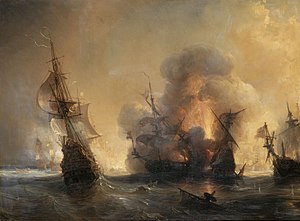 Theodor Guden , Battle of Lagos | |||
| date | June 17 (27), 1693 | ||
| A place | Lagos , Portugal | ||
| Total | victory of the french fleet | ||
| Opponents | |||
| |||
| Commanders | |||
| |||
| Forces of the parties | |||
| |||
| Losses | |||
| |||


Background
In the spring of 1693 a large convoy was formed to escort the British and Dutch merchant ships to Spain and the Mediterranean . Protection was required to prevent attacks by the French fleet and pirates.
The convoy, which included up to 200 merchant ships, was escorted by 8 English and 5 Dutch battleships and several auxiliary ships under the command of Admiral George Ruka. The squadron had a Mediterranean destination. To the port of Brest, the convoy additionally covered allied fleets from French attacks, whose main task was to protect the English Channel and prevent the invasion of England.
However, the French, taking into account the failures of the previous year, switched to raider tactics, attacking the enemy’s poorly protected merchant ships [1] . To this end, Louis XIV sent a French fleet under the command of Turville to ambush a convoy before his arrival in the Strait of Gibraltar . By the end of May, Tourville assembled a squadron of 70 military and nearly 30 auxiliary ships and was located near the Portuguese city of Lagos.
The convoy set off at the end of May and by June 7 (old style) 150 miles south-west of Wessan dispersed with the allied fleet accompanying it. Further, the squadron Ruka with merchant ships went south on their own. The allies made no attempt to find out the whereabouts of the French fleet and had no information about it until June 17 (old style). By this time, the French had already discovered Ruka squadron.
Battle
The hand could not avoid the fight, but had the advantage in the wind. Having ordered the merchant ships to disperse, he built a squadron in battle formation. The battle began at about 8 p.m. when the vanguard of the French entered the rear of Ruka squadron. Two Dutch ships, Zeeland (64 cannons, captain Philip Schraiver) and Wapen van Medemblik (64 cannons, Jan van der Pul) suicidally attacked the French. This gave the rest of the Allied ships time to retreat. When the Dutch finally surrendered, Tourville was extremely impressed with their courage and asked the captains whether they were humans or devils. Rook praised the action as one of the best decisions made in battle [2] .
The next day Rook and 54 merchant ships moved west. Only four French ships tried to chase him. As they approached, Rook deployed his Royal Oak flagship (100 guns), and after a short shootout, the French chose to turn back. Squadron Ruca was able to get to Madeira without incident. Here he discovered Monk (60 cannons), one of the Dutch ships and about 50 merchant ships. Together with them, picking up the stragglers along the way, the Hand squadron reached Ireland on July 30.
Consequences
It was possible to save more than half of the convoy. About 90 merchant ships, mostly Dutch, were lost, of which 40 went to the French. Both goals of the convoy: to deliver merchants to the Mediterranean and ensure a military presence in the region - were not achieved. The French received rich production in the amount of approximately 30 million livres . The City of London rated financial losses as the largest since the Great Fire of London , which occurred 27 years before [3] .
For Tourville, victory became revenge for the defeat at the Battle of Barfleur a year earlier.
Notes
- ↑ Mahan AT The Influence of Sea-Power upon History 1660-1805. - ISBN 0-600-34162-3 .
- ↑ The Command of The Ocean. - 2004. - ISBN 0-7139-9411-8 .
- ↑ Aubrey P. The Defeat of James Stuart's Armada 1692. - 1979. - ISBN 0-7185-1168-9 .