Tibetan go is a historical variation of the go game, currently preserved only in the Indian state of Sikkim and in Tibet .
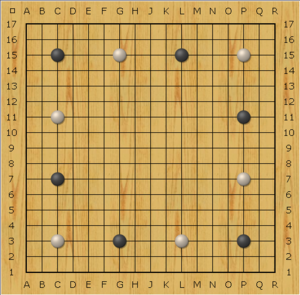
Content
Features
The rules of Tibetan go differ from the rules of modern go by the following features:
- The game board has a size of 17x17 lines.
- Hoshi points (star) are not marked on the board.
- The game does not start from an empty board, before the first move, 12 stones are put on the board - 6 black and 6 white. Stones are displayed on the third line, through three points, alternating black and white.
- White makes the first move.
- Moves are allowed no further than one point from a stone of its own color already standing on the board.
- The player who first puts the stone at the center of the board receives an additional 5 points when counting.
- If the opponent captures the corner of the board in which the player’s stone stands (by creating a live group there or capturing the corner stone), then the player will deduct 20 points when counting.
- Strengthened rule ko - it is forbidden to go to points from which stones were removed on the previous move.
- Scoring - according to Chinese rules: each empty point of its territory and each of its own stones put on the board, bring one point.
History
The proximity of the rules of Tibetan go to the rules of modern go is obvious. In this game there are also features related to it with the famous go rules that were canceled in antiquity. For example, in China for a long time there was a rule according to which several stones of both colors were put on the board before the first move. The oldest of go boards known to archaeologists has a size of 17x17, not 19x19 lines, as now, however, other boards of this size are unknown in China, and party records on such boards have not been preserved. All this led researchers to assume that Tibetan go is an old version of go that in ancient times came to Tibet, took root there and, due to the separation of the region from China, did not undergo changes made to the game later.
See also
- History of go