The M1917 Enfield is an American store rifle, also known under the formal designation United States Rifle, cal .30, Model of 1917 in the USA or P17 in Canada. It was essentially a processing of the British rifle Pattern 1914 Enfield under the American unitary ammunition 7.62 × 63 mm . It was developed in 1917, took part in all major wars of the XX century until the Vietnam War .
| Rifle M1917 Enfield | |
|---|---|
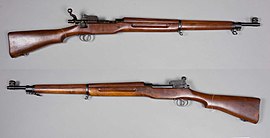 M1917 Enfield rifle from the collection of the Stockholm Museum, Sweden | |
| Type of | rifle |
| A country |  UK , UK ,  USA USA |
| Service History | |
| Adopted | |
| In service | USA |
| Wars and conflicts | World War I Banana wars The Second World War War in korea War in vietnam |
| Production history | |
| Designed by | 1917 - present |
| Manufacturer | Winchester Repeating Arms Company , Remington Arms , Baldwin Locomotive Works |
| Total released | 2 193 429 |
| Specifications | |
| Weight kg | 4.17 5.02 (with bayonet and belt) |
| Length mm | 1175 |
| Barrel length mm | 660 |
| Cartridge | 7.62 × 63 mm |
| Work principles | sliding bolt |
| Sighting range , m | 549 |
| Maximum range, m | 5,029 |
| Type of ammunition | 6 round magazine |
| Aim | open |
Due to the ability to fire at low temperatures, it was used in the Sirius ski patrol , a Danish navy unit dedicated to maintaining Danish sovereignty in Greenland.
Content
Design
Like the 1903 Springfield, the M1917 actually used the basic Mauser Gewehr 98 shutter design in combination with several modifications. Due to the original action of the P13, designed for the powerful .276 Enfield cartridge with a larger diameter housing than for the .30-06 Springfield, the magazine capacity for the smaller .30-06 Springfield was six rounds, although the puller retainers held only five rounds.
Rifles P14 and M1917 differ in several design features. The rifle was designed with an iron sighting line consisting of a rear sight aperture combat sight calibrated to 400 yards (366 m), with an optional ladder aperture sight that could be turned over and calibrated for 200-900 yards (183-823 m) in C in increments of 100 yards (91 m) and in increments of 900–1600 yards (823–1,463 m) in increments of 50 yards (46 m). The sight with a stairway moves vertically on a glass slide and, therefore, cannot correct the wind displacement. The rear sight element was protected by strong “ears” and turned out to be faster and more accurate than the typical middle barrel sight offered by Mauser, Anfield or Buffington’s 1903 Springfield sight. Future American rifles, such as the 1903-A3 Springfield, M1 and M1 Carbine, will use similar rear sights. The front sighting element consisted of a protected front wing post and was adjusted laterally and locked in position during assembly in the arsenal. The M1917 rear sight element was located on an elongated receiving bridge, which added weight to the action and also lengthened the bolt. The M1917 weighs 58 ounces (1,644 g) versus 45 ounces (1,276 g) for 1903 Springfield.
Especially for the rifle, a detachable bayonet-knife M1917 was produced.
Performance Specifications
Operator countries
- Australia
- Republic of China - 152,241 M1917 delivered from the United States under Lend-Lease in 1942-1945 [1]
- Great Britain - in 1941–1945, 119,000 M1917 were delivered from the USA under Lend-Lease [1]
- United States : Used during World War I , World War II , Korean War .
- Canada
- Denmark : Since 1953, the Home Guard is currently in service with the Slædepatruljen Sirius in Greenland.
- France : Fusil à répétition 7 mm 62 (C. 30) M. 17 (Model 770 mm (0.30 caliber).
- Honduras : Version of the Remington Model 1934 , chambered for 7 × 57 mm.
- Ireland : About 20,000 units used by local defense forces during an emergency (World War II).
- Latvia : Used in the Struggle for Independence of Latvia .
- Malaysia
- New Zealand
- Norway : In 1952, Norway received 24,992 P-17 rifles from the UK.
- Philippines
- Portugal
- South Korea : used during the Korean War.
- South Vietnam : used during the Vietnam War