The yellowish hare ( lat. Lepus flavigularis ) is a species of the genus Lepus from the order rabbit - like . One of the possible names is the Teuantepepe hare, according to the name of the bay, on the banks of which a single population lives.
| Yellow hare |
| Scientific classification |
|---|
| No rank : | Bilateral symmetrical |
| Squadron : | Euarchontoglires |
|
| International scientific name |
|---|
Lepus flavigularis Wagner , 1844 |
| Area |
|---|

|
| Security status |
|---|
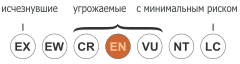
Endangered speciesIUCN 3.1 Endangered : 11790 |
|
Content
Range: Mexico , Oaxaca on the shores of the Teuantepec Bay . It lives at an altitude of no more than 500 m. Currently, this hare inhabits meadows with open shrubs and coastal grass dunes.
Leads a twilight and nightlife. Eats herbs and other green plants.
The length of the breeding season can last from February to December, with a peak in reproduction during the rainy season (from May to October). In the brood an average of 2 cubs. Both sexes reach puberty six to seven months after birth.
The total length is 59.5 cm. Adults weigh between 3,500 and 4,000 grams. Has large ears and legs. It is easy to distinguish it from other types of hares thanks to two black stripes running from the base of the ears to the back of the head, and along its white sides. The belly is white, the back is light brown with black streaky, the sacrum is gray, the tail is black on top.