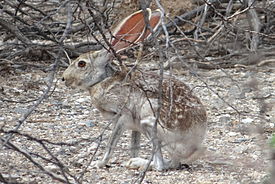
Antelope hare ( lat. Lepus alleni ) - one of the North American species of the genus Lepus , hares. The Latin name is given in honor of Joel Asaph Allen (Joel Asaph Allen), curator of the department of mammals and birds in the American Museum of Natural History in New York [1] .
| Antelope hare |
 |
| Scientific classification |
|---|
| No rank : | Bilateral symmetrical |
| Squadron : | Euarchontoglires |
|
| International scientific name |
|---|
Lepus alleni Mearns , 1890 |
| Area |
|---|

|
| Security status |
|---|
Least ConcernedIUCN 3.1 Least Concern : 41272 |
|
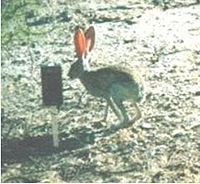
Blood vessels saturated with antelope hare auricles shine through in the sun
Content
The range of antelope hare covers the state of Arizona in the USA and the states of Chihuahua , Nayarit , Sinaloa and Sonora in Mexico [2] .
Antelope hare inhabits various habitats. It can be found in grassy biotopes both in hilly terrain and in the plains. They also live in deserts in the southwest. These hares are not uncommon in the suburbs, where they are very well adapted to the anthropogenic disturbances of their habitats.
The body length varies from 45 to 60 cm. The tail is from 3 to 10 cm in length. The length of the forelimbs is 10 to 20 cm, while the hind limbs are 20 to 30 cm in length. The ears of an antelope rabbit are up to 20.3 cm. They use the auricles not only for hearing, but also for lowering and regulating body temperature at high temperatures in the environment in which they exist. Antelope hares are more active in the evening, when the hot surface of the earth begins to cool.
Two subspecies of this hare are described:
- Lepus alleni alleni
- Lepus alleni tiburonensis
- A horned hare or rabbit, sometimes a jacalop, is a fictional cross between an antelope and a hare.
- ↑ Best TL, Henry TH, Lepus alleni // Mammalian species. No 424, The American Society of Mammologists, 1993. p. 1-8. (unopened) (inaccessible link) . Date of treatment September 16, 2014. Archived on September 16, 2014.
- ↑ Mexican Association for Conservation and Study of Lagomorphs (AMCELA), Romero Malpica, FJ & Rangel Cordero, H. (2008). "Lepus alleni." IUCN Red List of Threatened Species. Version 2009.2. International Union for Conservation of Nature. Retrieved February 1, 2010.