Jackson Crater ( lat. Jackson ) - a large young impact crater in the northern hemisphere of the far side of the moon . The name was given in honor of the English astronomer John Jackson (1887-1958) and approved by the International Astronomical Union in 1970. The formation of the crater dates back to the Copernican period [1] .
| Jackson | |
|---|---|
| lat Jackson | |
 Shot of the Lunar Reconnaissance Orbiter probe. | |
| Specifications | |
| Diameter | 71.4 km |
| Deepest | 2761 m |
| Title | |
| Eponym | John Jackson (1887-1958) is an English astronomer. |
| Location | |
| Heavenly body | Moon |


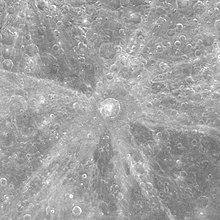
Crater Description
The immediate neighbors of the crater are the Marzi Crater in the west; Miner crater in the northeast; Bredikhin crater in the southeast; as well as the Mac Mas crater in the south-south-west [2] . Selenographic coordinates of the center of the crater , diameter 71.38 km [3] , depth 2.76 km [4] .
The crater has a polygonal shape, almost not affected by destruction. Crater shaft with a sharp edge and a terraced wide internal slope. The southeastern part of the rampart is somewhat rounded. The shaft height above the surrounding area reaches 1290 m [4] , the volume of the crater is approximately 4500 km³ [4] .
The bottom of the bowl is crossed, the northern part is hilly, there is a system of several massive central peaks. The composition of the central peaks is gabbro - norito - troctolite anorthosite with plagioclase content of 85-90% (GNTA1) and 80-85% (GNTA2), as well as anorthosite gabbro-norite (AGN) [5] . In the crater bowl there are areas with high albedo , the bottom of the bowl is covered with a cooled melt of rocks. The crater is surrounded by rocks with a high albedo ejected during its formation; a ring of darker rocks is adjacent directly to the external slope of the shaft.
The crater is impacted at a low angle from the northwest and is the center of a bright asymmetric ray system. The most intense rays lie within sectors with an angle of approximately 90 degrees in the north-east and south-west direction and extend hundreds of kilometers from the crater. A narrow sector of rays emanates in a southeast direction.
The bottom of the crater bowl is an excellent example of the diversity of structures that can occur when solidifying molten rocks after impact. The kinetic energy of a bolide ( an asteroid or comet ) transferred to the surface of the Moon and converted into thermal energy leads to almost instantaneous melting of the rocks. Most of the melt accumulates in the crater, part is ejected beyond its limits, part falls back into the crater cooling down along the road with the formation of spectacular cascades. During the formation of the crater, sections of rock from the inner slope collapse into the melt, which has not yet solidified, leading to ripples and waves. As the melt solidifies, the rocks compress and crack.
Satellite Craters
| Jackson [3] | Coordinates | Diameter, km |
|---|---|---|
| Q | 13,2 | |
| X | 16.8 |
See also
- List of Craters on the Moon
- Lunar crater
- Morphological catalog of Moon Craters
- Planetary nomenclature
- Selenography
- Mineralogy of the Moon
- Geology of the moon
- Late heavy bombardment
Notes
- ↑ Crater description on The Moon-Wiki
- ↑ Jackson Crater on LAC-51
- ↑ 1 2 Handbook of the International Astronomical Union
- ↑ 1 2 3 Lunar Impact Crater Database . Losiak A., Kohout T., O'Sulllivan K., Thaisen K., Weider S. (Lunar and Planetary Institute, Lunar Exploration Intern Program, 2009); updated by Öhman T. in 2011. Archived page .
- ↑ Stefanie Tompkins and Carle M. Pieters (1999) Mineralogy of the lunar crust: Results from Clementine Meteoritics & Planetary Science, vol. 34, pp. 25-41.