The E231 500 is a series of suburban direct current trains E231 kei densha (e.g. E231 系 電車 E231 kei denxia ) used by East Japan Railway Company in urban and suburban traffic.
| E231 | |
|---|---|
| E231-500 | |
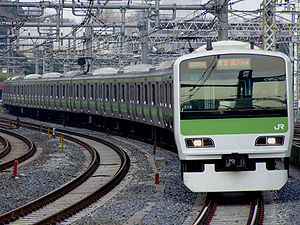 E231,500 on the Yamanote Line | |
| Production | |
| Years of construction | 2000, 2002, 2004, 2008, 2010 |
| Country of construction |  Japan Japan |
| Manufacturer | JR East Niitsu ; Kawasaki heavy industries |
| Compositions built | |
| Wagons built | 2632 |
| Technical details | |
| Type of current and voltage in the contact network | constant , 1500 V |
| The number of cars in the composition | 10 wagons (4M6T6M4T) 5 wagons (2M3T) 11 wagons (6M5T) |
| Passenger capacity | 156 - 162 people (Intermediate carriage) 137 - 143 people (Head carriage) |
| Car length | 20,000 mm [1] |
| Width | 2950 mm [1] |
| Height | 3980 mm [1] |
| Track width | 1067 mm |
| Wagon material | Stainless steel |
| Gear ratio | 7.07 |
| Construction speed | 120 km / h |
| Maximum service speed | 120 km / h [1] |
| Acceleration | 0.69 m / s² |
| Braking | 1.17 m / s² (official) 1.25 m / s² (emergency) |
| Traction system | IGBT variable frequency drive |
| Brake system | regenerative rheostatic inhibition |
| Security systems | ATS-SN (Tokaido, Utsunomiya, Takasaki, Joban), ATC-10 (Tozai), |
| Exploitation | |
| Countries of operation | Japan |
| Operator | JR Japan |
| Serviced Lines | Yamanote , Utsunomiya , Jooban , Narita , Tokaido , Ito , Takasaki , Joetsu , Ryomo , Yokosuka and Shonan - Shinjuku |
| In operation | Since 2002 |
Content
Overview
E231 is designed as a replacement for the 115 and 113 series , used as city metro trains and the 103 , 201 , 205 and 301 series, used as suburban trains of the Moscow Region routes, due to obsolete rolling stock and increased passenger traffic. The E231 series replaced the rolling stock on the Sobu line ( Chuo-Sobu Line ) and the Tohoku line ( Utsunomiya line ) in 2000, later, in June 2002, the 500 type E231 electric train and the E231 type 0 electric train for the Tozai Metro line were launched , which in May 2003 was included in the rolling stock of the line in the amount of 800 units. Type 500 of the E231 series from 2002 to 2003 was fully implemented on the Yamanote ring line. Later, the E231 500 replaced the obsolete rolling stock on the Utsunomiya, Jooban, Narita, Tokaido, Ito, Takasaki, Joetsu, Ryomo, Yokosuka and Shonan - Shinjuku lines.
The E231 500 series used technologies developed back in the 1990s to reduce production costs, as well as energy consumption and maintenance costs. This technology included a set of innovative developments adopted as a single standard for the production and maintenance of commuter trains. As the development goal of this series, a reduction in the cost of the operational period and improving the quality of services were adopted. This vehicle was developed jointly with Tokyu Car Corporation and JR East, the production of electric trains of this series was carried out at the factories of Tokyu Car Corporation, JR East Niitsu and Kawasaki Heavy Industries. The development of the design was done by Ekuan Kenji.
Subsequently, due to the reduction in the interval of movement in all directions of JR in 2010, the total production volume reached 2632 units; in 2011, in addition to 2632 units, 104 units of six-door (6 doors on each side) wagons were produced for the Yamanote line .
Features
Configuration
The brake system combines regenerative braking power with an electro-pneumatic brake, which in addition to regenerative braking is available for emergency stop.
Single lever current collector PS33B
Compressor box installed under the wagon
Box TIMS
Behind the TIMS terminal, a low-noise electric compressor type 209 (CP) is installed, which supplies air to the brakes and other pneumatic equipment. In this series, it was supposed to place exclusively electric control, and for pneumatic systems the use of a separate compressor, however, no decision was made.
In the cars of the E231 series, a drive trolley is installed on two axles in the amount of two pieces per car. In the E231 series, the DT61 trolley is used, which is similar in design to the type 209 trolley (Japanese standard). The DT61 type TR255 system trolleys for trailed wagons and the head wagon, and the TR246 type for a motor car, are installed on the cars. In subsequent years, for the wagons of the E231 and E233 series, the 4600 Bandai TR255A trolley was adopted for both motor and trailed wagons.
Trolley carriage DT61
photo type DT61GTrailer carriage type TR246
photo before the introduction of the TR246M trolleyYaw Damper on the TR246T on the Green Car Modification
TR255A Series 4600 Wagons SaHa E231
Parking brake cylinder that attaches to the TR246M (highlighted in red)
In this series, the control method (TIMS) of the equipment is very different, unlike the earlier types. The only exception is the emergency brake, which has not changed in the entire history of the E231 series, and was borrowed from earlier types of trains such as E230 , E194 , etc. For control and monitoring of all modules (including TIMS, ATS-P and GS) command transmission of all control systems uses digital communication systems RS-485 and EIA-485, the data transfer rate of which is 2.5 Mbps. These systems are designed to integrate and control all the traction drive modules of the train. RS-485 and EIA-485 also allow you to monitor the performance of control systems as a whole, and each indicator separately, this simplifies the control system and control of the electric train, as well as reduces production costs.
The AU726 air conditioning system, with a potential of 48.84 kW (42000 kcal / h), which is one of the innovations (including control of heaters and internal ventilation), has full automation. Also, this system is responsible for climate control in the cabin of the car, automatically determining the level of humidity and temperature both in the car and outside the car.
Body equipment
This series can be divided into two types of cars with differences in equipment and body shape. The basic design is designed to reduce the cost of mass production of cars of this series. The body structure corresponds to the types of commuter trains 209 and 500 of the E217 series, the body width of which is 2950 mm. The lightweight body frame and side walls are made of stainless steel, the exterior of the body is covered with a fiberglass shell. The cabin mask is also made of fiberglass. Floor height - 1165 mm from the level of the rail head.
Body Features
| Wagon base | 13800 mm |
| The number of doorways on one side | 4 things |
| Bending stiffness equivalent | 5.8 × 10 14 (N ・ mm 2 ) |
| Torsional rigidity equivalent | 176.9 × 10 12 (N ・ m 2 / rad) |
| Natural frequency | 12.7 Hz (bend) |
| Main material | SUS301L, SUS304 |
| Weight | motor - 5.1 t, trailed - 4.8 t |
Differences of each manufacturer
Different manufacturers had differences in the design of E231 cars. These differences are due to the fact that in many ways small parts were manufactured according to the standards of the particular enterprise on which the car was built.
Photo 1. Tokyu, Niitsu Seisakusho
Photo 2. Kawasaki Heavy Industries Ltd
Photo 3. Door Tokyu Car, Niitsu Seisakusho
Photo 4. Kawasaki Heavy Industries Ltd door
- Tokyu has no corrugations, Niitsu has vertical corrugations on the end walls, and Tateametoi have horizontal corrugations.
- Tokyu and Niitsu have a step at the junction of the roof surface and the butt (photo 1). Kawasaki Heavy Industries Ltd has a reinforcing corrugation. In addition, it became a flat connection of the surfaces of the end and the roof (see photo 2).
- Above the door there is an LED information board displaying the names of stations in kanji, katakana and romaji. On some modifications, a liquid crystal color display is installed to display various information (schedule changes, warnings, advertising).
- A track cleaner (sweeper) is installed on the front end of the head carriage in all modifications of the E231 500. The standard view of the tracker for the E231 500 was V-shaped, however, the manufacturer Niitsu has a modified skirt shape, but also a V-shape.
Salon
The trim is white plastic and glossy stainless steel. The seats are upholstered in blue fabric and gray PVC linoleum on the floor. The seats are parallel to the interior wall. Since 2003, soft seats have been introduced to improve comfort. Each group of seats is located between the doorways on both sides of the side. In addition, there is space for wheelchairs in each carriage. In the head and six-door cars, the seats are folded, which allows to increase capacity during peak hours.
Car Salon
Pram seats
7-seat
Transition to another car
Scoreboard with the name of the station
Cabin
The driver's cab in all versions of the E231 500 has the same configuration, similar to the 209 series . The control panel is located on the left, the main controller is arranged on the basis of "one-handle control" and is installed directly on the dashboard, service braking control is automated and integrated into the controller. For manual braking in normal mode, there is a separate handle, which is located to the right of the controller handle on the dashboard, for emergency braking there is a red mushroom button and an item in the on-board computer menu. In the center of the panel there is a liquid crystal display of the on-board computer for controlling the TIMS system (power, pneumatics, travel, cooling systems and interior). There are also security systems that can be controlled through the on-board computer. In the event of a violation or malfunction, depending on the situation, the on-board computer may apply regular or emergency braking. To improve the visibility of the readings, an analog speedometer, manometer and voltmeter are installed. The door leading from the cabin to the cabin is sliding and is located in the center.
Cabin view, dashboard
Sources
- ↑ 1 2 3 4 JR 全 車 輌 ハ ン ド ブ ッ ク 2009. - Japan: Neko Publishing. - ISBN 978-4-7770-0836-0 .
Links
- JR E231 series (Japanese)