Nikolai Bologov ( May 25 [ June 7 ] 1894 , Nizhnedevitsk , Voronezh Province - April 22, 1969 , Moscow ) - Soviet naval leader, Rear Admiral [1] ( 1940 ).
| Nikolai Aleksandrovich Bologov | ||||||||||||
|---|---|---|---|---|---|---|---|---|---|---|---|---|
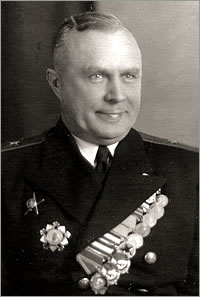 Rear Admiral N. A. Bologov | ||||||||||||
| Date of Birth | May 25 ( June 7 ) 1894 | |||||||||||
| Place of Birth | Nizhnedevitsk , Voronezh Province , Russian Empire | |||||||||||
| Date of death | April 22, 1969 (74 years) | |||||||||||
| Place of death | Moscow , USSR | |||||||||||
| Affiliation |  Russia Russia RSFSR RSFSR the USSR the USSR | |||||||||||
| Type of army | RIF , RKKF | |||||||||||
| Years of service | 1909 - 1948 | |||||||||||
| Rank |  rear admiral | |||||||||||
| Battles / Wars | World War I Civil War The Great Patriotic War | |||||||||||
| Awards and prizes |
| |||||||||||
| Retired | from September 1, 1948 dismissed due to illness | |||||||||||


Content
Biography
Born in a noble family. His father, Alexander Vasilyevich, in 1904 assigned his son to the Voronezh Cadet Corps for public bills. Five years later, Nikolai entered the Marine Corps , after which in 1914 he was sent to the Black Sea Fleet by ship's midshipman of the battleship " John Chrysostom ." Soon he was transferred to the Baltic Fleet , to the auxiliary cruiser Mitava , then in April 1915 he was appointed flag officer of the 2nd cruiser brigade. On the cruiser " Thunderbolt " he participated in a battle with German ships at the Ute lighthouse. In 1916 he entered the Mine class in Kronstadt , graduated from it and was determined by a senior mine expert on the destroyer Konstantin , being completed in Revel . He participated in the famous Moonsund sea battle , in the battle of Kassar was contused .
In February 1918 he voluntarily joined the Workers 'and Peasants' Red Fleet, remaining a senior mine expert on the Konstantin destroyer destroyer. In June 1918, due to health reasons (a concussion to the head during a naval battle), he was discharged into the reserve. In Voronezh, he joined the “Health Insurance Fund” social security secretary. When registering at the military office in the column, political affiliation indicated - "an independent socialist on the platform of Soviet power." In August 1918, he was summoned by a telegram of the Council of Commissioners of the Baltic Fleet and was appointed senior flag secretary of a mine division with the involvement of commissioners as a military specialist. In March 1919 he was appointed assistant commander of the destroyer " Captain Izylmetyev ". Member of the RCP (b) since May 1919.
Participated in the Civil War . At the end of August 1919 he was appointed commander of the destroyer Vynoslivy , and from May 1, 1920 to March 1921 he was commander of the destroyer Samson . March 20, 1921 was appointed commander of the battleship " Paris Commune ". In May 1922 he was appointed head and commissioner of the Training detachment of the Baltic Sea naval forces. Flag held on the battleship " Paris Commune " and the training ship " Komsomolets ". In March 1924 he was appointed head and commissioner of the only Naval School in the country (from January 1926 VMU. MV Frunze ) with a three-year training period for training combat commanders - watch supervisors of surface ships. In 1924 he was appointed commander and commissar of the Special Practical Detachment, who made the first foreign voyage after the events of 1917. The detachment consisted of two ships - " Aurora " and " Komsomolets ". His flag N. A. Bologov kept on the legendary cruiser "Aurora". In Bergen , Aurora was visited by Alexandra Mikhailovna Kollontai . The order on the fleet and the Navy Department was thanked for the successful completion of the overseas voyage. In 1928 he was awarded a Browning from the Central Committee of the Komsomol with the inscription: "The active builder of the Red Navy" [2] .
In 1929 he was sent on courses to improve the commanding staff, and then sent in December of the same year as a naval attache to Japan , where he worked at the USSR Plenipotentiary in Tokyo until 1932. He met with Richard Sorge . He worked as head of the personnel department of the USSR Naval Forces. Since October 1934 - Adjunct Naval Academy. KE Voroshilov . At the end of the adjuncture he taught at the academy. In 1936-1941 he headed the department of the history of naval art academy. At the same time he was deputy editor of the magazine “ Sea collection ”. He wrote a number of scientific works for which officers of the fleet were trained, who successfully applied their knowledge in the theater of operations during the Great Patriotic War. In the "World Imperialist War" gave a deep analysis of the First World War, revealing its causes and geopolitical situation in the world, the fighting of the countries participating in the war on land and at sea.
By order of the command, he was transferred from besieged Leningrad to Kuibyshev by the senior naval commander and at the same time headed the Historical Department of the Main Naval Staff of the Navy; in 1943 transferred to Moscow. At first he lived in the hotel TsDKA , then he was given a two-room apartment in the famous General's house number 33 in Starokonyushnom Lane on Arbat . At headquarters he was involved in writing correspondence on naval issues of JV Stalin with US presidents F. Roosevelt , G. Truman and British Prime Ministers William Churchill and K. Attlee during the Great Patriotic War. In October 1944 he was appointed representative of the People's Commissariat of the Navy under the representative of the Council of People's Commissars of the USSR for Affairs of the Control Commission in Romania and Finland . During this work, they were offered a plan for organizing and setting up a naval base on the Porkkala-Udd peninsula in Finland. This was of great geopolitical importance for the country after the Great Patriotic War. Working in Bucharest , cash received in foreign currency. When his adjutant offered to buy furniture in Romania, recalling that the Moscow apartment was almost empty, Nikolai Alexandrovich replied: "Half of the country was destroyed by the war, people live in dugouts, and I have no moral right to deal with these issues." I transferred all the money to the Homeland Defense Fund.
In 1945, he took part in a group of naval experts and advisers, delegations of the USSR in the work of the Crimean (Yalta) and Berlin (Potsdam) conferences of the heads of government of the USSR, the USA and Great Britain .
In 1946 the People's Commissariat of the Navy was abolished, transferred to the Military-Political Academy. V.I. Lenin Head of the Military History Department. The hard work, business trips to the front , sleepless nights during the Great Patriotic War greatly undermined the health of N. A. Bologov. On September 1, 1948, he was dismissed due to illness. Died in 1969, buried in the Vagankovo cemetery .
Ranks
- Midshipman ( 1909 );
- Midshipman ( June 1914 );
- Lieutenant ( December 6, 1916 );
- Captain 1st Rank ( December 2, 1935 ); [3]
- flagship 2nd rank ( March 13, 1938 );
- Rear Admiral ( June 4, 1940 ). [four]
Awards
He sailed on the cruiser " Stormbroi ", participated in the battle with the Germans at the lighthouse "Ute". 3a this sea battle was awarded the Order of St. Stanislav of the 3rd degree with swords and bow. For services to the Motherland he was awarded the Orders of Lenin, the Red Banner (twice), Nakhimov II degree, the Red Star (twice), medals "For the Defense of Leningrad", "For the Victory over Germany in the Great Patriotic War of 1941-1945", "For victory over Japan and others.
Family
In the battle for the Motherland on February 20, 1944, under Kingisepp , his eldest son, Lieutenant Nikolai Nikolaevich Bologov, born in 1923, also a member of the defense of Leningrad , was killed. Nikolai Alexandrovich with respect and love treated his wife Ekaterina Konstantinovna, who shared with him all the difficulties and hardships during 47 years of marriage together.
Literature
- Biryukov A. M. The life pages of Rear Admiral N. A. Bologov // Questions of history. - 2005. - № 5. - p. 153-157. - Bibliogr. in the notes. - ISSN 0042-8779 [5]
- Akinsh A. , Lasunsky O. Voronezh nobility in faces and destinies. - Voronezh, 1994. - p. 166.
- Greig O. Stalin could hit first. - Algorithm: Eksmo, 2010. - Series: Historical sensations. - ISBN 978-5-699-41154-2 . [6]
Notes
- Resolution SNK USSR № 945 of June 4, 1940 .
- ↑ Order on the fleet number 78 of 02/23/1928 G.
- ↑ Bologov Nikolai Aleksandrovich | Pages of Russian history
- ↑ Chronicle of the Great War "Participants" Bologov, Nikolai Alexandrovich "Biography
- Electronic catalog - Books in category: Bologov Nikolai Aleksandrovich (1894–1969) ros.kontr-admiral- ABSOPAC Unicode
- ↑ Stalin could hit first - Olga Greig - Google Books
Links
- List of flagships of the fleet of the 1st rank, flagships of the fleet of the 2nd rank, flagships of the 1st rank, flagships of the 2nd rank of the Naval Forces of the Red Army of the USSR (1935–1940)
- List of admirals, vice-admirals, rear admirals of the Navy of the USSR (1940-1945)
- Center for genealogical research
- Personal list
- The storm years of Rear Admiral Bologov
- Pages of life of Rear Admiral N. A. Bologov
- Rear Admiral Bologov
- Officer's card RIF: BOLOGES Nikolai Aleksandrovich (inaccessible link)