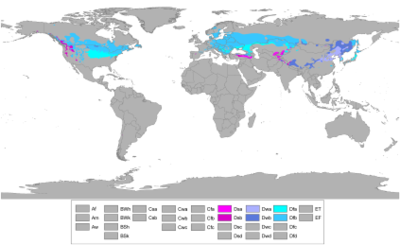
Humid continental climate (Latin capital letter D and lowercase a or b are used for designation) is a type of climate in the Köppen classification , characterized by high seasonal fluctuations in air temperatures, with hot (or warm) summers and cold winters . For a region with regions with a humid continental climate, the average temperature of the coldest month should be below –3 ° C, and at least 4 months a year, the average monthly temperature above 10 ° C.
Precipitation is relatively evenly distributed throughout the year. In most parts of the region, precipitation falls mainly in summer, often with thunderstorm rain. In winter, rain and snowfall are mainly associated with cyclones and associated fronts. Although the climate is defined as “wet”, in fact, the average humidity level is not so high, but it is sufficient not to classify these areas as “semi-arid” or “arid”.
Humid continental climate is typical for areas located, as a rule, north of 60 ° north latitude, in central and northeastern regions of Asia , Europe and North America , and not typical for the southern hemisphere due to the larger area of oceans in the corresponding latitudes, which soften the continental climate.
Content
Kinds of humid continental climate
The humid continental climate is classified depending on the average temperature of the hottest month of summer and the amount of precipitation a — the average temperature of the warmest month exceeds 22 ° C (hot summer): Dsa is the dry season in summer (no more than 30 mm fall out in the driest summer month and does not exceed 1/3 of the amount of precipitation (the wettest winter month); Dwa - dry season in winter (in the driest winter month, precipitation falls no more than 1/10 of the amount of precipitation in the wettest summer month); Dfa - is not subject to a clear classification; b - the average temperature of the warmest month exceeds 10 ° C (warm summer): Dsb - the dry season in summer; Dwb - dry season in winter; Dfb - is not subject to a clear classification.
Dfa / Dwa / Dsa: Humid Continental Climate with Hot Summer
The climate of the region is classified as a humid continental climate with a hot summer in case the average temperature of the hottest month exceeds 22 ° C. As a rule, this month is July, in some regions - August. These regions are characterized by significant fluctuations in air temperature throughout the year: the temperature of the hottest month can exceed 32 ° C, while the average temperature of the coldest month can fall below −3.0 ° C. In Europe, a humid continental climate with hot summers is characteristic of most of Romania , Moldova , the South of Ukraine , the Middle Danube Lowland (parts of Hungary, Croatia and Serbia), and certain regions of the south of the European part of Russia . In Asia, for Kazakhstan , certain regions of Iran , Turkey , Kashmir in India, most of Northeastern China , almost all of North Korea , most of South Korea and Northern Japan . In East Asia, the humid continental climate is transitional to monsoon: here the proportion of precipitation falling in summer is much higher than the proportion of winter precipitation. When due to the influence of the Siberian anticyclone, there are much colder winters here than in other regions located in these latitudes. In North America, a humid continental climate with hot summers is characteristic of New England and the Mid-Atlantic States and most of the Midwest USA , separate regions of the Canadian province of Ontario .
Much of Central Asia , Northwest China and Southern Mongolia have a temperature regime close to a humid continental climate, but due to significantly less precipitation, their climate is classified as a steppe (BSk) or desert climate (BWk).
| Chicago climate (norm 1981-2010) | |||||||||||||
|---|---|---|---|---|---|---|---|---|---|---|---|---|---|
| Indicator | Jan. | Feb | March | Apr | May | June | July | Aug | Sen | Oct. | Nov. | Dec | Year |
| Absolute Maximum, ° C | 19.4 | 23.9 | 31.1 | 32,8 | 36.7 | 40.0 | 40.6 | 38.9 | 38.3 | 34.4 | 27.2 | 21.7 | 40.6 |
| Average maximum, ° C | −0,6 | 1.8 | 8.1 | 15.0 | 21.1 | 26.5 | 28.9 | 27.7 | 23.8 | 16.8 | 9.0 | 1.6 | 15.0 |
| Average temperature, ° C | −4,6 | −2,4 | 3.3 | 9.4 | 15.1 | 20.5 | 23.3 | 22.4 | 18.1 | 11.4 | 4.6 | −2,4 | 9.9 |
| Average minimum, ° C | −8,6 | −6,6 | −1,6 | 3.8 | 9.1 | 14.5 | 17.7 | 17.2 | 12.4 | 6.0 | 0.2 | −6,3 | 4.8 |
| Absolute minimum, ° C | −32,8 | −29,4 | −24,4 | −13.9 | −2,8 | 1.7 | 7.2 | 5.6 | −1.7 | −10 | −18,9 | −31,7 | −32,8 |
| Precipitation rate, mm | 44 | 46 | 64 | 86 | 94 | 88 | 94 | 125 | 82 | 80 | 80 | 57 | 940 |
| Source: Weather and Climate | |||||||||||||
Dfb / Dwb / Dsb: Wet Continental Climate with Warm Summer
The climate of the region is classified as a humid continental climate with a warm summer if the average temperature of the hottest month does not exceed 22 ° C. This subtype of humid continental climate covers a larger area than the subtype with a hot summer. In North America, this climatic zone is typical for regions located between 40 ° and 50 ° north latitude, usually east of 100 ° west longitude. However, in the region of the Canadian prairies, this subtype of the humid continental climate is also observed in areas located much to the north of 50 ° north latitude. In Europe, a humid continental climate with warm summer extends up to 61 ° north latitude. In Europe, this subtype is typical for central Scandinavia, the Baltic states, eastern Austria, certain regions of Germany, most of Poland, the Czech Republic, Slovakia, Ukraine, and Northern Romania. The climate peculiarity of the coastal regions of central Scandinavia is much milder winters, more characteristic of regions with hot summers.
A mild continental climate with warm summers is characterized by mild summers, long cold winters and lower average annual rainfall compared with regions with hotter summers, which, however, does not exclude short periods with very hot weather.
Most of Mongolia and certain regions of Southern Siberia have a climate similar in characteristics to a humid continental, however, due to much less precipitation, they are classified as regions with a desert or semiarid climate.
| Moscow climate: records for the entire observation period (1879–2010 - combined data from the TAA + OCE), norm 1981–2010 ( OCE ) | |||||||||||||
|---|---|---|---|---|---|---|---|---|---|---|---|---|---|
| Indicator | Jan. | Feb | March | Apr | May | June | July | Aug | Sen | Oct. | Nov. | Dec | Year |
| Absolute Maximum, ° C | 8.6 | 8.3 | 19.7 | 28.9 | 33.2 | 34.7 | 38.2 | 37.3 | 32.3 | 24.0 | 16.2 | 9.6 | 38.2 |
| Average maximum, ° C | −4 | −3.7 | 2.6 | 11.3 | 18.6 | 22.0 | 24.3 | 21.9 | 15.7 | 8.7 | 0.9 | −3 | 9.6 |
| Average temperature, ° C | −6,5 | −6.7 | −1 | 6.7 | 13.2 | 17.0 | 19.2 | 17.0 | 11.3 | 5.6 | −1,2 | −5,2 | 5.8 |
| Average minimum, ° C | −9,1 | −9,8 | −4,4 | 2.2 | 7.7 | 12.1 | 14.4 | 12.5 | 7.4 | 2.7 | −3.3 | −7.6 | 2.1 |
| Absolute minimum, ° C | −42,2 | −38,2 | −32.4 | −21 | −7,5 | −2,3 | 1,3 | −1,2 | −8,5 | −20,3 | −32,8 | −38,8 | −42,2 |
| Precipitation rate, mm | 52 | 41 | 35 | 37 | 49 | 80 | 85 | 82 | 68 | 71 | 55 | 52 | 707 |
| Source: Weather and Climate | |||||||||||||