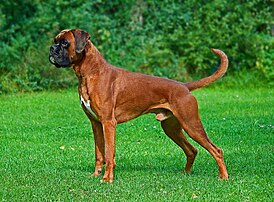
A German boxer or just a boxer is a breed of large stocky smooth-haired dogs bred in Germany. The coat color can be uniform red, brindle, white or brindle with white spots. The boxer was bred from the English bulldog and now extinct bullenbeyser and is part of the Molossa group.
| Boxer | |||||
|---|---|---|---|---|---|
 | |||||
| Other name | German boxer | ||||
| Origin | |||||
| A place |  German Empire German Empire | ||||
| Time | 1850 | ||||
| Specifications | |||||
| Growth |
| ||||
| Weight |
| ||||
| Wool | short, smooth | ||||
| Litter | 6-8 | ||||
| Life span | 9-15 | ||||
| IF classification | |||||
| Group | 2. Pinschers and schnauzers, Molossoid breeds, mountain and Swiss cattle dogs | ||||
| Section | 2. Molosses | ||||
| Subsection | 2.1. Mastiffs | ||||
| room | 144 | ||||
| Year | 1955 | ||||
| Other Classifications | |||||
| COP Group | Working | ||||
| AKC Group | Working | ||||

Boxers were first presented at the St. Bernards exhibition in Munich in 1895 , and the first boxer breeders club was founded a year later. According to the American Kennel Club, the boxer is the seventh most popular breed in the United States (2010) [1] .
Origin of breed
Already in the XVII century it was possible to see the image of a dog similar to modern boxers, this breed was Bullenbeiser. Bullenbeysers for many centuries were a very common breed of dog in Western and Central Europe [2] . A boxer in the form that we used to see him appeared in 1850 in the city of Munich . Mastiffs and bulldogs participated in the creation of this breed, breeding work with these dogs and gave a new breed, which was called a boxer. Mastiffs were intended for hunting large animals such as a bear or a wild boar, and bulldogs participated in battles with bulls. After conducting a selection selection, the experts created the dogs not aggressive and controllable - such as boxers are today. The breed was finally formed by 1896 and in the same year the first club of boxer lovers was organized
Character Features and Breed Application
Boxer is a faithful and balanced dog. Very used to the owners and loves children. The most playful breed among security dogs, and remains playful all his life. It is easy to train and successfully undergoes both a general training course and a protective guard.
They use dogs of this breed for work in the police , as guard dogs, bodyguard dogs. Also, due to the poise and intelligence of boxers, these dogs are used as guide dogs for the blind. Dogs of this breed are very mobile, like long walks, games in the fresh air, are distrustful and alert to strangers.
However, boxers are very gentle animals, they catch a cold easily, do not like the cold season, often suffer from rheumatism , for this reason it is impossible to allow the dog to be cooled for a long time and to be in rain and snow. After this kind of walks, it is necessary to thoroughly dry the hair of the animal. The life expectancy of boxers is not long, they rarely survive even until the age of 10, but with proper care, although very rarely, they can live up to 15 years. A dog of this breed will be a true friend and companion to its owner.
Breed Standard
The standard of the German boxer is regularly updated.
- On March 13, 2002, the next version of the standard was adopted, prohibiting the stopping of ears and tail [3] .
- On July 9, 2008, the next version of the standard that was currently in force (July 2, 2009) was adopted [4] .
The following is a translation of the standard dated July 9, 2008 [5] .
Historical Summary
The immediate ancestor of the boxer is a small (so-called Brabant) bullenbeyser. The breeding of bullenbasers in those days was mainly in the hands of hunters, whom they helped during the hunt. The main task of the Bullenbasers was to seize the hounds driven by the hounds and hold it until the arrival of the hunter, who finished off the prey. For this work, the dog should have maximally wide jaws and widely spaced fangs, allowing reliable grab and hold prey. Bullenbasers possessing these qualities were most suited to carry out such work and were used for breeding, which at that time was carried out only by working qualities. As a result, a special breed with a wide muzzle and upturned nose appeared.
General view
Boxer is a medium-sized, smooth-haired, strong, compact dog with a square format and strong bones. The muscles are dry, well developed, embossed. The movements are energetic, full of strength and nobility. A boxer should not look heavy or awkward, nor light or weak body.
Important proportions
- a) length-height ratio : A square-shaped body, that is, lines drawn through the extreme points: horizontal - through the highest point of the withers, and vertical - one through the extreme front point of the shoulder-shoulder joint, and the other through the extreme back point of the ischial tubercle, form a square;
- b) ratio of chest depth to height at the withers : The chest reaches the elbows. The depth of the chest is half the height at the withers;
- c) muzzle to skull length ratio : The length of the back of the nose refers to the length of the skull as 1: 2 (measured respectively from the tip of the nose to the inner corner of the eyes and from the inner corner of the eyes to the occipital bone).
Behavior / Character
A boxer must be fearless, confident, calm, with a strong nervous system. Character is of utmost importance and requires careful attention. His affection and loyalty to his master, the whole family and home, his sensitivity and his fearlessness, and the courage of a defender have been known since ancient times. He is affectionate with his family, but suspicious of strangers. Fun and friendly in the game, yet fearless in a serious situation. It is easy to learn thanks to its willingness to obey, fighting qualities and courage, natural passion and excellent sense of smell. Being unpretentious and tidy, it turns out to be a pleasant and valuable member of the family as a guard, companion and working dog. His character is trustworthy, without cunning or deceit, even in old age. He loves when they walk with him.
Head
Gives the appearance of a boxer its characteristic appearance. It should be in the right proportion with the body and should not look either too light or too heavy. The muzzle should be as wide and powerful as possible. The harmony of the head depends on the balance between the muzzle and the skull.
- When examining the head from either side : From above, front or side, the muzzle should always be in the correct proportion to the skull, that is, it should never look too small. The head should be dry and free from skin folds (wrinkles). However, wrinkles on the forehead appear spontaneously when the dog guards the ears with increased attention. From the base of the nose bridge, constantly marked skin folds fall on both sides. The black mask is limited to the muzzle, stands out clearly against the background of the head and should not give the boxer a gloomy expression.
- CRANIAL REGION : Skull should be as narrow and angular as possible. It is slightly curved, but not spherical and not short, not flat. The occipital protuberance is also not pronounced. The groove on the forehead is only slightly marked, should not be too deep, especially between the eyes.
- Stop : The forehead with the back of the nose forms a distinct angle. The back of the nose should not be pressed into the forehead like a bulldog, but at the same time should not be lowered.
- Muzzle : It should be voluminous in all three dimensions, that is, it should not be sharp and narrow, nor shortened or shallow. Its shape is determined by: a) the shape of the jaws, b) the location of the fangs and c) the shape of the lips. The fangs should be large and as wide as possible apart, so the nasolabial mirror is wide, almost square in shape and is located at an obtuse angle to the back of the nose. The front edge of the upper lip closes with the front edge of the lower lip. The curved front of the lower jaw together with the lower lip forms a pronounced chin. It should not be noticeably pushed out from under the upper lip or, even less desirable, be hidden by the upper lip. The chin should look clear when viewed from the front as well as from the side. With a closed mouth, incisors and fangs of the lower jaw should not be visible, and the tongue should not be visible. The groove in front of the upper lip is clearly visible.
- Lips (darted) : Give the face a complete shape. The upper lip is thick and fleshy, covers all the free space formed due to the length of the lower jaw, and is supported by the lower fangs.
- Nose : Wide, black, slightly upturned with wide nostrils. The tip of the lobe is only slightly above the base of the nose.
- Jaws and teeth : The lower jaw is longer than the upper and slightly curved upwards. The boxer's bite form is a snack. The upper jaw is wide at the base of the forehead and only slightly tapers towards the end. The teeth are strong and healthy. The incisors are located as even as possible in one line, the fangs are large and widely spaced.
- Cheekbones : Should be developed, respectively, as the jaw, but they should not be emphasized. They smoothly pass to the muzzle in the form of a small bend.
- Eyes : Dark, not small, not convex and not deeply sunken. The expression on the eyes is energetic and smart and should not be threatening or scratchy. The rim of the eyelids should be dark.
- Ears : Remain in their natural form, proportionate, located on the sides of the highest part of the skull. In a calm state, they are adjacent to the cheekbones and turn forward a bit, forming a distinct fold when the dog is alert.
Neck
The upper line of the neck has the shape of an elegant arc with a clearly marked transition to the withers. It should be of sufficient length, round, strong, muscular and dry.
Corps
Boxer has a square format. The body rests on strong straight legs.
- Withers : Well defined.
- Back : The back, including the lower back, should be short, strong, straight, wide and very muscular.
- Croup : Slightly sloping, somewhat rounded, wide. The pelvis should be long and wide, especially in bitches.
- Chest : Deep, reaching to the elbows. The depth of the chest is half the height at the withers. Well developed front of the chest. Ribs well curved, but not barrel-shaped, extending far back.
- Bottom line : Extends back in an elegant bend. The groin is short, moderately taut.
Tail
Rather, higher than low set. The tail has a normal length and is left in its natural form.
Limbs
- Front : When viewed from the front, they are even and parallel to each other with a good volume skeleton.
- Shoulders : Long and oblique, tight to the body. Should not be too loaded.
- Shoulders : Long, located at right angles to the shoulder blade.
- Elbows : Not too tightly pressed to the chest, but not turned outward.
- Forearm : Situated vertically, long, dry and muscular.
- Wrist : Strong, clearly marked, but not overly enlarged.
- Metacarpus : Short, almost sheer.
- Forefeet : Small, rounded, with firmly clenched fingers. Hard sole pads.
- Back : Have very powerful, dense and relief muscles. Seen from the rear, they are even.
- Hip : Long and wide. The angles of the joints of the hip and knee are as blunt as possible.
- Knee : Must be so far forward that it touches the perpendicular of the thigh from the iliac tubercle to the ground.
- Shin : Very muscular.
- Hock : Strong, well defined, but not overly enlarged. The joint angle is about 140 degrees.
- Metatarsus : Short, slightly sloping, at an angle of 95-100 degrees, to the ground.
- Hind feet : Slightly longer than the front feet , with firmly clenched fingers. Hard sole pads.
Movement
Energetic, full of strength, nobility and confidence.
Leather
Dry, elastic, without folds.
Coat
- Coat : Short, stiff, shiny and snug.
- Color : Red (in the original - deer) or brindle. Red is allowed in any shades from light yellow to red-brown, but medium tones (i.e. bright red) are most preferred. Black mask. Tiger color is a dark or black stripes on a red background, running along the ribs. The main color and stripes should be different from each other. White markings are in principle not forbidden and can even be very decorated.
Size and Weight
- Height at the withers : Males: 57-63 cm. Bitches: 53-59 cm.
- Body weight :
- Males: more than 30 kg (at a height at the withers of about 60 cm).
- Bitches: approximately 25 kg (at a height at the withers of about 56 cm).
Weaknesses
Any deviations from the above characteristics are considered defects, the assessment of which is proportional to the degree of these deviations.
- Behavior and character : not enough temperament.
- Head : Insufficient nobility and expressiveness, frown, pinchero or bulldog-like structure of the head. Drooling, showing teeth or tongue. Too narrow or insufficiently large muzzle. The lowered back of the nose. Light, spotty or non-pigmented nose and lip rims. Bright eyes, the so-called "hawk eye", not the stained edge of the sclera of the eyes. Uncropped ears: ears thrown back to the back (“flying”), raised on cartilage or erect ears, ears with a rose. Jaw distortion, inclined teeth, irregular teeth arrangement, poorly developed teeth, teeth damaged as a result of illness.
- Neck : Short, thick and pendant.
- Body : Excessively wide and too deep chest. Sagging, narrow, or falling back when moving. Too thin and too fat dog; narrow, long and sagging lower back. Dome-shaped loin, too sloping croup. Narrow pelvis, sunken sides, sagging belly.
- Tail : short docked
- Forelegs: Size (French set), free shoulder blades, free elbows, soft metacarpus, oval (hare) or loose paw, size.
- Hind limbs : Weak muscles, too blunt or too sharp angles of articulation, saber-like, barrel-shaped set-up, close hock joints (cow), dewclaws, flat (cleft) or loose leg.
- Movement : waddle, short step, amble, stilt walk.
- Color : Mask extending beyond the muzzle, too dense or too rare tigers. Dirty main background. Fuzzy borders of stripes, ugly white marks, such as, for example, half or a completely white skull. Other colors not specified by the standard, as well as the number of white marks, exceeding one third of the surface of the body.
- Disqualifying Defects :
- aggressive or overly sneaky behavior;
- short tail by nature.
- Any dog clearly showing physical or behavioral abnormalities must be disqualified.
- NB: Males should have two normally developed testes fully descended into the scrotum.
Notes
- ↑ AKC Dog Registration Statistics (inaccessible link) . Official site of the American Kennel Club . American Kennel Club (2010). Date of treatment May 15, 2011. Archived February 21, 2012.
- ↑ V. Novikov. The dog with the body of Apollo and the head of Socrates is a German Boxer. The origin of the breed . boxer.ru . boxer.ru (2000). Date of treatment May 15, 2011. Archived February 21, 2012.
- ↑ Comparison of FCI standards from 2.04.2001 and 03.13.2002
- ↑ FCI Standard No. 144 dated July 9, 2008 Archived copy of January 11, 2012 on the Wayback Machine
- ↑ FCI Standard No. 144 dated July 9, 2008. Transfer
Literature
- Savelov O., Nikitenko Yu. German boxer // Dog Island: magazine. - SPb. : Charity Fund "Fidelity", 2013. - No. 5 (25) . - S. 8-11 .