Petar “Veno” Bishkup ( Croatian Petar “Veno” Biškup , Serb. Petar “Veno” Bishkup ; March 4, 1918 , Podgortsy - April 28, 1945 , Pchelich) - Yugoslav Croatian military, partisan of the People's Liberation War of Yugoslavia . Lieutenant Colonel of the Yugoslav Army, commanded the 32nd Zagorsk Division of the NOAU. The national hero of Yugoslavia.
| Petar Bishkup | |
|---|---|
| Horv. Petar Biškup , Serb. Petar Bishkup | |
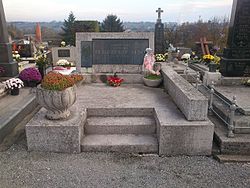 The grave of Petar Bishkup at the Old Belovar cemetery | |
| Nickname | Vienna |
| Date of Birth | March 4, 1918 |
| Place of Birth | Podgortsy , Kingdom of Croatia and Slavonia , Austria-Hungary |
| Date of death | April 28, 1945 (aged 27) |
| Place of death | Pchelić , Independent State of Croatia |
| Affiliation |  Yugoslavia Yugoslavia |
| Type of army | guerrilla troops |
| Years of service | 1940-1945 |
| Rank | lieutenant colonel |
| Part | 10th Zagreb Army Corps |
| Commanded | Bilogorsk partisan company 16th youth shock brigade (political instructor) 18th Slavonic shock brigade 32nd Zagorsk Division |
| Battles / wars | April war The People's Liberation War of Yugoslavia |
| Awards and prizes |  |
Biography
Born March 4, 1918 in Podgortsy. He graduated from elementary school, studied at a technical school for a house painter. In his youth he joined the labor movement. Member of the Communist Party of Yugoslavia since 1937. He lived and worked in Zagreb. In 1940, drafted into the royal army of Yugoslavia, met the April War there . After the surrender of Yugoslavia, he was mobilized into the Ustash army, but fled from there, learning about the crimes of the Ustash against the civilian population.
In Zagreb, Bishkup got in touch with the leadership of the Communist Party and joined them, starting the organization of sabotage in Zagreb. He participated in the arson of the stadium in the Sesvet quarter (not related to the arson of the stadium in Maximir ). After the arson, he joined the partisan ranks and continued the fight already in the rank of an ordinary soldier in the vicinity of Zagreb. After a skirmish with the Ustashi, he retreated to Kalnik and Bilogor ; upon arrival at Bilogora he became the political officer of the Bilogorsk partisan company. At the beginning of 1942 he arrived in Slavonia, where he was appointed political instructor of the battalion in the 16th youth shock brigade named after Joji Vlahovic . At the end of 1943, "Vienna", as Petara was nicknamed in the partisan ranks, was first appointed political officer, and then commander of the 18th Slavonic shock brigade. In 1944, in the Zagreb region, he took over the duties of the commander of the 32nd Zagorsk Division at the 10th Zagreb Army Corps. At the end of the war, his troops fought against the combined forces of German and Croatian troops.
On April 28, 1945, Petar Bishkup, NOAU Lt. Col. and commander of the 32nd Zagorsk Division, died from a sniper bullet, being mortally wounded in the chest and dying on the way to the hospital. He was buried in Podravska-Slatina: on his grave a farewell speech was delivered by the NOAJ Lt. Gen., commander of the 3rd Yugoslav Army, Costa Nagy . Later, the remains were transferred to Belovar in the Old Cemetery.
On December 14, 1949, by a decree of the Presidium of the People’s Assembly, the FPRY was posthumously awarded the Order and the title of People’s Hero of Yugoslavia.
Literature
- " Folk Heroes of Ugoslavia ". Beograd: Mladost. 1975.