Julian Pavlovich Anisimov (June 9 (21), 1886, Moscow - May 11, 1940) - poet of the Silver Age , translator, art historian.
| Julian Anisimov | |
|---|---|
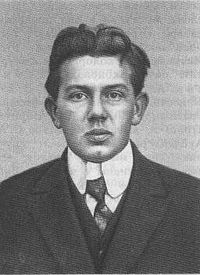 1914 | |
| Birth name | Julian Pavlovich Anisimov |
| Date of Birth | June 9 (21), 1886 |
| Place of Birth | Moscow |
| Date of death | May 11, 1940 (53 years) |
| Place of death | Moscow |
| Citizenship (citizenship) | |
| Occupation | poet , translator |
| Years of creativity | 1912–1940 |
| Language of Works | Russian |
Content
Biography
Born in the family of a military engineer, maternal grandson of the historian-Slavist A. F. Hilferding . Great-grandfather was the director of the diplomatic office under the governor of the Kingdom of Poland [1] . He was baptized in the Elokhovsky Epiphany Cathedral [2] .
Initially received a home education, then graduated from 6 classes of the gymnasium. In 1907, at the expense of his father, he went to Paris , Italy , attended lectures at the Sorbonne , took painting lessons from Henri Matisse . Returning to Russia, in 1910 he entered the Stroganov School , but for a long time he could not study because of the opened tuberculosis.
In 1911, he married the poet and translator Vera Oskarovna Stanevich (1890–1967), an active member of the Musagetov group, later the leader of anthroposophical groups, the translator of Charlotte Bronte , H. Wells , A. Conan-Doyle , Jack , Jules Verne (“ The Mysterious Island ” ), EM Remarque (“Black Obelisk”) and others.
He organized the literary circle "Serdarda", which included B. L. Pasternak , S. N. Durylin , B. A. Sadovskaya , K. G. Locks and others.
He sympathized with the Social Revolutionaries, in 1907, 1910 and 1911. subjected to short-term arrests. In the years 1910-1911. thanks to the efforts of Yu. Anisimov, the literary circle “Young Musaget” (secretary A. Kozhebatkin ) was organized, the participants of which gathered in the workshop of the sculptor KF Kraft. Pasternak and Tsvetaeva were frequent guests there [3] .
The Circle creates the Musaget Publishing House (secretary of the publishing house VF Akhramovich (Ashmarin) . Later, together with B. Pasternak, N. Aseev and S. Durylin, Anisimov organized the Lyric Publishing House. In April 1913, the Lyman poetry was published, where the poems of Yu. Anisimov, N. Aseev, S. Bobrov , B. Pasternak, S. Durylin, S. Rubanovich and V. Stanevich were published.
Creativity
Under the influence of the wife of Vera Stanevich, Anisimov became interested in anthroposophy , translated the treatise of J. Boehme , On the Threefold Life of Man, several poems by the German poet H. Morgenstern .
Prepared for publication a book of poems "Wind" (1916), but it never came out. Layout of the book is stored in RGALI.
The first poetic publication is the poem My Poems, Gentle Guests ... in Sovremennik (1912). Further publications in the collection "Lyrics" (1913), at the same time the first book "The Resident" was published, imbued with a religious outlook and Orthodox spirituality. In a book review, S. Bobrov wrote: “The inner life of the book constitutes spiritual humility, the religious acceptance of the sword of tears as an invaluable and joyful gift of God” [4] . N. Aseev warmly reacted to the book: "By faith, calm and clear breathes from these pure verses." V. Ya. Bryusov , however, met the poems with irony [5] .
The second almanac “Lyrics” was supposed to be devoted to German poetry at the suggestion of Anisimov, giving verses to Rilke , R. Demel , R. Shaukal, A. Mombert and others. Anisimov also intended to publish in his translation the book of Rilke “Stories of the Lord”, a collection of poems by Novalis in the translation of G. Petnikov and S. Bobrov, a book of B. Pasternak’s articles “Symbolism and Immortality”. None of this was done. Anisimov only released 24 poems of Rilke in his translation entitled “The Book of Hours” (part of the Rule of Hour's Book). In the preface, Anisimov wrote that he "gives" his translation work to "the few who value Rilke not only as an exceptional poet and who feel his meaning for Russia." S.N. Durylin, who responded to the book with a review under the pseudonym Sergei Rajewski, noted: “Native Russian sadness and faith are in the poems of the German poet, and therefore they are dear and sweet, and close” [6] .
In the autobiographical novel “Security Instructions” (1930), B. Pasternak writes that he introduced Anisimov to the poems of Rilke, whom Pasternak already “preferred to all his contemporaries”. Pasternak, in his words, brought to Anisimov the book “To me for the holiday” (“Mir zur Feier”, 1899), which was once donated by the author to Father L. O. Pasternak [7] .
Comrade Anisimov in the poetry shop ironically: “Sitting in a tattered chair, Julian read a thin little book in a colorful cover with a pencil and admired her. These were Rilke's poems, then his translations from Rilke. (...) Julian loved Rilke, and it seems to me that he successfully translated it. Listening to these translations, I thought: “One more effort, and with the help of Rilke you will become a real poet.” But this did not happen, and it was destined ” [8] .
In 1926, the third book of poems by Yu. Anisimov "Earthy" was published with an illustrated cover of L. Bruni , in which images of nature, irony over a new life and an attempt to determine the fate of his generation predominate.
Later he was engaged in translation, translated “ Othello ” and “ Venus and Adonis ” by Shakespeare, wrote art criticism essays about F. S. Rokotov and M. A. Vrubel .
In the 1930s, he translated poems by American Negro poets (Langston Nuzhnes. Hello, Revolution; "Africa in America: an anthology of American Negro poetry", etc.). An example of Y. Anisimov’s translations in the 1930s is Langston Hughes ’s poem “The Ballad of Lenin”
Russian comrade Lenin, Dressed in granite granite: Move over, Comrade Lenin, I will lie down next to you. Ivan, I am a Russian peasant, My boot is covered with dung. We fought together, Lenin. I did everything I could.
He was buried at Donskoy Cemetery (3 lessons).
Contemporaries about Julian Anisimov
Poems Anisimov was dedicated to B. Pasternak, S. Bobrov. Anisimov himself devoted poems to the composer B. Krasin , botanist F. Nenyukov , S. Durylin, K. Loks.
In his autobiographical essay “People and Positions”, B. Pasternak wrote about Anisimov: “The master, a talented creature and a man of great taste, well-read and educated, who spoke several foreign languages freely, as in Russian, himself embodied poetry to the extent that makes up the charm of amateurism and in which it is difficult to be in addition to being a creatively strong personality, character from which the master is made. We had similar interests, common pets. I really liked him. ” [9]
Poet S. P. Bobrov, friend of Anisimov, spoke of him like this:
“Once we were bored with the sermons of unmusco-ness and all 'pomilos-pomilos-pomilos“' a! Tired of seriously. With us was the cute and capable drunk Julian Anisimov, whom we called “Disassembled Bicycle”, - he used an old bast on the red deer with strange rhymes about the pantheistic Christ, and with his other hand he fried on a canvas under some kind of a mixture of Sapunov and Matisse. Julian was ready to giggle with us about every kind of wooden lamp oil, for he really loved poetry, but he had friends who dragged him back to this dump of shrew acid. Once we asked him just in the forehead - what about Igor Severyanin? He could not stand it and depicted contempt on his face. It was all over. We left him with long strides along the Malaya Molchanovka, mocking and cursing. A certain evening came, and the three of us founded the CENTRIFUGU ” [10] .
In 1914, after the quarrel between Anisimov and Pasternak, when the former called the poems of the second “the pharmacist dialect,” the publishing house fell apart. Later, in 1916, B. Pasternak wrote to S. Bobrov: “Before I was touched by the fact that Julian pricked my eyes with“ distant guesses ”that I was not a Jew, since I had cases and pretexts were limping (as if we were just cases and excuses only neck rolled up). I was hurt by this, I had enough of this whole feeling, I, t. Sc., Could indulge in it (you will understand). Now I would not have these guesses on the rye. Now, if Julian happened again with such shrewdness, I would suggest that my things be translated into Russian from my own ” [11] .
After 1917, Anisimov served in the All-Russian collegium on museums at the Narkompros , a member of the collegium of the subdivision of the provincial protection of the Museum department of the Glavnauka Narkompros, (1918-1927), a member of the commission on the organization of estate museums (1919-1924), participated in the creation of museums in Ostankino , Arkhangelsk , Olgove , served as one of the custodians of the Tretyakov Gallery (1919-1931) [12] . Since the second half of the 1920s. employee of the Moscow section of the GAIMK, employee of the Academy of the History of Material Culture . He lived on Malaya Molchanovka , 6, then in the Dead Lane [13] .
The creative legacy of Julian Anisimov is stored in IMLI and RGALI.
Books
- Monastery Poems. - M., Alcyone. 1913. p. 92
- Rilke R. M. Book of hours. Transcribed by Yu. A. - M., 1913
- Earthy. Poems, M., 1926
- Langston Hughes. Hello, revolution! Collection of poems. Comp. and translations of Yu. Anisimov. M., State. ed-hud lit-ry. - M. 1933. P. 103
- Africa in America: an anthology of poetry of American blacks. Comp. and translations of Yu. Anisimov. Ed. S. Dinamov. Hood L. Epple. - M., GIKHL, 1933. P. 107
Notes
- ↑ Vlasova Z. I. Hilferding Alexander Fedorovich // Russian writers. 1800-1917. - M. , 1989. - T. I. - p . 560 .
- ↑ Julian Anisimov . Orthodox encyclopedia. The appeal date is August 22, 2014.
- ↑ Manfred Schruba. Literary associations of Moscow and St. Petersburg, 1890-1917. Vocabulary. - M .: New Literary Review, 2004. - 448 p. - ISBN 5-86793-293-1 .
- ↑ S. Bobrov. On the lyrical excitement // Works and days. - M .: Publishing house "Musaget", 1913. - № 1-2 . - p . 114 .
- ↑ Bryusov V. Ya. Among the poems, 1894-1924. - M .: Soviet writer, 1990. - p. 408. - 720 p. - 30 000 copies - ISBN 5-265-00941-8 .
- ↑ S. Durylin. On the poetry of Rilke // Path. - M. , 1914. - № 3 . - p . 69 .
- ↑ Pasternak L. O. Records of different years. - M .: Soviet artist, 1975. - p. 146-150. - 288 s.
- ↑ K. Locks. A Tale of One Decade (1907-1917) // Past. Historical almanac. - M. , 1994. - № 15 . - p . 53 .
- ↑ Konstantin Polivanov. "Musical episode" Pasternak Biographies . The appeal date is August 22, 2014. (unavailable link)
- ↑ Bobrov S.P. "It was hot and talented." Letters of S. P. Bobrov to A. P. Kvyatkovsky // New World. - M. , 2009. - № 8 .
- ↑ Kobrinsky A. A. “Linguistic” duel: Boris Pasternak - Julian Anisimov // Duel stories of the Silver Age: the fights of poets as a fact of literary life. - SPb. , 2007. - p . 313 .
- ↑ Evgraf Konchin. Revolution called: Stories about the Moscow emissaries. - M .: Moscow Worker, 1988.
- ↑ Julian Anisimov // Moscow Encyclopedia. / Ch. ed. S. O. Schmidt . - M. , 2007—2014. - T. Tom I. Faces of Moscow : [in 6 books.].
Literature
- Writers of the modern era, vol. I, M., 1928
- Mashkovtsev N.G. Obituary // Art. 1940. № 4
- Pasternak B. L. Airways. M., 1982
- Pasternak B. Selected: In 2 t. / Comp., Podg. text and com. E.V. Pasternak and E. B. Pasternak. M., 1985. T. 2: Prose. Poems S. 245. - Fiction, 1985
- Pasternak B. L. Security Code // Coll. cit .: 5 t. M., 1991. T. 4.
- Gelperin Yu. M. Yu. P. Anisimov // Russian writers, 1800-1917. T. 1. M., Soviet encyclopedia. 1989. p. 672. p. 76-77
- Two Fates: (B. L. Pasternak and S. N. Durylin. Correspondence) // Meetings with the Past. M., 1990. Vol. 7
- Durylin S. N. In his corner. Compilation and notes V.N. Toropovoy. Preface G. E. Pomerantseva. M., Young Guard, 2006, 880 pp. (Library of memoirs)
- Locks K. A Tale of One Decade (1907–1917) // Past. M .; SPb., 1994. Vol. 15
- Sarabyanov A.D. Anisimov Julian Pavlovich // Encyclopedia of the Russian Avant-garde : Visual Arts. Architecture / Compiled by V.I. Rakitin , A.D. Sarabyanov; Scientific editor A. D. Sarabyanov. - M .: RA, Global Expert & Service Team, 2013. - T. I: Biographies. A — K - p . 19 . - ISBN 978-5-902801-10-8 .