The 285th Uman-Warsaw Red Banner Order of the Kutuzov Regiment ( 285th regiment ) is a military formation of the USSR Armed Forces and the Armed Forces of Uzbekistan ( 22nd MSBR ).
| 285th Tank Uman-Warsaw Red Banner Order of Kutuzov Regiment (285th TP) | |
|---|---|
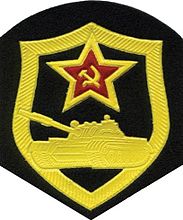 | |
| Years of existence | July 1943 December 1993 |
| A country |  the USSR the USSR  Uzbekistan Uzbekistan |
| Subordination | 40th Army of the USSR Armed Forces Ministry of Defense of Uzbekistan |
| Included in | USSR Armed Forces : 1945-1980 - 60th Tank Division of the Moscow Military District 1980-1991 - 108th Motorized Rifle Division TurkVO Uzbekistan Armed Forces : 1st Army Corps Southwest Special Military District |
| Type of | 1943-1957 - self-propelled artillery regiment 1957-1984 - tank regiment 1984-1989 - Motorized Rifle Regiment 1989-1993 - tank regiment Since 1993 - motorized rifle brigade |
| Dislocation | Dzerzhinsk , RSFSR Kabul , Afghanistan Termez UzSSR Sherabad Republic of Uzbekistan |
| Equipment | T-62 |
| Participation in | The Great Patriotic War Afghan war |
| Marks of Excellence | Umansky Warsaw   |
History
Regiment during the Great Patriotic War
The regiment leads its history from the 1892th self-propelled artillery of the Uman-Warsaw Red Banner Order of the Kutuzov Regiment ( 1892th glanders ).
The 1892th glanders was formed in July 1943 in the Moscow Military District . The regiment was armed with 21 units of self-propelled artillery units SU-76M . During the war, the 1892th glanders was given to the fire reserve of various associations and acted on different fronts.
Subordination of the regiment at different stages of the war [1] :
- from September to October 1943 as part of the 2nd Guards Army of the Southern Front ,
- from November to December 1943 as part of the 4th Ukrainian Front ,
- in January 1944 as part of the Kharkov Military District ,
- from February to May 1944 as part of the 27th Army of the 1st Ukrainian Front and after the 2nd Ukrainian Front ,
- in June 1944 transferred to the RVGK ,
- from July 1944 to May 1945 (until the end of the war), the 1892th glanders were subordinate to the 47th Army of the 1st Belorussian Front .
As part of the army, the 1892th glanders was in the following periods [2] :
- August 25, 1943 - December 3, 1943
- January 26, 1944 - May 11, 1944
- June 19, 1944 - May 9, 1944
Participation in military operations
The 1892th glanders participated in the following military operations [1] :
- Donbass operation
- Melitopol operation
- Korsun-Shevchenkovskaya operation
- Uman-Botoshan operation
- Lublin-Brest operation
- Warsaw-Poznan offensive operation
- East Pomeranian operation
- Berlin offensive operation
At the final stage of the war, the 1892th glanders was assigned to the reserve of the 125th Rifle Corps (125th sk) of the 47th Army .
On April 20, 1945, the reserve of corps artillery of the 125th SK in the form of the 1892th glanders along with the 334th Guards Heavy Self-propelled Artillery Regiment (334th Guards Technical Assault Regiment), in cooperation with the 175th and 76th Infantry Division took with the battles of Bernau .
On April 24, the 125th ck cut the last rail link between Berlin and Rathenov .
Towards the end of May 8, 1945, on the eastern shore of the Elbe, northeast of the city of Magdeburg , the 125th sk formations held their last battle to destroy the remnants of the enemy [3] .
Awards and honorary titles
- For the liberation of Uman on March 19, 1944, the 1892th glanders was awarded the honorary name Umansky .
- By a decree of the Presidium of the Supreme Soviet of the USSR of October 31, 1944, the 1892th glanders, which distinguished themselves when taking the Prague fortified area in Warsaw , was awarded the Order of the Red Banner .
- For the liberation of Warsaw on February 19, 1945, the 1892th self-propelled artillery Uman regiment was added the honorary name Warsaw .
- By decree of the Presidium of the Supreme Soviet of the USSR of June 11, 1945, for the successful completion of combat missions under the Sturm of Berlin, the 1892th self-propelled artillery Uman-Warsaw Red Banner Regiment was awarded the Order of Kutuzov 3rd degree [1]
Postwar History
The 47th combined arms army was stationed after the end of the fighting in Germany (headquarters in the city of Halle ).
With the end of the war, self-propelled artillery regiments of corps artillery were included in the composition of infantry divisions. The 1892th glanders of the 47th Army was included in the 60th Rifle Sevsk-Warsaw Red Banner Order of the Suvorov Division .
By 1946, the 47th OA included the 77th Sokhachevsky Rifle Order of the Suvorov and Kutuzov Corps (composed of the 60th, 185th, 328th Rifle Divisions ) and the 12th Guards Rifle Red Banner Corps (composed of 23rd Guards SD and 22nd Guards Md (formerly 52nd SD ).
The Army Directorate, all corps and divisions except the 60th Rifle Sevsk-Warsaw Red Banner Order of the Suvorov Division and the 185th Rifle Pankratov-Prague Order of the Suvorov Division were disbanded after its withdrawal to the Moscow Military District on February 5, 1946 [4] [5] .
The 60th SD was relocated to the city of Dzerzhinsk in the Gorky Region of the Moscow Military District and was included in the 13th Guards Army Corps.
In the postwar period, the USSR Armed Forces reorganized the armored forces . There was a transition from the brigade structure of the formation of troops, introduced in the second half of 1941, to the pre-war structure of armored forces on the basis of divisions .
In this regard, the 60th SD after rearmament was reorganized in 1957 into the 43rd Panzer Division.
There is also a change in the numbering of regiments - the 1892th self-propelled artillery regiment is reorganized into the 285th tank regiment with the preservation of all honorary titles and awards. The regiment receives the full name of the 285th Tank Uman-Warsaw Red Banner Order of Kutuzov Regiment (military unit 77755). In addition to the 285th regiment, in the 43rd TD, the 272nd Tank Regiment (military unit 21084) and the 14th Guards Tank Regiment were formed [6] .
In 1965, the 43rd Panzer Division returned the previous number. The full name of the division was: 60th Panzer Sevsk-Warsaw Red Banner Order of the Suvorov Division [5] .
285th Afghan War Regiment
Entering a regiment in Afghanistan
Since January 2, 1980, in accordance with the directive of the General Staff of the USSR Armed Forces, the 285th military unit, at the place of permanent deployment (the city of Dzerzhinsk in the Gorky Region ), was transferred to new states, understaffed to the full extent at the expense of MBO units and 9th railway levels transferred to the area of Termez of the Uzbek SSR .
In mid-January 1980, in Termez , the regiment was staffed with an anti-aircraft missile and artillery battery from PribVO , a chemical defense company from PribVO and in full force were subordinated to the 201st motorized rifle division TurkVO .
Prior to the entry of troops into the DRA as part of the 201st Moscow Detachment, stationed in the Tajik SSR , there was no tank regiment, since it was a cropped division with outdated weapons. For the entire post-war period, the 201st motorway was unfolded for the first time before the state of wartime. From the 58th Roslavl motorized rifle division deployed in the territory of the Turkmen Soviet Socialist Republic , it was transferred to the 234th Permishl-Berlin Red Banner Order of the Suvorov Tank Regiment (234th regiment or military unit 75115) [7] .
Thus, by the beginning of the introduction of troops subordinate to the 201st Infantry Detachment there were simultaneously 2 tank regiments (234th military regiment and 285th military regiment) [8] .
After the introduction of troops, on January 28, 1980, the 234th military unit was reassigned to the 108th motorized infantry division and redeployed to the city of Kabul to receive a new conventional name (military unit 71177). In December 1979, the 108th Nevelskaya Motorized Rifle Division was introduced into the DRA without a regular tank regiment. The 281st tank regiment (military unit 44077) of the 108th infantry division, which was formed in 1947 on the basis of the 845th separate artillery self-propelled division (the 845th siege of the same 108th infantry division), remained on the territory of the USSR , due to that had outdated weapons ( T-34 , T-44 , BTR-152 ) [7] .
From January 15 to February 14, 1980 - the 285th military unit is located in a field camp near the height of the Red Grave , between the cities of Termez and Kokayty , where combat coordination was carried out.
On February 14, the 285th TP, as part of the 201st motorway, made a march along the route Khairaton - Puli-Khumri - Kunduz , concentrated on the northern outskirts of Kunduz in a field camp.
After entering the 285th TP received a new conditional name (military unit 86997) [8] .
Composition of the 285th Regiment
The composition of the 285th TP for the summer of 1980 [7] :
- Office shelf
- Commandant platoon
- platoon of the chief of artillery
- 1st tank battalion
- 2nd tank battalion
- 3rd tank battalion
- artillery division ( on 122 mm howitzers M-30 )
- anti-aircraft missile artillery battery
- reconnaissance company
- communications company
- engineering sapper company
- material support company
- repair company
- chemical protection company
- regimental medical center
Regiment Combat Activities
With the introduction of the 285th TP, its units were dispersed over the area of responsibility of the 201st motorized infantry division and the 860th separate motorized rifle regiment (860th motorized infantry regiment ).
Regiment units began to equip military camps, combat training exercises and were constantly involved in the tasks of guarding routes, important facilities, escorting convoys, participating in raids and operations to liquidate gangs.
The 1st tank battalion was sent to strengthen the 860th Omsp, located in Fayzabad , Badakhshan Province .
The 860th Omsp command of the 40th Army was assigned to carry out a special combat mission to deter the enemy in a separate strategic direction - to partially block the exit from the Vakhan corridor to the rest of Afghanistan . The 1st tank battalion was engaged in the combat mission of guarding the Kishim - Fayzabad road, along which the 860th Omsp was supplied from the Kunduz city with the rear services of the 201st MRS. The 3rd tank company was put on guard at the Fayzabad airfield.
When troops were introduced, the full-time tank battalion and artillery division of the 860th Omsp were not introduced into the DRA . The reason was a difficult mountain road to the city of Fayzabad from the city of Ishkashim of the Tajik SSR , along which the 860th Omsp was introduced. In mid-1981, the 1st tank battalion of the 285th tank became part of the 860th Omsp [9] .
Regiment Reassignment
By mid-1980, the USSR Armed Forces leadership would decide to withdraw military units and formations from the DRA whose presence was deemed unnecessary.
The number of withdrawn formations and military units until September 1, 1980 will include:
- 2nd anti-aircraft missile brigade
- 353rd Guards Mogilev Order of Bogdan Khmelnitsky and Alexander Nevsky Artillery Brigade
- 234th Permnihl-Berlin Red Banner Order of the Suvorov Tank Regiment
- 646th separate missile division of the 108th motorized rifle division
- 307th Separate Missile Division of the 5th Guards Motorized Rifle Division
By the decision of the command of the 40th Army , which considered the redundancy of the military grouping on the Kunduz direction , from December 30, 1980 to January 5, 1981, the 285th regiment (without the 1st tank battalion remaining at the reinforcement of the 860th Omsp) was redeployed to Bagram city of Parwan province , and reassigned from the 201st motorized division to the 108th motorized infantry division [10] [11] .
As part of the 108th ISD, the 285th TP performed combat missions to escort transport convoys and participated in raids and operations to liquidate gangs.
Reforming the 285th Tank Regiment into the 682nd Motorized Rifle Regiment
By the beginning of 1984, the command of the 40th Army recognized the urgent need for a permanent military presence in the Panjshir Gorge .
This 120-kilometer gorge was the main transport artery for the Dushmans , through which they were assisted by pack caravans with weapons, ammunition, ammunition, human reserves, medicines and many others from Pakistan . In addition, the gorge, having a complex mountainous terrain, served as a good base for dushmans to concentrate and train personnel.
Three Panjshir operations carried out by that time showed that for the partial control of the Panjshir Gorge, a large military unit should be relocated to it. But, since the difficult political situation at that time did not allow the Soviet military leadership to introduce an additional motorized rifle regiment into Afghanistan , the General Staff of the USSR Armed Forces took the next tricky step. It was decided to form a motorized rifle regiment based on the existing tank regiment.
In March 1984, the personnel of the 3rd Tank Battalion stationed in Bagram of the 285th TP were transported by plane from Afghanistan to Termez of the Uzbek SSR . Officers and soldiers of the 3rd TB will be part of the former tank regiment of the 108th Infantry Division - the 281st TP, which, together with the 234th TP withdrawn in 1980, became part of the 114th Motorized Rifle Division.
In Termez , the formation of the 682nd motorized rifle regiment ( 682nd MSP ) began. The structure of the new 682nd SME included the regiment’s management, combat and rear support units , an artillery division and the 2nd tank battalion from the 285th military regiment.
The main combat backbone of the newly created 682nd MSP consists of three motorized rifle battalions of the 365th Guards Motorized Rifle Regiment of the 4th Guards Motorized Rifle Division, relocated to Termez from Lugansk, Ukrainian SSR in 1980.
As an experiment, the regiment was formed with mixed weapons: the 1st and 2nd battalions on the BMP-2 , the 3rd motorized rifle battalion on the BTR-70 The battle flag of the newly formed regiment was left from the 285th regiment.
Line battalions were staffed by military personnel (150 officers and warrant officers, 1,500 soldiers) who did not have experience in military operations in Afghanistan . This, in turn, will be one of the causes of the death of the 1st motorized rifle battalion [12] . The introduction of three motorized rifle battalions and the complete reorganization of the 682nd SME ended in Bagram in the former military camp of the 285th military unit on March 23, 1984. So the 682nd Uman-Warsaw Red Banner Order of Kutuzov Motor Rifle Regiment was formed [13] .
Composition of the 682nd Regiment
The composition of the 682nd MSP for the summer of 1987:
- Office shelf
- Commandant platoon
- platoon of the chief of artillery (vuna)
- orchestra
- 1st Motorized Rifle Battalion (on BMP-2 )
- 2nd Motorized Rifle Battalion (on BMP-2 )
- 3rd Mountain Rifle Battalion (on BTR-70 )
- tank battalion (on T-62 )
- artillery division (on 2C1 and 122 mm howitzers D-30 )
- anti-aircraft missile artillery division
- anti-tank battery
- reconnaissance company
- communications company
- engineering sapper company
- material support company
- repair company
- flamethrower platoon
- regimental medical center
“Standing in the Rukh” - Situation with the 682nd Motorized Rifle Regiment
Relocation in n. n. Rukha occurred during the next Panjshir operation on April 26, 1984. As a result of such military-organizational castling, the number of regiments in the 40th Army remained the same, but the personnel increased, since the motorized rifle regiment in terms of the number of personnel more than doubles the tank regiment and can solve a wider range of combat missions. Moreover, in n.p. Anava Panjshirskogo gorge, deployed in May 1982, the 2nd Parachute Airborne Battalion (2nd infantry regiment) and one howitzer battery from the 345th Separate Airborne Regiment (345th OPDP). The 2nd infantry safety squad of the 345th military police detachment occupied positions halfway between Rukha and the exit from the Panjshir Gorge to the Charikarsky Plain , dispersed over 20 watch outposts [14] .
With their presence in Panjshir, motorized riflemen and paratroopers significantly constrained the enemy’s actions in supplying their formations and transferring forces. The number of attacks on convoys supplying Soviet troops sharply decreased in the region of the Charikar Plain and the southern part of the Salang Pass. The 682nd MSP was a kind of “lightning rod” that pulled the main blow of the Mujahideen. The enemy did not abandon attempts to drive motorized rifles out of Rukha. The personnel of the 682nd SME with a staffing of 2,200 were initially opposed by the Ahmad Shah Masouda group, whose strength at the time the regiment was introduced was 3,500 [15] .
In subsequent years, the number of fighters Ahmad Shah Masouda grew rapidly and by 1989 amounted to 13,000 fighters [16] .
Over the next four years, the 682nd MSP found itself in a very difficult tactical situation. The regiment was stationed on a small plateau on the site of an abandoned village of Rukh, surrounded on all sides by mountains.
In the den of the Panjshir Lion :
... Rukha is located on a small plateau surrounded by mountains. In fact, the regiment lived in a stone bag, and the living conditions were harsh. Moving without risking one’s life was possible only in trenches, the extensive network of which covered the entire village. Only an abandoned village was visible from a distance, and no movement. Every day from six o'clock in the evening Moscow time, when the heat subsided, the Mujahideen reminded of who the boss was in the house. Therefore, life in the trenches for the Soviet guys became familiar. Despite the fact that the regiment was in full view of the enemy, the Mujahideen could not take control of the village ...
In order to protect themselves from enemy shelling, almost 60% of the regiment’s divisions were dispersed by guard outposts and outposts within a radius of 2-3 kilometers from the regiment’s headquarters. Barracks for the personnel of the regiment, as well as all the objects of the regiment (headquarters, canteens, club, infirmary, workshops, warehouses, etc.) will be low fortified buildings like dugouts and dugouts. In the literal sense of the word - "the regiment was dug in the ground." In fact, in the dark, the 682nd MSP was in a state of siege each time. Firing contacts with the enemy at the guard posts occurred daily [17] . Shelling of the regiment’s territory with rockets and mortar shells also often took place. In essence, the perimeter of the military camp of the regiment was the front line of defense. There is no such extraordinary precedent in the history of the USSR Armed Forces , when the regiment actually defended its own deployment point in a state of continuous contact with the enemy for such a long time.
For only 8 months of 1984, the stay of the 682nd small and medium business in the Panjshir Gorge , the irretrievable losses of the regiment amounted to 195 troops. In total, during the “Standing in the Rukh”, irretrievable losses amounted to 386 people [18] .
It should be noted that the 682nd MSP was not the first military unit to be located in Rukh for a long time. In the period from June 1982 to March 1983, the “2nd Muslim Battalion” (177th separate special-purpose detachment (1st formation)) was deployed in Rukh, with a strength of 500 troops and fire support units ( D-30 howitzer battery, MLRS BM-21 battery, tank platoon) attached from the 177th ISP 108th ISD. The 177th OSPN also conducted active hostilities with Ahmad Shah Masouda detachments and lost 50 people in 9 months [19] .
To strengthen the regimental artillery of the 682nd MSP, the following will be attached: 1 firing platoon of the 4th cannon artillery battery 2A36 “Hyacinth” (replaced in the spring of 1986 by the firing platoon of the 5th battalion) and 1 firing platoon of the 6th mortar battery of heavy mortars M-240 from the 1074th artillery regiment of the 108th motorized infantry division [20] . The intensity of the battles in the summer of 1986 will lead to tragedy among artillerymen who supported the outposts of the 682nd MSP from enemy attacks with fire. According to veterans of the 1074th ap at the end of July and mid-August, two identical accidents will occur - a spontaneous explosion of the propellant charge of M-240 heavy mortar shells during loading. As a result, 11 fighters will be seriously injured (of which 2 fighters with loss of limbs and 2 fighters will lose their sight). The true causes of the tragedy are not disclosed by veterans and are still classified.
By the beginning of 1988, the command of the 40th Army , desiring to reduce losses in personnel in light of preparations for the upcoming withdrawal of troops from Afghanistan, would decide to withdraw the 682nd MSP and the 2nd PSB 345th military police unit from the Panjshir Gorge . The regiment will be withdrawn on May 26, 1988, with the support of the 781st separate reconnaissance battalion of the 108th MRD and front-line aviation from the air base in Bagram . Ahmad Shah Masoud would reject a temporary truce with the Soviet command at the time of withdrawal, so the regiment left the gorge with battles, while losing a significant amount of automotive equipment [14] .
After the withdrawal from Rukha, the regiment’s headquarters will be redeployed to the city of Jabal-Ussaraj , and the regiment’s military units will be dispersed along the outposts along the Kabul – Hairaton highway in the area of responsibility of the 108th MRB.
Incidents associated with the 682nd Regiment
Death of the 1st Battalion
On April 30, 1984, in the Khazar Gorge, during a large-scale combined-arms operation in the Panjshir Gorge , he was ambushed and suffered heavy losses by the 1st motorized rifle battalion of the 682nd MSP.
Jester tragedy
October 16, 1986, on the road from n. Gulbahor settlement in Rukha, a group of the 682nd small-arms regiment, consisting of part-time 2 motorized rifle companies, a separate flamethrower platoon and reconnaissance company, returning from a combat mission, was ambushed. In a transient battle, 3 people died and 10 were injured, 5 BMP-2 and 6 trucks were burned.
On the evening of the same day, October 16, 1986, another group from the 1st motorized rifle battalion of the 682nd small-arms regiment reached a glacier in the Shutul gorge during a raid operation, not having completed half the route planned for the day. In anticipation of further orders from the command, the tactical group, which had only summer uniforms with it, was forced to spend the night in the autumn conditions of the highlands. The air temperature dropped below zero at night. Exhausted by a difficult passage, the soldiers went to bed uncontrollably. As a result, on the night of October 16-17, 17 people died from hypothermia and more than 30 received frostbite of varying severity [21]
Shelf Output
The regiment will be withdrawn to Termez on February 11, 1989 . After withdrawal, the 682nd MSP will be reorganized back to the 285th Tank Regiment with the assignment of a new conventional name (military unit 44278) [10] .
Lost Regiment in Afghanistan
The irretrievable losses of the 285th TP amounted to:
- 1981 - 6 people
- 1982 - 21 people
- 1983 - 18 people.
- 1984 - 4 people.
- Total: 49 people.
The irretrievable losses of the 682nd MSP amounted to:
- 1984 - 195 people
- 1985 - 93 people
- 1986 - 45 people.
- 1987 - 42 people.
- 1988 - 19 people.
- 1989 - 2 people.
- Total: 396 people
The total irretrievable losses (those killed, died from illnesses and wounds, who died as a result of an accident) of the 285th TP and 682nd MSP - 445 people [18] .
Heroes of the Soviet Union
- Grinchak Valery Ivanovich . Site " Heroes of the country ". The commander of the reconnaissance company of the 285th TP (682nd MSP).
- Shakhvorostov Andrey Evgenievich . Site " Heroes of the country ". Deputy commander of a motorized rifle company of the 682nd MSP. Awarded posthumously.
Regiment in the Armed Forces of Uzbekistan
In January 1992, military units and formations on the territory of the Republic of Uzbekistan will come under its jurisdiction.
In December 1993, by decree of the President of the Republic of Uzbekistan , in connection with the transfer of troops to brigade manning , the 108th motorized infantry division was disbanded, and its units and divisions, after reorganization, became part of the 1st Army Corps (1st ak) with headquarters in Samarkand city.
As a result of the reorganization, the 22nd motorized rifle brigade was formed on the basis of the 285th military regiment (22nd infantry brigade or military unit 44278) and after it was relocated from Termez to Sherabad in the Surkhandarya region .
In 2000 , as a result of the ongoing reform in the Ministry of Defense of the Republic of Uzbekistan, the South-West Special Military District was established with headquarters in the city of Karshi . At present, it consists of the formations of the former 108th FFM [10] .
Regiment Command
List of commanders of the 285th TP and 682nd SMEs during the Afghan war [8] :
- Palamarchuk, Anatoly Vasilievich - 1977-1981, commander of the 285th military unit;
- Litovchenko, Igor Ivanovich - 1981-1983, commander of the 285th military unit;
- Suman, Pyotr Romanovich - 1983-1984, commander of the 285th TP and commander of the newly formed 682nd MSP;
- Chikal, Adam Vasilievich - 1984-1984, commander of the 682nd MSP;
- Koshkin, Anatoly Sidorovich - 1984-1985, commander of the 682nd MSP;
- Petrov, Nikolai Valerevich - 1985-1987, commander of the 682nd MSP;
- Grishin, Nikolai Nikolaevich - 1987-1988, commander of the 682nd MSP;
- Krivosheev, Valery Vasilievich - 1988-1989, commander of the 682nd MSP;
- Filonenko, Yuri Dmitrievich - 1989-1991, commander of the newly formed 285th TP [7] .
Notes
- ↑ 1 2 3 1892 self-propelled artillery Uman-Warsaw Red Banner Order of Kutuzov Regiment
- ↑ Перечень танковых, самоходно-артиллерийских и мотоциклетных полков, входивших в состав Действующей армии в годы Великой Отечественной войны 1941—1945 гг
- ↑ 76-я стрелковая Ельнинско-Варшавская Краснознаменная ордена Суворова дивизия (2 формирования)
- ↑ Советская Армия в годы холодной войны. 1946—1991. Феськов Виталий Иванович.
- ↑ 1 2 Танковый Меч Страны Советов. Дроговоз Игорь Григорьевич.
- ↑ Феськов В. И., Голиков В. И., Калашников К. А., Слугин С. А. Танковые дивизии в мае 1957 - январе 1965г. // «Вооружённые Силы СССР после Второй мировой войны: от Красной Армии к Советской. Часть 1: Сухопутные войска». — Томск: Издательство Томского университета, 2013. — P. 201. — 640 p. - 500 copies. — ISBN 978-5-89503-530-6 .
- ↑ 1 2 3 4 в\чп пп 86997 — 285 Танковый полк(Баграмский)
- ↑ 1 2 3 Афганистан. Перечень советских воинских частей (40-я Армия). Бешкарев Александр Иванович.
- ↑ Сайт 860-го омсп
- ↑ 1 2 3 Сайт 108-й мотострелковой дивизии Архивировано 9 октября 2017 года.
- ↑ Боевой путь 108-й мотострелковой (360-й стрелковой) Невельской дважды краснознамённой дивизии (недоступная ссылка) . Дата обращения 21 августа 2014. Архивировано 10 июля 2008 года.
- ↑ Хронология 682 мсп. 1984 год . Архивировано 12 мая 2013 года.
- ↑ Никитенко Е. Г. Афганистан: От войны 80-х до прогноза новых войн / под ред. Захарова Л.. — Балашиха : Астрель , 2004. — С. 305. — 362 с. - 10,000 copies. — ISBN 5-271-07363-7 .
- ↑ 1 2 Серебряков В.Г. Выход из Панджшера и Афганистан // «Афганистан: боевые действия в Панджшере. ОГ «Анава» . — Рязань: «Рязанская обл. типография», 2014. — P. 161-341. — 600 p. — ISBN 978-5-93165-295-5 .
- ↑ Ляховский Александр Антонович. Ахмад-Шах
- ↑ Перестройка " Ахмад Шах Масуд (недоступная ссылка)
- ↑ Кузин Евгений Николаевич. Рядовой, наводчик танка В/ч пп 86997, 682-й МСП, 108-я МСД
- ↑ 1 2 Книга Памяти 285 тп — 682 мсп. Егоров Сергей Андреевич
- ↑ Капчагайский батальон — Десантура.ру — о десанте без границ
- ↑ bmp1.mylivepage.ru:. Последние изменения на сайте
- ↑ Шутульская трагедия. Ущелье Панджшер. Архивировано 11 апреля 2015 года.