The Most High Prince Alexander Sergeevich Menshikov ( August 15 [26] 1787 - April 19 [ May 1 ] 1869 , Petersburg ) - Adjutant General , Admiral , Minister of the Navy of the Russian Empire in 1836-1855, Governor-General of Finland in 1831-1854 . Great-grandson of Petrovsky favorite .
| Alexander Sergeevich Menshikov | |||||||||||||
|---|---|---|---|---|---|---|---|---|---|---|---|---|---|
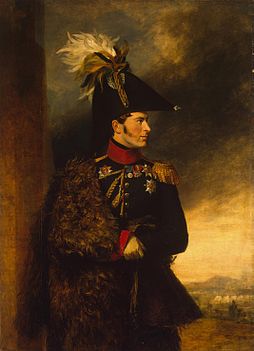 Portrait of Dow brush, 1826 | |||||||||||||
| |||||||||||||
| Predecessor | Arseny Andreyevich Zakrevsky | ||||||||||||
| Successor | Fedor Fedorovich Berg | ||||||||||||
| |||||||||||||
| Predecessor | Anton Vasilievich Moller | ||||||||||||
| Successor | Ferdinand Petrovich Wrangell | ||||||||||||
| Birth | August 15 (26), 1787 | ||||||||||||
| Death | April 19 ( May 1 ) 1869 (81 year) St. Petersburg , Russian Empire | ||||||||||||
| Rod | Menshikovs | ||||||||||||
| Father | |||||||||||||
| Mother | |||||||||||||
| Children | Vladimir | ||||||||||||
| Autograph |  | ||||||||||||
| Awards |
| ||||||||||||
| Military service | |||||||||||||
| Years of service | 1809-1856 | ||||||||||||
| Affiliation |  Russian empire Russian empire | ||||||||||||
| Type of army | |||||||||||||
| Rank | adjutant general admiral | ||||||||||||
| Battles |
| ||||||||||||


Content
Biography
Alexander was born in 1787 in the family of Lieutenant-General Prince Sergey Alexandrovich Menshikov (1746-1815) and Princess Ekaterina Nikolaevna Golitsyna , one of the first beauties of her time. According to the zlogyazny Dolgorukov , his biological father was the famous Lovelace Armfeld . He had a younger brother Nicholas and sisters Elizabeth and Catherine. Received home education; attended lectures at the best universities in Germany.
In 1805, in the 18th year, he came from Dresden to Russia and was hired by the collegiate cadet (or cadet collegium ) in the College of Foreign Affairs ( St. Petersburg , English Embankment , 32). The following year, he was granted the rank of Junker chamber . At first he was numbered with the Russian mission in Berlin , and then, since 1807, he was at the mission in London ; some time was attache in Vienna .
Military Service
Russian-Turkish War
July 15 (Art. Style) in 1809 began military service: he entered the Lieutenant Lieutenant Lieutenant in the artillery battalion. In 1809–1811, he participated in the Russian-Turkish war , consisting of an adjutant under the commander-in-chief of the Moldovan army, General of Infantry, Count N. M. Kamensky (Kamensky 2nd).
May 20, 1810 participated in the battle of the crossing of the Danube and the taking of fortifications Turtukai ; From 24 to 29 May - during the siege of Silistra . At the beginning of June 1810, Kamensky, the 2nd for two consecutive days (June 11 and 12), tried to seize the fortress of Shumla through an assault. Alexander Menshikov participated in the battle and "during the occupation of the heights was sent with arrows . " Convinced of the impossibility of taking fortified positions by force, Kamensky retreated, having lost up to 800 people, and decided to seize the fortress through a blockade.
On June 18, Menshikov was at the occupation of Jimi , and on June 25 and 26, when building siege batteries in front of Noisy and at repelling the enemy sally from the fortress. However, the blockade did not work, because the Turks were richly supplied with food. Then Count Kamensky 2nd decided first to take the fortress Ruschuk , and under Shumla left a detachment of 28 thousand people, appointing him the head of his brother. On July 22, Menshikov participated in the assault on Ruschuk, where he was wounded by a bullet in his right leg. From August 6 to September 15, he was at the construction of siege trenches and batteries against the fortress of Zurzha , and on October 15, during the capture of Nikopol .
In the same 1810, Menshikov received the first distinction - for military service he was awarded the Order of St. Vladimir of the 4th degree with a bow. In 1811, the 24-year-old Alexander Menshikov was granted aide-de-camp to Emperor Alexander I. Thus he entered the retinue of the emperor and often carried out his assignments.
Patriotic War and Foreign Campaigns
At the beginning of World War II, Lieutenant Prince Menshikov was appointed Divisional Quartermaster of the 1st Grenadier Division ( 3rd Infantry Corps ) in the 1st Western Army, and after that repeatedly served in the General Staff. He also participated in all battles in which the division took part, including the battle of Borodino . Being personally brave, for his distinction under Borodino on November 21, 1812, he was promoted to captain-general .
At the end of 1812, Prince Alexander Sergeevich was transferred to the Life Guards Preobrazhensky Regiment , promoted to lieutenant. In 1813-1814, he participated in foreign campaigns of the Russian army . On January 1, 1813, the Preobrazhensky regiment as part of the column of General Tormasov crossed the Neman River in the Highest Presence - the war with the French was transferred abroad to Prussia and the Duchy of Warsaw . January 16 Alexander Menshikov promoted to captain of the Life Guards Preobrazhensky Regiment . With the occupation of Berlin on February 20, the Russian army united with the Austrian; there, on 21 March, the regiment participated in the parade of troops in the presence of Emperor Alexander I and the King of Prussia Friedrich Wilhelm III [1] .
Captain Menshikov fell difficult task to get through the location of the enemy army of the French and pass to the commander of the Allied Northern Army and Crown Prince of Sweden, Jean-Baptiste Bernadotte [2] , the news that the Allied forces had joined and are taking offensive actions. He was sent from the city of Dungeon, accompanied by a small party of Cossacks. Menshikov fulfilled the assignment entrusted to him, after which he was with the crown prince until the capture of Leipzig . In May 1813, Bernadotte landed in Pomerania with the 30 thousandth Swedish army.
In July 1813, after the Plesvitsky truce, Bernadotte led the Northern Allied army of more than 100 thousand people. For successfully completing the assignment, Menshikov was awarded the Order of St. Vladimir of the 3rd degree (October 13, 1813) and the Swedish Order of the Sword . Distinguished in the battles of Kulm (August), Leipzig (October). September 20, 1813 for the difference in the battle of the Kulema was promoted to colonel. In March 1814, during the capture of Paris, he was again wounded in the leg. In 1814, for bravery, he was awarded the Order of St. Anne of the 2nd degree with diamond marks and on April 2, 1814 a gold sword with the inscription “For Bravery”.
After the death of his father in 1815, Alexander Sergeevich, as the eldest son, passed the Alexandrovo family estate, near Klin (now a rural settlement of Vozdvizhenskoye ) [3] . The Moscow Region " Cheryomushki " he inherited only in 1863, after the death of his brother Nicholas.
In the retinue of Alexander I
In 1816, February 15, he was appointed Director of the Office of the Chief of the General Staff E. I. In the same year, “for distinguished service”, he was promoted to major general with his Imperial Majesty in the quartermaster unit [4] . On December 16, 1816, during the reorganization, the General Staff of His Imperial Majesty was formed. The first head of the General Staff was appointed Adjutant General P. M. Volkonsky . [five]
In 1820, when Arakcheev had a great influence at court, he was offered the command of the Black Sea Fleet - in order to remove him from St. Petersburg; he refused because he had no idea about the maritime service.
At this time, Menshikov was known as a free-thinker. In 1821, together with Novosiltsev and Vorontsov , he drafted a plan for the liberation of landlord peasants, which was not accepted by the emperor. The proposal to take the place of the envoy in Dresden, well known to him, was considered by Menshikov as an insult. In November 1824, he retired and retired to the village, where he studied marine affairs.
Fleet leadership and the Crimean War
In January 1826, Nicholas I took the throne. In his reign "from the liberal, the prince became an ardent supporter of the existing order." [6] Menshikov returned to the civil service and was sent by the emperor on an extraordinary mission to Persia . Russia offered to cede part of the former Karabakh and Lenkoran khanates , but the envoy was received coldly at the Shah court. Menshikov was arrested and was in prison until 1827. Upon his return, he received instructions to transform the maritime ministry , which he performed with great energy.
In the Turkish campaign of 1828, commanding the amphibious detachment sent to the eastern shores of the Black Sea, captured the fortress of Anapa , after which he was appointed commander of the Russian troops, approaching Varna . Vigorously led the siege of this fortress, but was wounded by the core in both legs and was forced to leave the army.
In 1829, as chief of the naval headquarters, he assumed command of the naval forces of the Russian Empire; since 1830, was a Finnish governor-general . In 1833 promoted to admiral . In 1848 he was appointed chairman of the secret Committee on April 2 on the control of the press and censorship , which attracted the attention of Nicholas I to the two first Saltykov-Shchedrin stories. [7]
In 1853, for talks with Porto , he was sent as Extraordinary Ambassador to Constantinople . With the beginning of the Crimean War, on his own initiative, he arrived in Sevastopol , where he began to organize the land defense of the fortress. Long before the landing of the enemy, Menshikov determined the area of the future landing under Evpatoria . But, due to the lack of necessary forces, he could not oppose the landing.
During the battle of the river Alma in September 1854, Russian troops under the command of Prince A. S. Menshikov gave way to the superior forces of the British and French and were forced from Sevastopol to move to Bakhchisarai. Sevastopol remained to defend the Russian sailors under the command of Kornilov and Nakhimov .
After the Battle of Almina , on September 30, 1854, he was appointed commander-in-chief of land and naval forces in the Crimea and remained in that post until February 1855. His actions during the Crimean War are considered not very successful, he was criticized for his caution, Menshikov went down in history as the culprit of the Russian defeat in the war, although in recent times there have been attempts to revise this reputation.
In fact, he supervised the entire naval department and had a sharply negative impact on the development of the navy, hampering its technical progress and combat training. He proved himself a mediocre commander, lost the battle of Alma and Inkerman.
- Great Soviet Encyclopedia [8]
However, the battle of Alma ended quite decently for the Russian army, the enemy, having a nearly double margin in numbers, a considerable margin in guns, could not defeat the Russian troops, and its movement to Sevastopol slowed down, which allowed the defenders of Sevastopol to gain time to prepare for defense.
In high society, Prince Menshikov was famous for his slander and eccentricities. His acumen at one time enjoyed great fame, but many of them were only attributed to him. Menshikov was educated for his time remarkably; his library was one of the best in Petersburg [9] .
It is known that Prince Menshikov was skeptical about the construction of railways by his old enmity with the Minister of Railways, Count Kleinmichel .
In his jokes, the prince did not spare the departments of communications. When St. Isaac’s Cathedral , the permanent bridge across the Neva and the Moscow Railway were built , he said: “We will not see the completed cathedral, but our children will see; we will see the bridge, but our children will not see; and neither we nor our children will see the railway. ” When his skeptical prophecies did not come true, he said at the very beginning of driving by rail: “If Kleinmichel calls me to a duel, instead of a pistol or sword, I will offer him to both of us to go to the car and ride to Moscow. We will see who will kill! ”
- “ Old notebook ”
Retired
In the reign of Alexander II, Menshikov left his posts, but still took an active part in the preparation of legislative acts on the emancipation of the peasantry . According to Denis Davydov , he “knew how to adapt his mind to everything, but he could not make his mind out of a destructive creator” [10] .
Prince Menshikov died at the age of 81 and was buried in the Church of the Exaltation of his estate Alexandrovo, in the village of Klin district of the same name . In the post-war period, the temple was demolished, and the admiral's grave was lost. In the newly built rural church there is a memorial plaque in memory of Admiral Menshikov; it was cast from the blades of a nuclear submarine at the shipbuilding plant in Severodvinsk. On the initiative of Petersburg sailors headed by Rear Admiral G. N. Antonov, the bust of A. S. Menshikov was established and opened in the village on September 24, 2011 [11] .
Awards
- Order of St. Vladimir 4 st. with bow (1810)
- Order of St. Vladimir 3 st. (13.10.1813)
- Order of St. Anne 2 tbsp. with diamonds (1814)
- The golden sword "For courage" (04/02/1814)
- Order of St. George 3 tbsp. (06/15/1814)
- Order of St. Anne 1 tbsp. with diamonds (1827)
- Order of St. Alexander Nevsky (1829)
- Diamond signs to the Order of St. Alexander Nevsky
- Order of St. Vladimir 1 tbsp. (1833)
- Order of St. Andrew the First Called (1839)
- Diamond signs to the Order of St. Andrew the First Called
- Portrait of Emperor Alexander I adorned with diamonds for wearing in his buttonhole on the St. Andrew's ribbon
foreign:
- Swedish Order of the Sword , Knight (1st class) (1813)
- Swedish Order of Seraphim (06/12/1838)
- Diamond signs to the Swedish Order of the Seraphim (1848)
- Danish Order of the Elephant (02.06.1848)
Family
His wife is Countess Anna Alexandrovna Protasova (09/27/1978–03.12.1849), the niece of the chamber-maid of honor A. Protasova . According to the memoirs of K. I. Fisher , when the father notified Menshikov that he had found a bride for him and asked to come see her, he wrote in reply: “I have nothing to watch; I would also marry a goat if she had golden horns and she could give birth to Menshikov. " Countess Protasov, owner of 7,000 souls and masses of diamonds, was a fat, red, ugly woman, of a mind limited and without any education. Her conversations were limited to conversations with monks and pilgrims, and her activities were visiting churches and monasteries. Menshikov was horrified at the sight of his bride, but did not abandon her; to the admonitions of his friends, he replied that his future spouse was a bag that he would throw away after removing his heir from him. The marriage was unsuccessful. The princess tormented her husband with jealousy, which hurt his feelings. Little by little, the marital quarrels reached the point that the prince, who lived in a separate outhouse, communicating with the corridor to his wife's house, ordered to lay a brick entrance to the corridor - and since then the spouses, who already had a son and a daughter, were no longer seen [12 ] . Children.
- Vladimir Alexandrovich (1816–1893), adjutant general, cavalry general.
- Alexandra Alexandrovna (1817-1884), maid of honor of the court (1835), was raised by her mother, who lived in Moscow separately from her husband. In 1838, against the will of his father, she voluntarily married Ivan Yakovlevich Vadkovsky (1814-1865; the son of Ya. E. Vadkovsky , a classmate of Lermontov ). Regarding this choice, Grand Duke Mikhail Pavlovich said that he did not yet know a single person braver than Princess Menshikova, because she is not afraid to go out for such a desperate rake [13] . The father himself did not name the daughter other than “cette femme infernale” —this unbearable woman. Being the constant friend of Countess Lidia Nesselrode, Vadkovskaya was not interested in literature or public affairs, and was busy only with a bold manifestation of the most reckless fun.
Ancestors
Notes
- ↑ Life Guard Preobrazhensky Regiment. Fighting trips
- ↑ former Napoleon general, after the French left Moscow, Bernadotte broke off diplomatic relations with Napoleon in October 1812, and in the spring of 1813 joined the 6th anti-French coalition formed after the defeat of Napoleon in Russia
- ↑ Archived copy (inaccessible link) . The date of circulation is December 9, 2015. Archived March 4, 2016.
- ↑ The suite of E.I.V. in the Quartermaster Section — for some time the General Staff was called.
- ↑ http://www.vestnik-mgou.ru/mag/2009/ist_i_pol_nauki/3/st4.pdf (inaccessible link)
- ↑ Chapter 5
- ↑ RVB: M.Ye. Saltykov (N. Shchedrin)
- ↑ Menshikov Alexander Sergeevich // Great Soviet Encyclopedia : [in 30 t.] / Ch. ed. A. M. Prokhorov . - 3rd ed. - M .: Soviet Encyclopedia, 1969-1978.
- ↑ On the library of Prince Menshikov, see A. Ivanovsky , “ Count N. P. Rumyantsev ” (pp. 160-161).
- ↑ Lib.ru/Classic: Vyazemsky Peter Andreevich. L. Ginzburg. P. Vyazemsky. An old notebook. Notes . The appeal date is April 29, 2013. Archived April 29, 2013.
- ↑ Opening of the monument pr. A. S. Menshikov in sec. Vozdvizhensky in 2011
- ↑ K. Fisher. Notes senator. - M .: Zakharov, 2008. - 368 p.
- ↑ Ya. K. Grotto. Correspondence of J. C. Groth with P. A. Pletnev. V. 1. - SPb., 1896. - p. 60.
Literature
- Excerpts from the letters and papers of Menshikov, relating mainly to the time of the Crimean War, were published in the Russian Archive ( 1881 , Prince II, pp. 361–379) and in the Russian Antiquity ( 1875 , Vol. XII ; 1877 , t. XVIII and XIX; 1882 , t. XXXIV; 1884 , t. XLI, etc.).
- A.V. Butenin . A. S. Menshikov - statesman, courtier and man. Collection "From the depths of time" 1995. issue 5th Ss. 112-122
- Prince A.S. Menshikov. 1853-1854 Correspondence / Mess. and comments. A.D. Krylov // Russian olden time, 1873. - T. 7. - № 6. - P. 843-854.
- Prince A.S. Menshikov. (Obituary) // Russian Archive, 1869. - Vol. 6. - Stb. 1067-1076.
- Prince Alexander Sergeevich Menshikov. Anecdotes - Stuck and wit. // Russian antiquity, 1875. - V. 12 - № 3. - P. 638-653.
- Menshikov A. S. Letters of Prince A. S. Menshikov to Prince. M.D. Gorchakov. 1853-1855. // Russian antiquity, 1875. - V. 12 - № 1. - p. 174-196. - Under the heading: Defense of Sevastopol. , № 2. - p. 298-328.
- Journal of hostilities in the Crimea, September-December 1854 / comp. A. V. Efimov. - Simferopol: Antiqua, 2010. - 192 pp .: il, maps, portr. - (Archive of the Crimean War of 1853-1856). 500 copies
- Journal of hostilities in the Crimea, January-August 1855 / comp. A. V. Efimov. - Simferopol: Antiqua, 2016. - 304 pp .: il, maps, porr. - (Archive of the Crimean War of 1853-1856). 1000 copies
- A.S. Menshikov in the Crimean War. Diaries. Letters Memories. Part 1 / status A. V. Efimov. - Simferopol: Antiqua, 2018. - 288 p.
- A.S. Menshikov in the Crimean War. Part 2. Orders of 1853–1855 / status A. V. Efimov. - Simferopol: Antiqua LLC, 2019. - 280 p.