The Air Force and the Air Defense Forces of the Vietnamese People’s Army ( Vietnamese Không Quân Nhân Dân Việt Nam ) is one of the branches of the Vietnamese Armed Forces . Officially formed May 1, 1959 . The basis of the technical park consists of Soviet / Russian aircraft and helicopters. Vietnam has about 550 military aircraft and helicopters. The primary objective of the Vietnamese Air Force is to protect Vietnamese airspace and provide air cover for the operations of the Vietnamese People’s Army .
| Vietnam Air Force vietnam Không Quân Nhân Dân Việt Nam | |
|---|---|
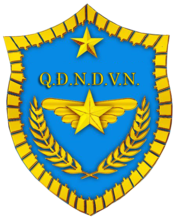 Emblem of the Air Force of Vietnam | |
| Years of existence | 1959 - n. at. |
| A country |  Vietnam Vietnam |
| Subordination |  Viet Nam Ministry of Defense Viet Nam Ministry of Defense |
| Enters into |  Vietnamese People's Army Vietnamese People's Army |
| Number of | 30,000 people (2009) 550 aircraft |
| Dislocation |  Hanoi (headquarters) Hanoi (headquarters) |
| Colors | azure , green |
| Participation in | operation "Linebacker" Operation Linebacker II Spring Offensive (1975) |
| Marks of Excellence |      |
| Commanders | |
| Acting commander | Lt. Gen. Phuong Minh Hoa |
Content
History
1945-1964 (North Vietnam)
The Democratic Republic of Vietnam was proclaimed throughout the Vietnamese territory of Ho Chi Minh in Hanoi on September 2, 1945 . The first aircraft of the Vietnamese army were two training aircraft - the British biplane Tiger Moth and the French high-wing Moran-Solnier , which belonged to the emperor Bao Dai [1] . In 1945, Bao Dai handed over the aircraft to the Vietnamese government. By December 1946, the anti-colonial uprising had become a full-scale national liberation war. The Vietnamese people's army conducted successful offensive operations on the ground, but it was practically powerless against the actions of French aviation.
On March 9, 1949, on the initiative of Vo Nguyen Ziapa, the Ministry of Defense took over the organization of the Air Force Research Committee (Ban Nghien Cuu Khong Quan) to study methods of air warfare. One of the first steps of the committee was the selection of candidates for pilots, technology, aviation meteorologists . The method of preparation was based on French instructions, and Germans and Japanese who were imprisoned since the end of World War II were attracted as instructors. The Tiger Mot and Moran-Solnier airplanes were used as training desks for pilots and mechanics .
The first Vietnamese pilot was Nguyen Dak Viet. August 15, 1949 Viet pulled away from the ground Tiger Moth . The pilot gained an altitude of 900 m when the plane unexpectedly went into a dive (apparently due to a technical malfunction). Viet miraculously planted a car that, after contact with the ground, was no longer subject to recovery. Nevertheless, the flight of Nguyen Duck Vieta entered the history of aviation in Vietnam : for the first time, an airplane with Vietnamese insignia rose in the sky of the DRV.
The further development of aviation in North Vietnam began in 1956 , when a group of 110 people was sent to study in the USSR and China . In China, they were to be trained on transport aircraft Li-2 and Mi-4 helicopters. A group of 30 people went to the Soviet Union, which were to master the Il-14 , An-2 , Mi-4 helicopters and MiG-15 fighter jets . The first group of pilots returned from China after three years of training and immediately began to transfer their experience and knowledge to others. At the beginning of 1959, the training of crews of IL-14 , An-2 , Li-2 and Mi-4 helicopters began. These crews were to become the base for the formation of a transport aviation regiment. The formation date of the 919th Aviation Transport Regiment (Trung Doan Khong Quan Van Tai 919) was May 1, 1959 , a few months later the 910th Aviation Training Regiment (Trung Doan Khong Quan 910 ) and the Air Force Aviation School (Truong Doan Khong Quan Viet Nam) . In 1962, several Vietnamese arrived in the USSR to learn how to fly on the most modern, then Soviet, MiG-21 fighter. There was an arrangement of runways . By the beginning of 1959, North Vietnam had a developed airfield network.
In June 1963, it was decided to combine the Air Force and Air Defense (Phong Khong - Khong Quan Nhan Dan Viet Nam) . In October 22, 1963, Colonel-General Fang Ti Tai became commander of the Air Force and Air Defense Forces.
1964-1974 (North Vietnam)
Training and combat aircraft T-28 "Troyan" was the first fighter of the Air Force of North Vietnam. He went to the Communists , when the pilot of the Royal Air Force of Laos hijacked the plane and flew with him to North Vietnam. Northerners used it as a night fighter. On February 15, 1964, it was on the T-28 Air Force that the DRV won their first air battle victory, having shot down the American C-123 transport provider Provider [1] .
The first pilots completed the course of piloting and combat use of the MiG-17 fighter in the USSR and the PRC by the end of 1962 , after which they returned to Vietnam. In February 1964, the first jet planes arrived in Hanoi from the Soviet Union - 36 MiG-17 fighters and training MiG-15UTIs . The 921st Fighter Aviation Regiment was formed, but it was based on the airfields of mainland China. The famous incident with the attack of the North Vietnamese torpedo boats of the destroyer of the US Navy "Maddox" , which occurred in August 1964 in the Gulf of Tonkin , gave rise to an air campaign against the DRV. The ministry urgently gave the command to the 921st Fighter Aviation Regiment to redeploy from China to its homeland: on August 6, the regiment arrived at Noybai airfield [1] . On September 7, 1964, the 923rd Fighter Aviation Regiment was formed. On the armament of the 923rd regiment were MiG-17 aircraft, in service with the 921st - MiG-17 and more modern MiG-21 . In the late 1960s , the Il-28 bombers appeared in service with Vietnam, but they were not used in combat. Later, in the early 1970s, the North Vietnamese IL-28 carried out a series of combat missions over Laos .
April 3, 1965 there was a first air battle between the North Vietnamese and American pilots. The Vietnamese Air Force claimed that they shot down two US Navy F-8 Crusader aircraft, but the losses were not confirmed by the Americans [1] . On April 3, the government announced Vietnamese Air Force Day. Already on April 4, the MiG-17 unit shot down two F-105 Tanderchif fighter-bomber, which flew at full bomb load to attack the Ham Zhong Bridge. The Vietnamese also suffered losses.
In order to make the best use of a limited number of fighters, it was decided to pull down all the aircraft in the area of Hanoi . The Air Force already had in service the MiG-21 fighter jets, which were not inferior in terms of the tactical data to American aircraft, but the MiG-17 remained the "workhorse" of the Air Force fighter regiments. The Air Force command had high hopes for the joint actions of the two types of fighters, which would allow the strengths of both types of aircraft to be used. However, in the first week of January 1967, the MiG-21s were subjected to crushing destruction by pilots of Colonel Robin Olds from the 8th tactical fighter air wing of the US Air Force : during Operation Bolo in two air battles, on January 2 and 6, the F-4C crews shot down nine MiG-21 fighters. Temporary combat missions MiG-21 had to stop.
The main task of the Vietnamese Air Force was to defend North Vietnam, therefore, until the last stages of the war, the DRV aircraft did not conduct air operations in South Vietnam . However, aviation sometimes performed raids on US Navy ships. April 19, 1972 there was a battle in the Gulf of Tonkin between several US Navy ships firing on the coast and the North Vietnamese Navy and Air Force. During the battle, the 250-kilogram bomb from the MiG-17 was destroyed by a five-inch feed weapon of the US destroyer "Higby . " For the US Navy , it was the first targeted US attack on US ships since the Second World War . Also, the Americans believe that they were the first to manage to shoot down a Soviet cruise missile. As a result of the battle, the Vietnamese retreated, and the Americans continued shelling the coast.
The main role in ensuring the air defense of the DRV was performed not by aviation, but by the Dvina S-75 anti-aircraft missile systems and anti-aircraft artillery. Most of the American aircraft were shot down by them. Vietnamese Air Force MiGs avoided collision with American fighters if they did not feel an advantage over them. The Americans had to force the Vietnamese to fight.
In February 1969, the Ministry of Defense decided to start the formation of the third fighter regiment. The 925th regiment began to be based at the Ienbay airfield, with the MiG-17 and J-6 fighters in service (the Chinese copy of the MiG-19 ).
Vietnamese air force fighters practiced ambush attacks. MiGs carried out an attack from several directions at once, and after they shot down several American planes, they forced others to drop their bombs prematurely and carry out anti-aircraft maneuvers. MiGs did not wait for a response and quickly retreated from the battlefield. Such a "guerrilla war in the air" gave its fruits. In December 1966, pilots of the 921 fighter regiment on the MiG-21 shot down 14 F-105 airplanes without suffering a loss (a total of 7 F-105 were lost in December 1966 in South-East Asia for all reasons) [2] [3] .
The US Navy and the Air Force had high hopes for the F-4 Phantom . Hoping that a large combat load, a perfect onboard radar complex, high speed in combination with the new tactics will provide an advantage over the MiGs. But when confronted with more maneuverable MiG-21 , F-4 began to suffer defeat. From May to December 1966, the United States lost 14-47 aircraft in air battles, destroying only 12 enemy fighters. From April 1965 to November 1968, 268 air battles were conducted over North Vietnam, the air force of the DRV claimed to have shot down 244 airplanes and lost 85 MiGs [4] [5] .
One of the largest air battles of 1972 took place on the morning of May 10 , when F-4 , A-6 and A-7 aircraft of the US Navy attacked Hajduong, as well as bridges to Layva and Fuloung. Vietnamese fighters took off to defend the ferries from the Kip airfield. The Vietnamese claimed that they shot down 7 Phantoms (the USA confirmed 5), the Americans managed to shoot down two MiG-21s , three MiG-17s and one MiG-19s [6] . On May 18, the Vietnamese shot down 4 Phantoms without losing any of the losses.
In total, in 1972, 201 air combat occurred between American and Vietnamese aircraft. The Vietnamese Air Force claimed that they lost 54 MiG (including 36 MiG-21), but shot down 90 US aircraft [4] .
The legend of the flight crew was the name of Colonel Thun . The legend of "Colonel Thune" appeared in the middle of the Vietnam War . During the battles between the People’s Air Force of Vietnam and the US Navy, American pilots were reportedly often seen belonging to the People’s Air Force MiG-17 aircraft with the number 3020 and MiG-21 with the number 4326, on their noses there were painted thirteen symbols of red stars, which This meant that these aircraft shot down thirteen enemy aircraft [7] . At the same time, while listening to radio messages exchanged by Vietnamese pilots with ground forces or among themselves, the Americans allegedly heard the regular repetition of the word “Tun” or “Tomb”. There is information that this word is the name of the legendary pilot. Since that time, the legend of the Vietnamese "superas" Thun. Most of the rumors about the "Tuna" spread among American pilots in the period from 1967 to 1972 : by that time he had become a kind of legend among pilots, and information about him was overgrown with all sorts of rumors. So, “Tuna” was soon “assigned” the title of “colonel”, and also “given” to him the name “Nguyen”, which was very common in Vietnam. Some documents also showed evidence that his name is “Nguyen Tun”. These rumors had an impact on the mental state of some American pilots, as a result of which they dropped bombs in a hurry before reaching the goal, or simply retreated when the MiG aircraft appeared.
Rumors continued to circulate until May 10, 1972 , when MiG-17 , number 3020, was reportedly shot down by an F-4 Phantom II US Navy , operated by lieutenants Randy "Duke" Cunningham (pilot) and William "Irish" Driskoll (navigator ). After this, the legend of "Colonel Thune" in the ranks of the pilots of the US Navy gradually faded away.
In December 1972, President Nixon decided to cut the Vietnamese knot with the help of the Strategic Air Command of the US Air Force. In the course of Operation Linebaker II, strategic bombers Boeing B-52 Stratoforthress carried out more than 3,000 missions and dropped about 40,000 tons of explosives. The main attacks came in the air defense system of North Vietnam. In a short time, the Americans almost managed to do something [ what? ] , which could not perform for many years [1] .
All the training airplanes of the air forces of the DRV were destroyed during the raids, after which the training of the pilots had to be transferred to the territory of China , but the aviation schools remained under the jurisdiction of the headquarters of the air forces of the DRV. At the end of 1973, the training process of cadets was able to be restored almost to the same scale that existed before the start of Operation "Laynbaker II". There was an acute shortage of materiel: there were up to ten cadets per plane. The training was conducted mainly on the MiG-17 of the 923rd air regiment dispersed throughout Chinese airfields. Although the Vietnamese reported 81 aircraft shot down during Operation "Linebaker II", the Americans recognized only 27 aircraft shot down (including 15 B-52 [8] ).
In May 1975, the war in Indochina came to an end - the tanks of the People’s Army of Vietnam entered Saigon - the capital of South Vietnam. On April 28, 1975, during the Spring Offensive, the DRV air force was subjected to the bombing of Tan Son Nhut ( Tan Son Nhat ) Air Force Base ( Bombing of Tan Son Nhut ).
During the Vietnam War, the Vietnamese air force exploited the MiG-17F, J-5, MiG-19 (J-6), MiG-21F-13, MiG-21PF, MiG-21PFM and MiG-21MF fighters [1] . The loss (see Plane losses in the Vietnam War ) of the aircraft of North Vietnam was about 154 MiGs [9] .
1975 present
In the final part of the Spring Offensive (Operation Ho Chi Minh), the Air Force of the DRV did not play a major role. The operation involved only six captured light attack aircraft Cessna A-37 "Dragonfly" . In order to prevent the possibility of air strikes by American aviation, the communist positions in South Vietnam redeployed C-75 anti-aircraft missile systems.
On September 15, 1972, the 372nd Air Division was formed from the 937, 918 and 917 regiments, and two days later the 370th Air Division appeared, which consisted of 925 Fighter Regiment (IAP), 917 mixed aviation regiment, and former South Vietnamese units. After winning the war, 877 aircraft of the former Air Force of the Republic of Vietnam were captured. Of these, 41 F-5 fighter and 95 light attack aircraft A-37 [10] . When Vietnam invaded Cambodia in 1979 , the A-37 was actively used to support ground operations, since these aircraft were more suitable for air strikes than MiGs. The F-5E , C-123 , C-130 and UH-1 captured from the air forces of South Vietnam were used by the Vietnamese air forces for many years after the end of the war.
May 31, 1977 air defense troops were created. The separate existence lasted until March 3, 1999 , when the Air Force swallowed up all the structures responsible for air defense, thus the two types of armed forces were reunited again [1] .
Between 1953 and 1991, about 700 combat aircraft, 120 helicopters, as well as 158 rocket complexes were delivered to North Vietnam from the USSR and the PRC . Even today, three-quarters of the Vietnamese weapons in service were supplied during the Cold War period [11] .
Today the Vietnamese Air Force is in the process of modernization. Late modifications of the MiG-21 and Su-22 aircraft [12] [13] are still being exploited, but there is a build-up of close military ties with Russia and the purchase of new fighters to gain air superiority in the Su-27SK . To date, Vietnam has 12 such aircraft. In 2004, the Vietnamese Air Force acquired 4 Su-30MK2 . In May 2009, a contract was signed for the supply of 12 such aircraft for naval aviation. A contract worth $ 300 million was signed for the supply of two modern S-300PMU-1 batteries. [11] In addition to the air defense missile system, air defense has about 300 anti-aircraft guns of 23, 37 and 57 mm caliber.
Perspectives
The Vietnamese government plans to replace the outdated Su-22 with a modern Su-34 , which is predominantly a naval strike aircraft as soon as the Su-34 is exported. It is planned to replace the L-39 UBS with a newer aircraft, the government is leaning towards the Russian Yak-130 . The plans provide for the purchase of 12 Yak-130 between 2015 and 2025 [14] . The most numerous aircraft of the Vietnamese Air Force is the MiG-21 , it is planned to continue its operation for another ten years, after which it will be replaced by another type of light fighter, possibly JAS-39 Gripen . The possibility of acquiring at least two DRLOU aircraft is being considered . The recently introduced CASA EC-295 is the preferred option [14] .
Ace Pilots
During the Vietnam War, many pilots of the Vietnamese Air Force were awarded the title " pilot-ace ." The air forces of North Vietnam did not separate the victories over unmanned reconnaissance aircraft from others. In total, 16 North Vietnamese pilots became asses during the war, which can be considered a great success for a country that had no fighter aircraft before 1964 . Almost all the aces flew the MiG-21 , only 3 pilots became aces on the MiG-17 [15] .
One of the pilots of asss should be considered, not included in this list, Air Force General Pham Tuan ( Phạm Tuân ) - the only pilot who ever shot down an American B-52 driving a light fighter. By his own admission, he knew the route of the bombers flying to the bombardment of his home province, he was driven by the desire to protect his fellow countrymen and going to the tail of B-52, he fired all the missiles and fought with fighter planes with only a cannon ammunition. After the war, Pham Tuan became a living legend in Vietnam. As a member of the Intercosmos program, he flew into space.
| Name | Victory | Aircraft | Subdivision | Years |
|---|---|---|---|---|
| Nguyen Van Kok | 11 (including 2 UAVs ) | MiG-21 | 921st Fighter Wing | 1967-69 |
| May Van Kuong | eight | MiG-21 | 921st Fighter Wing | 1966-68 |
| Nguyen Hong Ni | eight | MiG-21 | 921st / 927th Fighter Wing | 1966-72 |
| Fam Thanh Ngan | eight | MiG-21 | 921st Fighter Wing | 1967-69 |
| Dang Ngoc Ngy | 7 | MiG-21 | 921st Fighter Wing | 1966-72 |
| Nguyen Van Bey | 7 | MiG-17 | 923rd Fighter Wing | 1966-72 |
| Le Hai | 6 | MiG-17 | 923rd Fighter Wing | 1967-72 |
| Le Thanh Tao | 6 | MiG-21 | 927th Fighter Wing | 1971-72 |
| Luu hui tiao | 6 | MiG-17 | 923rd Fighter Wing | 1966-68 |
| Nguyen Dang Quin | 6 | MiG-21 | 921st Fighter Wing | 1967-68 |
| Nguyen Duk Soat | 6 | MiG-21 | 921st / 927th Fighter Wing | 1969-72 |
| Nguyen Ngoc Do | 6 | MiG-21 | 921st Fighter Wing | 1967-68 |
| Nguyen Nyat Chieu | 6 | MiG-17 / MiG-21 | 921st Fighter Wing | 1965-67 |
| Nguyen Tien Sam | 6 | MiG-21 | 921st / 927th Fighter Wing | 1968-72 |
| Wu Ngoc Dinh | 6 | MiG-21 | 921st Fighter Wing | 1966-70 |
| Nguyen Van Ngia | five | MiG-21 | 927th Fighter Wing | 1972 |
Structure
Divisions and regiments of the Air Force and Air Defense of the DRV
| Command | Division | Regiment | Name | Equipment | Base |
|---|---|---|---|---|---|
| High Command Air Force and Air Defense | Air Force Division 371 (Thăng Long Air Wing) | 921st Fighter Regiment | "A red star" | Su-22M-4 / UM-3K | Hanoi |
| 923rd Fighter Bomber Regiment | " Yenthe " (Yên Th) | Su-30MK2 | Shaowang | ||
| 927 Fighter Regiment | Lamson (Lam Sơn) | Su-30MK2 | Kep Air Base | ||
| 931st Fighter Regiment | Yenbay (Yên Bái) | Su-22M-4 / UM-3K | Yong Bai air base | ||
| 916th Helicopter Regiment | Bavi (Ba Vì) | Mi-6 , Mi-8 , Mi-24D , Mi-171 | Hua Lac Air Base | ||
| 918th Transport Regiment | Hongha (H (ng Hà) | An-2 , An-26 , An-30 , M-28 | Gia Lam Air Base | ||
| 372nd Air Force Division (Hai Van Air Wing) | 929th Fighter Bomber Regiment | Sontra (Sơn Trà) | Su-22M4 | Da Nang | |
| 930th helicopter regiment | Mi-8 , Mi-171 | Da Nang | |||
| 940th Fighter Regiment | Teyshon (Tây Sơn) | Сu-27СKM / УБК / ПУ | Quinёn | ||
| 370 Air Force Division (Lê Lợi Air Wing) | 937th Fighter Bomber Regiment | Hузu Giang | Su-22M-4 / UM-3K | Airbase Fan Rang | |
| 935th Fighter Regiment | Dong Nai (Đồng Nai) | Su-30MK2 | Ben Hoa Air Base | ||
| 917th Transport Regiment | Dong Thap (Đồng Tháp) | UH-1H , Mi-8 , Mi-171 | Tan Son Nhat | ||
| Air Force Aviation School | 910th training regiment | L-39C | Tuihua | ||
| 920th Training Regiment | Yak-52 | Kamran | |||
| 361st Air Defense Division | 218th Anti-Aircraft Artillery Regiment | Hoals (Hoa Lư) | ZSU-23-4 Shilka , C-75 Dvina , C-125 Pechora , 9K31 Strela-1 , 9K35 Strela-10 , Buk , C-300 Favorit , Pantsir -C1 " | Hanoi | |
| 280th Anti-Aircraft Artillery Regiment | Honglin (Hồng Lĩnh) | ||||
| 236th anti-aircraft missile regiment | Yes (sông Đà) | ||||
| 250th anti-aircraft missile regiment | "Hanoi" (Thăng Long) | ||||
| 257th anti-aircraft missile regiment | "Red flag" | ||||
| 64th anti-aircraft missile regiment | |||||
| 363rd Air Defense Division | 240th Anti-Aircraft Artillery Regiment | ZSU-23-4 Shilka , C-75 Dvina , C-125 Pechora , 9K31 Strela-1 , 9K35 Strela-10 | Haiphong | ||
| 213rd anti-aircraft missile regiment | |||||
| 238th anti-aircraft missile regiment | Halong (Hạ Long) | ||||
| 285th anti-aircraft missile regiment | Nam triều | ||||
| 365th Air Defense Division | 228th Anti-aircraft Artillery Regiment | Hamrong (Hàm Rồng) | ZSU-23-4 Shilka , C-75 Dvina , C-125 Pechora , 9K31 Strela-1 , 9K35 Strela-10 , Cube | Bakzyang | |
| 267th anti-aircraft missile regiment | Dien Bien (Điện Biên) | ||||
| 284th anti-aircraft missile regiment | "Songla" | ||||
| 375th Air Defense Division | 224th anti-aircraft artillery regiment | Tovinhdien (Tô Vĩnh Diện) | C-75 "Dvina" , C-125 "Pechora" , "Beech" | Da Nang | |
| 275th anti-aircraft missile regiment | Coxon (Sóc Sơn) | ||||
| 282nd anti-aircraft missile regiment | Tam Giang (Tam Giang) | ||||
| 377th Air Defense Division | 591st anti-aircraft artillery regiment | Truong Son (Trường Sơn) | C-75 "Dvina" , C-125 "Pechora" , "Beech" , "Cube" , "Armor-S1" | Kamran | |
| 274th anti-aircraft missile regiment | "Hungwings" (Hùng king) | ||||
| 367th Air Defense Division | 230th zenith artillery regiment | Thống nhất | C-75 "Dvina" , C-125 "Pechora" , "Cube" , C-300 "Favorite" | Ho Chi Minh City | |
| 261st anti-aircraft missile regiment | "Thanh Loa" | ||||
| 263rd anti-aircraft missile regiment | "Nguyen Hue" (Nguyễn Huệ) | ||||
| 276th anti-aircraft missile regiment | |||||
| 93rd anti-aircraft missile regiment |
Home Items
Some air bases in the south of the country were built by the French, Japanese, as well as the Air Force or the US Navy for South Vietnam. The northern air bases were built with the assistance of the USSR and the PRC during the Vietnam War.
- Kep Air Base
- Bien Hoa Air Base
- Dong Hoi (Airport)
- Hoa Lac Air Base
- Gia Lam Air Base
- An Sun Air Base
- Airbase Fan Rang
- Airbase Fan Son
- Aviation Base Frong Sa
- Tan Son Nhut Air Base
- Yong Bai air base
- Kamran (base)
- Hanoi (airport)
- Nha Trang (air base)
Air Force Museums
There are two Vietnamese Air Force museums: the Vietnamese Air Force Museum in Hanoi and the Vietnamese Air Force Museum in Ho Chi Minh City .
Sorts of troops
| Aviation | Anti-aircraft missile forces | Flak | Airborne | Radar reconnaissance |
|---|---|---|---|---|
Aviation technology
Most of the airplanes and helicopters were supplied from the USSR and China, but the Western technology, intended for South Vietnam, remained in service.
| A photo | Name | Producing country | Purpose | Modifications | amount | Comments |
|---|---|---|---|---|---|---|
| Training Aviation | ||||||
| Aero L-39 Albatros | Czechoslovakia | Combat training aircraft | L-39C [16] | 26 [17] | Subsonic jet combat training aircraft | |
| Yak-52 | the USSR | Sports training aircraft | Yak-52 | 36 | ||
| Strike aircraft | ||||||
| Su-30 | Russia | Multipurpose fighter | Su-30MK2 | 35 | More than 12 units ordered [18] | |
| Su-27 | Russia | Fighter gaining air superiority | Su-27SK / UBK [19] | 12 | Su-27SK: 7; Su-27UBK: 5 [20] | |
| Su-22 | the USSR | Fighter bomber | Su-22M3 / 4, Su-22UM3K | 38 [21] | + 50 units in storage 54 Su-22M3 / M4 were modified in 1998. | |
| MiG-21 | the USSR | Fighter | MiG-21bis, MiG-21 "Bison", MiG-21UM | 144 [21] | ||
| Transport aviation | ||||||
| CASA C-295 | Spain | Transport aircraft | C-295M | 3 | ||
| An-26 | Ukraine | Transport aircraft | An-26 | 30 [21] | ||
| An-2 | Poland | Light multipurpose aircraft | An-2TD | 15 | ||
| PZL M28 Skytruck | Poland | Light multipurpose aircraft | M-28 | one | In 2005, Vietnam purchased two PZL M28-1R (M-28B) from Poland. In November 2005, one PZl M-28 Vietnamese air force crashed [23] | |
| Helicopters | ||||||
| Mi-24 | the USSR | Attack helicopter | MI-24 | 26 [21] | ||
| Mi-8 | the USSR | Transport helicopter | Mi-8 | 70 | ||
| Mi-17 | Russia | Transport helicopter | Mi-17/171 | 68 | ||
| UH-1H Huey | USA | Multipurpose helicopter | UH-1H | 15 [17] | ||
| Eurocopter dauphin | France | Multipurpose helicopter | SA-365 N2 | 6 | ||
| AS 332 Super Puma | France | Multipurpose helicopter | AS-332L2 | eight | ||
Air Defense Technique
| A photo | Name | Producing country | Purpose | Modifications | The number of launchers | Number of missiles | Comments |
|---|---|---|---|---|---|---|---|
| Missile systems | |||||||
| S-300 | Russia | Long range missiles | S-300PMU-2 | 2 batteries (+4 ordered), 12 PU | 75 rockets (+150 ordered) | ||
| Beech | Russia | Medium range radar | Buk-M2E | 6 batteries, 36 PU | 200 missiles 9M317 | ||
| Pantsir-C1 | Russia | ZRPK short range | Pantsir-C1 | 12 cars | 300 missiles 9M311 "Pine-R" | ||
| S-125 "Pechora" | the USSR | Short range air defense system | S-125 "Pechora" 2TM | 30+ systems | Unknown | ||
| C-75 "Dvina" | the USSR | Medium range air defense system | S-75 Volga 2MB | 30+ systems | ~ 1000 rockets | ||
| Cube | the USSR | Medium range radar | 2Q12 | 10+ systems | 1600 rockets | ||
| Strela-10 | Russia | Short-range air defense system | 10M3MB Boom | 20 PU | 200 rockets | ||
| Strela-2 | the USSR | Portable anti-aircraft missile system | Arrow 2M | 100 PU | 350 rockets | ||
| Needle | Russia | Portable anti-aircraft missile system | Needle-C | 50 PU | 400 missiles | ||
| Flak | |||||||
| ZSU-23-4 "Shilka" | the USSR | Self-propelled anti-aircraft installation | ZSU-23-4M | 100 installations [24] | |||
| C-60 | the USSR | 57-mm anti-aircraft artillery complex | C-60 | 250 | |||
| 61-k | the USSR | 37mm automatic anti-aircraft gun | Double Barrel Version | 260 | |||
| ZU-23 | the USSR | 23 mm twin anti-aircraft gun | 2500 | ||||
| ZPU-4 | the USSR | 14.5 mm anti-aircraft machine gun | 1300 | ||||
Missile weapons
| A photo | Name | Producing country | Purpose | Modifications | Carriers | amount | Comments |
|---|---|---|---|---|---|---|---|
| X-59 Gadfly | Russia | Air-to-surface tactical missile | X-59MK X-59MK2 X-59ME | Su-30MK2 | 280 rockets | ||
| X-31 "Krypton" | Russia | Anti-submarine missile | X-31A X-31P X-31AM X-31PD | Su-30MK2 Su-27SKM | 80 rockets [25] more than 100 ordered | Delivered in 2012 [26] | |
| X-29 | Russia | Air-to-surface tactical missile | X-29T X-29TE | Su-30MK2 Su-27SKM Su-22M4 | 100 rockets | [27] | |
| Р-27 | Russia | Air-to-air missile | R-27EP Р-27Р P-27ET R-27T | Su-30MK2 Su-27 | [28] | ||
| R-73 | Russia | Air-to-air missile | R-73 | Su-30MK2 Su-27 | ~ 250 rockets [25] | [28] | |
| Р-77 | Russia | Air-to-air missile | BB-AE | Su-30MK2 Su-27SKM | |||
| X-25 | Russia | Air-to-surface tactical missile | X-25ML X-25MP / X-25MPU X-25MR | Su-22M4 | |||
| X-28 | the USSR | Anti-radar missile | X-28E | Su-22M4 | [29] |
Out of service:
- Czechoslovakia Zlín Z-226 Trener - Training (8)
- Czechoslovakia Aero Ae-45 - educational (3)
- Czechoslovakia Aero L-29 Delfin - Training (12)
- USSR Li-2 - transport (24)
- USSR IL-28 - tactical bomber (16)
- USSR IL-14 - transport (45)
- USSR IL-18 - transport (7)
- USSR MiG-15 - fighter (50)
- USSR MiG-17 fighter (77)
- Soviet Union MiG-19 - fighter (45)
- USSR Su-7 - fighter-bomber (30)
- USSR Yak-40 - transport (15)
- USSR Mi-4 - transport (1). Used by Ho Chi Minh
- NDP Mi-2 - transport (24)
- USA Douglas A-1 Skyraider - attack aircraft (21)
- USA Sikorsky H-34 - transport (34)
- USA Cessna A-37 Dragonfly - Light Attack Attack (95)
- US Northrop F-5 - Light multipurpose fighter
- US Northrop F-5E Tiger II - Lightweight Multi-Purpose Fighter
- United States Northrop F-5B Freedom Fighter - Training Fighter (3)
- USA C-47 Dakota - Military Transport (16)
- US C-119 Flying Boxcar - Military Transport (5)
- USA C-130 Hercules - Military Transport (4)
- USA CH-47 Chinook - Heavy Military Transport Helicopter (23)
- USA Cessna O-1 Bird Dog - aircraft targeting and communication (19)
- USA T-28 Trojan - Training (14)
- USA Cessna T-37 Tweet - Training (9)
- USA Bell UH-1 Iroquois - multipurpose helicopter (42). 15 UH-1H still in service
Some fighter jets ( F-5 and A-37 ) were sold in 1998, currently owned by private companies and individuals in America , Australia , New Zealand and Europe .
The current government procurement program for the Air Force and Air Defense of Vietnam includes the purchase of up to 3 regiments (12 airplanes each) of Su-30MK2 multi-role fighters until 2015 , and there are plans to purchase the modern Triumph S-400 missile system by 2017. [30] . In recent years, Vietnam has upgraded its air defense system with weapons such as the Pantsir- S-1 air defense missile system and the Beech air-defense missile system .
Symbols
Flag
Identification mark
Emblem
See also
- Vietnam war
- Air Force of the Republic of Vietnam
- Vietnamese Air Force Museum in Hanoi
- Vietnam Air Force Museum in Ho Chi Minh City
- Colonel Thun
Notes
- ↑ 1 2 3 4 5 6 7 Ivanov, SV Fighting use of the MiG-17 and MiG-19 in Vietnam (Unidentified) // War in the air. - 2000. - № 16 .
- Name Vietnamese Aces - MiG-17 and MiG-21 pilots . Acepilots.com The appeal date is August 9, 2013.
- ↑ Chris Hobson. Vietnam Air Losses. Midland Publishing, 2001, p. 82—84
- ↑ 1 2 Mig-21 against the Phantom (inaccessible link) . Archived November 29, 2014.
- Vietnam Air Losses: United States Air Force, Navy and Marine Corps Fixed-Wing Aircraft Losses in Southeast Asia, 1961-73. Chris Hobson. 2001. p. 271
- ↑ Vietnamese Air-to-Air Victories, Part 2
- ↑ Sherman, Stephen Randy Cunningham . Acepilots.com (October 2002).
- See “Published Government Documents” and “Secondary Sources” below.
- Igs Migs over North Vietnam: Combat Air Force in Combat, 1965-75, Stackpole Military History
- ↑ Toperczer (29) p. 80, 81
- ↑ 1 2 Blagov, Sergey . Russian missiles to guard skies over Vietnam (September 5, 2003).
- ↑ Su-17, -20, -22 FITTER (SUKHOI) . GlobalSecurity.org.
- ↑ MiG-21 FISHBED Undefeated . GlobalSecurity.org.
- ↑ 1 2 Vietnam Air Force: Defending the Heavens of the Motherland
- ↑ Bowers, Al Fighter Pilot Aces List . The Air University (May 17, 1999).
- ↑ Flightglobal Insight | World Air Forces 2011/2012
- ↑ 1 2 “World Air Forces 2013”. Flight International .
- ↑ Russia to Deliver 12 Su-30 Fighter Jets to Vietnam - Source (August 21, 2013). The appeal date is December 5, 2013.
- ↑ Ukraine to Repair Engines of Vietnamese Su-27 Aircraft (July 23, 2013).
- ↑ Multiple engine failure blamed for An-124 Irkutsk accident - 12/17/1997 - Flight Global
- ↑ 1 2 3 4 World Air Forces 2014 , Flightglobal
- ↑ Su-22: Xương sống trong tác chiến không đối hải của KQVN | soha.vn
- ↑ Báo Trung Quốc nói về máy bay tuần tiễu M28 của Việt Nam Archived November 19, 2011.
- ↑ ZSU-23-4 . Jane's Information Group (October 30, 2008). The appeal date is November 8, 2008.
- ↑ 1 2 Thống kê hợp đồng mua sắm đạn dược của Việt Nam | soha.vn
- ↑ Việt Nam mua tên lửa chống hạm siêu âm cho Su-30MK2 (July 18, 2008).
- ↑ Soviet Missiles: Air-to-Surface Missiles . Archived January 1, 2009.
- ↑ 1 2 Vietnam Arranges Event for Media for the Su-30MK2 Missile (April 1, 2013).
- ↑ Kopp, Dr. Carlo (August 2009), Soviet / Russian Tactical Air to Surface Missiles , Air Power Australia ( http://www.ausairpower.net ) , < http://www.ausairpower.net/APA-Rus-ASM .html >
- ↑ Việt Nam là khách hàng mua S-400 thứ ba , Vietnam Press (baodatviet.vn) (March 24, 2012). Archived August 15, 2012.
Literature
Published Government Documents
- Boyne, Walter J. . Linebacker II (Eng.) // Air Force Magazine: magazine. - 1997. - May ( vol. 80 , no. 11 ).
- Gilster, Herman L. Maxwell Air Force Base AL: Air University Press, 1993.
- Heading Up The Clouds: B-52 Operations During The Underground Racing And Doctrine . Maxwell AFB AL: Air University Press, 2002.
- McCarthy, Brig. Gen. James R. and LtCol. George B. Allison, Linebacker II: A View from the Rock . Maxwell Air Force Base AL: Air University Press, 1979.
- Nalty, Bernard C. Air War Over South Vietnam: 1969-1975 . Washington, DC: Center of Air Force History, 1995.
- Schlight, John, A War Too Long . Washington, DC: Center of Air Force History, 1993.
- Tilford, Earl H. Setup: What is the Air Force ? Maxwell Air Force Base AL: Air University Press, 1991.
- Thompson, Wayne, To Hanoi and Back: The US Air Force and North Vietnam, 1966-1973 . Washington, DC: Smithsonian Institution Press, 2002.
Secondary Sources
- Asselin, Pierre, A Bitter Peace, Washington, Hanoi and Chapel Hill: University of North Carolina Press, 2002.
- Ambrose, Stephen E., The Christmas Bombing in Robert Cowley, ed. The Cold War: A Military History , New York: Random House, 2005.
- Casey, Michael Clark Dougan, Samuel Lipsman, Jack Sweetman, Stephen Weiss, et al., Flags Into Battle . Boston: Boston Publishing Company, 1987.
- Dorr, Robert. Boeing's Cold War Warrior: B-52 Stratofortress . Osprey Publishing, 2000. ISBN 978-1-84176-097-1
- Drendel, Lou, Air War over Southeast Asia: Vol. 3, 1971-1975 . Carrollton TX: Squadron / Signal Publications, 1984.
- Hobson, Chris, "USAF / NAVY / MARINE Air Losses, USA, Fixed-wing aircraft losses Southeast Asia 1961-1973. 2001. ISBN 1-85780-115-6
- Karnow, Stanley, Vietnam: A History . New York: Viking Books, 1983.
- Lipsman, Samuel, Stephen Weiss, et al., The False Peace: 1972-74 . Boston: Boston Publishing Company, 1985.
- Littauer, Raphael and Norman Uphoff, The Air War in Indochina . Boston: Beacon Press, 1972.
- McCarthy, Donald J. Jr. MiG Killers: A Chronology of the US Air Victories in Vietnam 1965-1973. North Branch, Minnesota: Specialty Press, 2009. ISBN 978-1-58007-136-9 .
- Morocco, John, Rain of Fire: Air War, 1969-1973 . Boston: Boston Publishing Company, 1985.
- Pribbenow, Merle L. (trans) Victory in Vietnam University Press of Kansas, 2002. ISBN 0-7006-1175-4
- Zaloga, Steven J. Red SAM: The SA-2 Guideline Anti-Aircraft Missile . Osprey Publishing, 2007. ISBN 978-1-84603-062-8
Links
- Vietnamese's Air-to-Air Victories (English) . The appeal date is August 25, 2014.
- Vietnamese Aces (eng.) . The appeal date is August 25, 2014.
- Vietnam Air Force Museum (eng.) . The appeal date is August 25, 2014.
- Ace Pilots North Vietnam Aces (Eng.) . The appeal date is August 25, 2014.