Flavius Basilisk Augustus ( Greek Βασιλίσκος , Latin Flavius Basiliscus Augustus ) - Byzantine emperor (475–476).
| Basilisk | |||||||
|---|---|---|---|---|---|---|---|
| Greek Βασιλίσκος lat Basiliscus | |||||||
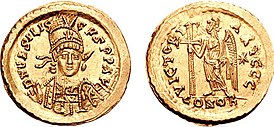 Solid of Emperor Basilisk | |||||||
| |||||||
| Predecessor | Zenon | ||||||
| Successor | Zenon | ||||||
| Birth | |||||||
| Death | Cappadocia | ||||||
| Kind | |||||||
| Spouse | |||||||
| Children | |||||||
| Religion | Orthodoxy | ||||||
Content
- 1 Biography
- 1.1 Management Board
- 1.2 Characteristic
- 2 notes
- 3 Literature
Biography
Board
The basilisk - the brother of Empress Verina , wife of the former Byzantine Emperor Leo I - in 475 took the imperial power from Zeno , who fled, taking with him the treasury of the empire. The basilisk was forced to raise taxes and return to the unpopular practice of selling government posts. In addition, the Basilisk set against himself many courtiers, including Verina, who, according to many historians, tried to enthrone her lover (executed by Vasilisk shortly after the coup), which led to a rapid decline in his popularity.
It was deposed after twenty months of reign, when Zeno, by intrigue and without bloodshed, was able to take the throne again in 476. Basilisk with his wife and children took refuge in the church and left there after Zeno's oath that their blood would not be shed. The basilisk, together with his family, was imprisoned in one of the fortresses in Cappadocia , where they all died a death of starvation (Emperor Zenon kept his oath and the death of Basilisk and his family was not accompanied by the shedding of blood).
During his reign, the Basilisk tried to expel the patriarch Akaki from the city, which provoked a rebellion against him, in which numerous Constantinople monks also participated. During the urban battles between the rebels and the troops loyal to Basilisk, as a result of the arson, the public library in Constantinople , numbering more than 120,000 manuscripts , burned down, many works of ancient masters also burned: Venus Knidskaya, Hera from Somos, Athena from Linda and others.
Feature
The basilisk was a fierce and uncultured man; he was a heavy mind and easily indulged in deceivers. His greed for money was exorbitant, he did not disdain to take it from persons who send the lowest crafts. When he became emperor, the collection of taxes made everyone shed tears [1] .
Notes
- ↑ Malch of Philadelphia . Byzantine history in seven books (passage 8).
Literature
- Basilisk, Byzantine emperor // Encyclopedic Dictionary of Brockhaus and Efron : 86 volumes (82 volumes and 4 additional). - SPb. , 1890-1907.
- Dashkov S. Emperors of Byzantium '