The battle of Stallupenen ( August 17, 1914 ) - a clash of advanced units of the Russian and German armies during the East Prussian operation on the Eastern Front of the First World War .
| Battle of Stallupenen | |||
|---|---|---|---|
| Main Conflict: World War I East Prussian operation (1914) 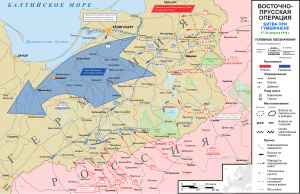 | |||
| date | August 17, 1914 | ||
| A place | Stallupenen , East Prussia | ||
| Total | The retreat of the German army | ||
| Opponents | |||
| |||
| Commanders | |||
| |||
| Forces of the parties | |||
| |||
| Losses | |||
| |||


The battle took place between the 27th and 25th divisions of the 3rd corps of the 1st Russian army gene. Rennenkampf and the 1st Army Corps under the command of gene. Francois of the 8th German Army.
Suddenly attacking the advanced Russian units, the 1st Army Corps of the German Army defeated the 27th Infantry Division of the Russian Army, but under the threat of encirclement from the 25th Infantry Division of the 3rd Corps and parts of the 20th Russian Corps, bypassing it from the north, retreated to Gumbinnen . The fact of the retreat of the German army can be seen as a victory for the Russian army.
Content
Background
To invade East Prussia, the Russian command allocates two armies under the command of Generals Rennenkampf and Samsonov . The 1st Army was ordered to speak on August 14, cross the border on August 17 , bypass the Masurian Lakes from the north and cut off the Germans from Koenigsberg . The 2nd Army was to perform on August 16 , cross the border on August 19 , bypass the Masurian Lakes from the west and prevent the German troops from leaving the Vistula .
In accordance with the general strategic plan of the German General Staff for the war against the Entente, the main forces of the German army - 102 divisions (7 armies) - were sent at the beginning of the war to the Western Front against France , and only one 8th army was left against Russia. The commander of this army, Colonel-General Maximilian von Pritwitz, decides to deploy a defense along the Angerapp River (in the area of which it was planned to defeat Rennenkampf , and then turn south against Samsonov's army).
Battle Progress
Covering the eastern part of the border was entrusted to the commander of the 1st Army Corps, Lieutenant General Francois .
On the morning of August 17, General Francois received a message that the advanced units of the Russian troops, having penetrated deeply into East Prussia, were advancing, opening their right flank to strike the enemy.
Then Francois began to act at his discretion, not paying attention to the instructions of von Pritvice to concentrate at Gumbinnen. On the morning of August 17, the 1st Army Corps, consisting of the 1st Infantry Division, the 2nd Infantry Division of General von Falck, the 2nd Brigade of Colonel Paschen and the 1st Brigade of Major General von Troth , far advanced , attacked the right flank of the advanced 27th infantry division of the 3rd Russian corps of the 1st Russian army near Stallupenen . Moreover, François was convinced that he was striking the northern flank of the entire Russian front, although the 25th division of the same corps went to the right of the 27th, and the 29th and 40th divisions of the 20th corps to the right. In doing so, he put his corps at risk of encirclement.
The 27th Russian Infantry Division, having suffered heavy casualties, began to retreat back to the border, losing about 6,600 people, of whom 3,000 prisoners were recaptured the next day in Stallupenen.
On the afternoon of August 17, Pritvice, having learned that Francois, in violation of the strategic plan, had advanced far ahead and got involved in the battle, ordered him to urgently withdraw his troops near Gumbinnen . General Francois ignored this order, arrogantly responding: “Tell General von Pritvice that General Francois will end the fight when he defeats the Russians.” The battle continued.
Towards the middle of the day, the Russians began to threaten to encircle the northern flank of the German corps and Francois brought into battle a grenadier regiment with artillery regiment units.
Towards evening, on the south wing, the 27th division of the 3rd Russian corps, which received a sensitive blow in the morning, continued to withdraw. On the north wing, on either side of Bilderweich, the Russians continued to cover the left flank of the Francois corps with superior forces, but the 1st Army Corps held back all Russian attacks before dark. After the victory on the southern flank, General Francois hoped the next day to enter the battle on the northern wing of the 3rd Infantry Brigade.
However, realizing that further resistance would lead to the encirclement of the corps, as well as receiving a new order from Pritwitz to withdraw troops to the Gumbinnen area, General Francois ordered the retreat on the night of August 18. Losses of the 1st Corps amounted to 1,200 people (killed, wounded, missing).
Pursuing hastily retreating to the west parts of the 1st Corps of Francois, the Russian troops captured Stallupenen in the morning of August 18, where they captured large trophies, including 7 guns, and also released all the soldiers of the 27th Division captured the day before.
Thus, according to the German side, the retreat on August 17 was tactical. Pritvitz decided on the Angerapp line to defeat the 1st Russian army under the command of von Rennenkampf, and then turn the troops against Samsonov's army.
Consequences
In the battle of Stallupenen, the German 1st Army Corps achieved significant tactical success with relatively small losses of about 1,200 killed and wounded, 84 of whom were captured. Russian forces suffered significant losses - 619 were killed, 2382 were injured, 4466 were missing (most of them were captured by German forces). The largest part of the casualties occurred in the Russian 27th Infantry Division, which lost 6,664 soldiers. The 105th Orenburg Regiment was almost completely defeated.
Despite its success, the 1st German Corps remained in a difficult situation - Russian forces, although they suffered significant losses, still had significant and ever-increasing numerical superiority. In this setting, François was forced to retreat, but, encouraged by his success, he persuaded Pritwitz to give a new battle a few days later at Gumbinnen .
Literature
- Zayonchkovsky, Andrei Medardovich The First World War. - St. Petersburg: Polygon, 2000 .-- 878 p. - ISBN 5-89173-082-0
- The history of the First World War of 1914-1918 / edited by I.I. Rostunov. - M .: Nauka, 1970. - T. in 2 volumes. - 25,500 approx.
- Basil Liddell Garth 1914. The Truth About World War I. - 1. - M .: Eksmo, 2009. - S. 480. - (Fracture of history). - 4300 approx. - ISBN 978-5-699-36036-9
- Gilbert, Martin (1994). The First World War: A Complete History. New York: Henry Holt and Company. ISBN 080501540X .
Notes
- ↑ Otto, Helmut, Schmiedel, Karl, Der erste Weltkrieg. Militärhistorischer Abriß, 3., völlig überarbeitete und ergänzte Auflage, Berlin 1977, S. 62.
- ↑ Reichsarchiv (Hrsg.), Die Befreiung Ostpreußens (Der Weltkrieg, Band 2), Berlin 1925, S. 76 sowie Anlage 2.
- ↑ Tannenberg 1914, Warszawa, 2005; p. 18.
- ↑ Tannenberg 1914, p. 18.