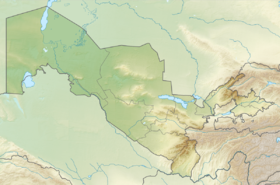
Uval Karabaur , Kara-Baur [1] ( Uzbek. Qorabovur, Қorabovur [2] , Kaz. Қarabauyr [1] ) - a hill in the center of the Ustyurt plateau [2] , in the Republic of Karakalpakstan as part of Uzbekistan and the Mangystau region of Kazakhstan .
| Uval Karabaur | |
|---|---|
| Uzbek Qorabovur , kaz. Қarabauyr | |
 | |
| Characteristics | |
| Dimensions | 220 × 120 km |
| Highest point | |
| Highest point | 290-292 m |
| Location | |
| Countries |
|
| Regions | Republic of Karakalpakstan , Mangystau region |



Content
- 1 Etymology of the name
- 2 Description
- 3 notes
- 4 Literature
Name Etymology
In the "Dictionary of Kazakh geographical names" the name of the oval is translated as "the foot protected from a snowstorm" [1] .
E. M. Murzaev connects the name Karabaur with the Turkic word Bair , which is systematically found in various toponyms, meaning “hill, hill”, possibly also “slope, wasteland”. He indicates that in Karakalpak language this word sounds like baur or bauyr , meaning " mountainside " [3] .
Description
The Karabaur Uval is a hill extended from the northwest to the southeast, having a length of 220 km. The width in the central part is over 120 km. The average height of the dump is 200 m, in the northwestern part reaches 290 m [2] . The highest point on the territory of Uzbekistan is 292 m [4] . The surface of the earth is flat, the side slopes are indented with sai [com 1] [2] . The lump delimits the Assake-Audan Depression from the north [5]
The rock is composed of Triassic , Jurassic , Cretaceous , Paleogene and Neogene rocks . Limestone of the Sarmatian stage with interlayers of marl and clay is typical of the surface. There are forms of karst relief, there are karst funnels with a diameter of up to 30 m and a depth of up to 16 m, in the lower part of which caves with lakes form [2] .
The climate of the hill is sharply continental . Winter is cold, the temperature reaches −30 ° С. Summer is long, hot (up to +44 ° С) and dry. No more than 150 mm of precipitation falls annually [2] .
The soil is gray-brown [2] .
The vegetation cover is rare, represented by wormwood , hodgepodge and other plants. Desert animals are found [2] .
Notes
- Comments
- ↑ Sayas in Central Asia refer to ravines with permanent or temporary watercourses, as well as the watercourses themselves (in particular, relatively small rivers experiencing sharp seasonal fluctuations in full flow or are completely dry).
- Sources
- ↑ 1 2 3 Konkashpayev, 1963 , p. 57.
- ↑ 1 2 3 4 5 6 7 8 Қrabovur - National Encyclopedia of Uzbekistan . - Tashkent, 2000-2005. ( Uzbek )
- ↑ Murzaev E.M. Selected Turkic geographical vocabulary // Onomastics of the East / Murzaev E.M. et al. - Nauka Publishing House. The main edition of oriental literature, 1980. - S. 81 .
- ↑ Uzbek Soviet Socialist Republic. Encyclopedia. - Tashkent: Main Edition of the Uzbek Soviet Encyclopedia, 1981
- ↑ Asakaovdon - National Encyclopedia of Uzbekistan . - Tashkent, 2000-2005. ( Uzbek )
Literature
- Khorabovur - National Encyclopedia of Uzbekistan . - Tashkent, 2000-2005. ( Uzbek )
- Konkashpaev G.K. Dictionary of Kazakh geographical names. - Alma-Ata: Publishing House of the Academy of Sciences of the Kazakh SSR, 1963. - P. 57. - 184 p.