Lee-Metford ( English Lee-Metford ) - British army rifle with a sliding bolt . In 1888, she replaced the Martini-Henry rifle , but in less than ten years she lost to the Lee-Anfield rifle.
| Lee metford | |
|---|---|
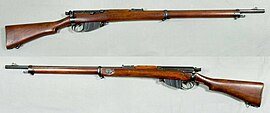 Shop Rifle Lee Metford | |
| Type of | magazine rifle |
| A country |  United Kingdom United Kingdom |
| Service History | |
| Years of operation | 1888 - 1926 years |
| Adopted | |
| Wars and conflicts | Boer war , Boxer Rise Colonial Wars of the British Empire, partly World War I |
| Production history | |
| Constructor | James Paris Lee |
| Manufacturer | Royal Arms Factory |
| Years of production | 1884-1896 |
| Options | MLM Mk II, carbine MLM Carbine, Charlton automatic rifle |
| Characteristics | |
| Length mm | 1257 |
| Barrel length mm | 767 |
| Cartridge | .303 Mk I |
| Caliber mm | 7.7 |
| Work principles | slide shutter |
| Rate of fire rounds / min | twenty |
| starting speed bullets , m / s | 621.8 |
| Sighting range , m | 730 |
| Maximum range, m | 1650 |
| Type of ammunition | 8- or 10-cartridge magazine |
| Aim | sliding aiming strip, fixed front sight |
Content
- 1 Design
- 2 Substitution for Lee-Anfield
- 3 Application
- 3.1 Rebellion of the Mahdists in Sudan
- 3.2 Boer War
- 3.3 Ceremonial weapons
- 4 Charlton automatic rifle
- 5 “A Minute of Madness”
- 6 notes
- 7 Literature
Design
The Lee Metford Magazine Rifle (MLM) combined James Pieris Lee's bolt pattern and William Metford's seven-rifle barrel design. An important improvement was Lee's slide shutter . The back handle of the shutter was located above the trigger and allowed the shooter to quickly control the weapon . The angle of rotation of the handle was reduced to 60 degrees against 90 degrees in some modern French and German rifles . A detachable box magazine with an increased capacity was introduced instead of an in-house Manlycher type. Shallow polygonal cutting of the Metford trunk bore prevented the formation of soot.
Replacing Lee Enfield
Despite progressive structural changes, the rifle was designed for .303 cartridges equipped with obsolete smoke powder . Soon, cartridges with smokeless powder ( cordite , ballistite , rayfllit ) that did not unmask the shooter and gave a high initial velocity of the bullet . However, as Li-Metford tests showed, for new cartridges deeper cuts were required due to the strong wear of the barrel , which became unusable after 5 thousand shots . Due to this design mismatch, as well as the delay in cordite production, the troops had to temporarily use smoky black powder cartridges for existing weapons.
During the short service, the store underwent improvements (increased from 8 to 10 rounds), sights and a fuse.
The Li-Anfield rifle that came to replace generally inherited the design of its predecessor, but was adapted to smokeless cartridges. Since 1895, the Lee-Metford rifle began to be replaced by the Lee-Anfield. A number of rifles were squandered and brought to the Lee Enfield standard of the SMLE modification . Commercial production of the sports model continued until World War II .
Application
Mahdist Rise in Sudan
The technical superiority of British soldiers , the use of Maxim's high- speed magazine rifles and machine guns ensured victory at Omdurman ( 1898 ).
Boer War
Replacing the rifle with a new model was delayed for several years, and the Lee-Metford was still in service in some regiments by the beginning of the Second Boer War ( 1899 ). The clash with a civilized adversary equipped with modern weapons ( Mauser 1895 ) revealed the weaknesses of British tactics and the shortcomings of the rifle itself . The British significantly lost in accuracy at distances over 360 meters. The experience of the war was summarized in the design of the Mauser-like rifle “Pattern 1913 Enfield”, which was not implemented due to World War II.
Ceremonial Weapons
Lee Metford is now accepted as a ceremonial weapon in the company of the Atholian Scottish Riflemen .
Charlton Automatic Rifle
A number of old copies of Lee-Metford and Lee-Anfield were converted into experimental self-loading rifles, for example, according to the Howell project or the Ryder project ( South African Union , 1940 ). The more famous is the design of an automatic rifle proposed by a New Zealand engineer Philip Charlton [1] .
During World War II, most of the New Zealand units operated away from their homeland, in northern Africa . Japan's entry into the war posed a threat to the islands and discovered a shortage of machine guns for local defense. The lack of machine guns "Bren" forced to look for ways to convert old weapons into automatic. Since 1942, more than 1,500 units were manufactured for the New Zealand government [2] , made, in particular, from Lee-Metford rifles.
A small number of converted rifles are preserved in museums and private collections .
The Minute of Madness
The term “Minute of Madness” refers to the pre-war standard requiring British soldiers to fire 15 aimed shots per minute at a 30- cm target at a distance of 270 meters . The rate of fire recorded in 1914 is 38 shots and belongs to instructor Sergeant Major Snoxhall. During world wars, soldiers often overlapped the standard “minutes of insanity”.
Notes
- ↑ Special Service Lee Enfields: Commando and Auto Models by Ian Skennerton. Published by Ian D Skennerton, PO Box 80, Labrador 4215, Australia, 2001. ISBN 0-949749-37-0 .
- ↑ Skennerton (2007), pp. 37–38
Literature
- Lee-Enfield Arms & Militaria Press, Gold Coast QLD (Australia), 1997. ISBN 0-949749-25-7 .
- Skennerton, Ian: Small Arms Identification Series No. 7: .303 Magazine Lee-Metford and Magazine