Maakia Amurskaya [2] , or Kladrastis Amursky [3] ( lat. Maackia amurensis ) is a species of dicotyledonous plants of the Maakia genus ( Maackia ) of the Bean family ( Fabaceae ). The species was first described by the Russian-Austrian botanist Franz Ivanovich Reprecht [4] .
| Maakia Amur |
 |
| Scientific classification |
|---|
| The kingdom : | Green plants |
|
| International Scientific Name |
|---|
Maackia amurensis Rupr. |
| Security status |
|---|
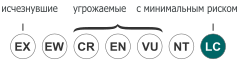
Least concernIUCN 3.1 Least Concern : 19892768 |
|
The other ( trivial ) name is Maak's Acacia ; among locals, the tree is also known as “Amatnik Amur” [3] .
Content
General view of the leaves and inflorescences of the Amur maakia
It is widespread in the People’s Republic of China ( Hebei , Heilongjiang , Jilin , Liaoning , Inner Mongolia , Shandong provinces), on the Korean Peninsula and in Russia . In the wild, it is found in forests, on hillsides at an altitude of 300–900 m [5] .
Deciduous tree or shrub. Shoots are upright, the leaf position is next. The sheet is complex, with a sharp top and a smooth or folded edge; egg-shaped plate with feathery segmentation, petiole; young leaves are pubescent. The raceme is inflorescence, bears five-petal white flowers with some shades of 1-2 cm in size. The fruit is a bean , brown or green [3] .
Mesophytic , mesotrophic , shade-tolerant plant [3] .
The number of chromosomes - 2n = 18 [6] .
Cultivated. Used as an ornamental, medicinal and technical plant [3] . Can be grown in parks, roadside sites, city streets [7] .
Wood is weakly affected by rotting , and therefore it is used for the manufacture of well log cabins, furniture, plywood, wooden parts of tools, etc. [8] .
Maakia Amurskaya is listed in the Red Book of the Amur Region of Russia [3] . The plant is absent in the Red Book of Russia, as this species is widely distributed in the Primorye Territory and is easily self-renewing. .