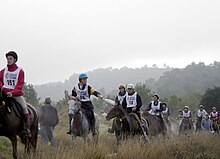
Remote horse racing is a discipline of equestrian sport , in which the championship is determined by the best time for the athlete to ride a horse , provided that its physiological parameters are normal [1] .
Content
Discipline conditions
Remote horse runs (DCT) are aimed at developing distance horse endurance and the ability of a rider to correctly calculate the physical capabilities of a horse at a distance. Competitions in runs are held in natural conditions, on a specially marked track, with measurement of the time taken to complete the course and with veterinary control of the horse throughout the competition. Horse runs can be carried out with a limited speed (usually no more than 16 km / h at distances of 30-40 km, sometimes 80-90 km per day) and without speed limits (at distances up to 160 km per day) [1] . Within the framework of the race competition, a competition for the best condition of the horse (Best Condition) [1] may be held.
The rules for race competitions vary widely from country to country. For example, in South Africa, a special system of handicaps is used in equestrian competitions, not only by the weight of the rider, but also by speed, which makes it possible to equalize the chances of athletes [2] . In France , the national regulation spells out more than ten options for "club" runs (from a distance of 10 km with an average speed limit of 6-8 km / h to 60 km at a speed of 12-15 km / h) and several options for "amateur" runs (from a distance 20 km at a speed of 12-15 km / h to a distance of 160 km without speed limits) [3] . Time-less informal equestrian events are also popular in the United States , where the complexity of the natural obstacles overcome by riders on a route is rated in points .
The Equestrian Federation of Russia is constantly conducting systematic work to bring the national rules on the PrEP in accordance with the rules of the International Equestrian Federation [4] [1] .
Horses of any breeds can participate in competitions, however, horses of the Arabian breed dominate in high-level races (world championships, European championships, etc.) due to their natural endurance and features of breeding work [5] . Also very popular are the Anglo-Arab crossbreeds, showing high speed in runs.
Features of qualification runs
- In free speed racing competitions (no speed limit)
- the transit time of the intermediate stages stops at the moment the horse enters the zone of veterinary control, based on this time the speed at the stage is calculated;
- the passage of the final stage stops at the moment of crossing the finish line;
- determination of winners and classification of participants is carried out according to the best (least) time of passing the entire distance, subject to successful completion of the final veterinary inspection [1] .
- In limited speed competitions
- the passage time of each of the stages stops at the moment of crossing the finish line, based on this time, the speed at the stage is calculated;
- speed at each stage should not exceed the maximum allowed speed;
- determination of winners and classification of participants is carried out according to the best (smallest) total time taken for the entire distance and horse recovery time between stages (with the exception of recovery time after the finish), provided that the final veterinary inspection is successfully completed [1] .
History of DCT
It is believed that horse races originate in Arabia , where the Bedouin nomads, having discovered that horses in the desert can move faster than camels , began to experience Arabian horses in races. Later in other countries, runs began to be used as an important element in the preparation of cavalry [6] .
In pre-revolutionary Russia, runs were one of the most common types of army competitions. A remarkable example of the endurance of a local Amur horse was shown in the race of 1890, completed by the Cossack centurion Peshkov, who traveled 8862 km on the Serko gelding from Blagoveshchensk on the Amur to St. Petersburg in 193 days. In 1895, another Cossack officer on the run from St. Petersburg to Chita covered 7009 km in 112 days. In 1899, Cornet Aseev rode on horseback from Luben (Poltava province) to Paris . For the run, he used two mares, on which he rode alternately. On average, they covered about 88 km per day, and 110 km were covered in the last crossing directly in front of Paris.
In the USSR, already in the first post-revolutionary years, high-speed runs per 100 km were widely practiced, in which, along with other horsemen, the outstanding Soviet military commanders S. M. Budenny and K. E. Voroshilov took part. In 1931, an excellent time was shown on the improved Kabardian mare Aze in a 100-kilometer run - 4 hours 25 minutes. In the maximum daily runs before World War II, the best result was shown by MF Moiseev-Cherkassky, who in 23 hours 30 minutes. overcame a distance of 252 km.
In 1946, in the Salsk - Rostov race, conducted in hot weather, at a temperature reaching 40 ° C, on Budennovskaya horses (how could the breed bred in 1948 participate in the race 1946 ??? We answer: in 1948 the Budyonnovsky breed of horses It was officially registered, but work on its breeding began long before that, and the 1946 run was one of the tests for new breed horses) and Don breeds, 200 km were covered in 18 hours. 25 minutes
In 1947, the maximum daily run was held in Kazakhstan (Urdinsky stud farm), in which participants competed on Don and cross-country Kazakh horses. The rider, who won first place (281.9 km), rode on the Anglo- Kazakh gelding Katka. The run took place on a trotting gait, and after each hour, the participants stopped for 5-10 minutes.
In 1948, in the Urdinsky stud farm on the Don stallions Zazhim and Kagale and the Anglo-Kazakh Talisman, 283.5 km were covered in daily runs, and the next year the record was improved to 301.2 km in the cross-breeding stallion Saigak.
In 1950, in the Degeres stud farm (Alma-Ata region), 11 horsemen on Don, Budyonnovsky and Anglo-Kazakh stallions participated in the daily run; 8 of them covered 305 km, one 272 km, one 242 km and one rider was eliminated before the end of the competition due to the horse’s accidental limp. It is noteworthy that the winners of the run Don stallions Bandurist and Dobry the next day went another 130 km, returning to their farm - the Kurdai stud farm.
In the same year, on the stallions of the Budyonnovsk breed Zanos and Brev Boe from the stud farm them. S. M. Budyonny covered 309 and 304 km, respectively, and in 1951 at the Degeres stud farm on the Donekino- Kazakh stallion Zenith all previous achievements were improved, and in the daily run (20 hours on the move, 4 hours rest ) a record distance of 311.6 km was covered.
In 1951, to find out the maximum endurance of horses in the stud farms of the Rostov Region, a multi-day race without days was conducted, in which riders on the stallions Zanos and Brev Boe, as well as on the mares Kassa, Paratrooper and Daughters of Bukvarka, took part. In this race horses traveled 120 km daily, and 15 days after the stallions traveled 1800 km and the mares 1775, the race was completed. After his graduation, the horses felt great. [7]
Special preparation for the runs took up to 4 months and consisted of daily systematic work with gradually increasing loads. Trained horses at different times of the day. During preparation for the runs, trotting took at least 50% of the entire time, and the runs themselves were carried out almost exclusively on this gait . In the last period of the training, preceding the run itself, the horse’s willingness to bear a high load was revealed in one or two control runs on 60-75 km [7] .
DCT in the world
In foreign countries, initial remote testing of horses was especially popular in the United States and Great Britain , where in the thirties of the 20th century their conduct was streamlined and began to pass under veterinary control. However, the main goal of these tests was not sports, but breeding work for horses for the needs of the cavalry . For example, in the USA, cavalry horses were tested on five-day 300-mile (483 km) runs, with each horse carrying a load of more than 200 pounds (91 kg) [5] .
The date of the birth of runs in their modern sporting form with strict veterinary control can be considered 1955, when Wendell Roby with a group of riders overcame the most difficult route from Lake Tahoe to the city of Auburn ( California ) through the Sierra Nevada mountain range in less than a day. Since then, sporting runs for 100 miles (160 km) on steep mountain slopes have been held here regularly and are called the Tevis Cup. This is one of the most challenging race events in the world. .
In the 60-70-ies of the XX century, racing sports began to develop in Europe , Australia , New Zealand and South Africa. In addition to the most responsible and prestigious competitions for 100 miles (160 km), there were many runs and shorter distances in which both experienced riders and amateurs took part. The mandatory presence of strict veterinary control has become a distinctive feature of modern runs.
Since 1978, Remote Equestrian Racing has been recognized as an equestrian sport by FEI .
In the 90s of the XX century, athletes from the UAE and other Arab countries began to take part in the runs. This led to a significant inflow of capital and, as a result, an increase in the number of large international competitions. Further rapid development of this sport in the world has led to the fact that currently in the ranking of the International Equestrian Federation (FEI), horse racing ranks second after the competition in the number of international competitions held. The main race competitions are held at the World Equestrian Games and at the FEI European Endurance Championships [5] .
In 1998, the UAE hosted the first World Equestrian Championship . Horse races in the UAE are very popular, the venues are very well equipped technically, however, in early 2015, due to a large number of violations of the rules for conducting competitions in the DCE, the UAE's membership in the FEI was suspended [8] , and all competitions in the UAE were excluded from FEI calendar [9] . In July 2015, the UAE's membership in the FEI was restored, but in early 2016, conflicts between the FEI and the UAE Equestrian Federation again led to the scandalous cancellation of international starts in Dubai on March 19, 2016 and the cancellation of the World Cup scheduled for December 2016. on runs in the UAE.
In 2018, the World Equestrian Championship was to be held at the World Equestrian Games in Tryon (USA), but due to many errors and misunderstandings in the work of the organizing committee and the technical delegate, the competitions were stopped, then started again, and then were canceled with a big scandal , and already after most of the distance was covered by the participants [10] .
Current State of Runs in Russia
In Russia, dozens of competitions in distance horse racing are held annually in different regions. International and All-Russian competitions, such as the Championship of Russia, the Sodruzhestvo Cup, the Cup of Russia, have been and are being held in the Moscow Region , Leningrad Region , Tver Region , Ryazan Region , Vladimir Region , Tyumen Region , Stavropol Territory , the Republics of Kabardino-Balkaria , Karachaevo Circassia , Tatarstan [11] . Currently, sports training for distance horse racing is regulated by Order of the Ministry of Sports of the Russian Federation N 402 dated June 18, 2013 [12] .
Notes
- ↑ 1 2 3 4 5 6 Rules of Competition for DCT .
- ↑ South Africa Equestrian Association
- ↑ French Equestrian Federation
- ↑ Rules on the FEI website
- ↑ 1 2 3 FEI site
- ↑ FCC website of St. Petersburg
- ↑ 1 2 Horse breeding and equestrian sport. Ed. prof. Yu. N. BARMINTSEVA. Moscow, Kolos, 1972, 319 pp. with silt. UDC 636.1 + 798.2
- ↑ FEI News, March 2015
- ↑ FEI News, February 2015
- ↑ FEI News, September 2018
- ↑ Calendar of competitions in DCT
- ↑ Order of the Ministry of Sports of the Russian Federation of June 18, 2013 N 402 “On approval of the Federal standard for sports training in the sport of equestrian sports” (registered by the Ministry of Justice of Russia on July 23, 2013, Registration N 29134).