Greece is an industrial-agrarian country, occupying 37th place in the world in terms of gross domestic product (GDP) growth and 33rd - in purchasing power parity [ when? ] . According to the 2007 Human Development Index , Greece ranked 25th in the world and belonged to the “ developed countries ” group [7] . However, due to the global economic crisis [ specify ] Greece's economy is in a very difficult position [to clarify ] . In March-July 2013, as a result of the ongoing economic crisis of 2008-2013, Greece for the first time in the practice of world financial agencies lost the status of a developed country and returned to the category of developing [8] [9] [10] [11] .
| Greek economy | |
|---|---|
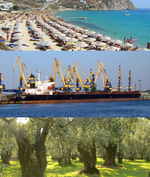 Greek agriculture, shipping and tourism, important sectors of the Greek economy | |
| Currency | 1 euro (= 100 euro cents ) |
| Fiscal year | calendar year |
| International the organization | EU , WTO , OECD , BSEC |
| Statistics | |
| GDP | ▲ $ 312.538 billion (PPP) [1] ▲ $ 218.57 billion (face value) [1] |
| Place by GDP | 57th place (faculty) / 52nd place (nominal) |
| GDP growth | ▲ 2.2% (Q3 2018) [2] [3] |
| GDP per capita | ▲ $ 29 111 (PPP, 2019) [1] ▲ $ 20 311 (face value, 2019) [1] |
| Inflation ( CPI ) | 0.8% (September 2017) |
| Population below the poverty line | 23.4% (2015) |
| Human Development Index (HDI) | 0.942 (2007) |
| Economically active population | 4.96 million |
| Pre-tax average salary | € 1060.45 / $ 1224.25 per month (2019) |
| Post-tax average salary | € 890 / $ 1027.15 per month (2019) |
| Unemployment rate | 17.6% (April 2019) [4] |
| Major industries | tourism , metallurgy , food industry , tobacco production , textile industry chemical industry mining industry |
| International trade | |
| Export | 30.2 billion [5] (2017) |
| Export Articles | petroleum products , medicines , food , chemicals , textiles |
| Export partners |  Italy - 11% Italy - 11% Germany - 7.7% Germany - 7.7% Cyprus - 6.1% Cyprus - 6.1% Turkey - 5.4% Turkey - 5.4% Bulgaria - 5% Bulgaria - 5% USA - 4.4% USA - 4.4% Great Britain - 4.2% Great Britain - 4.2% Lebanon - 4.2% Lebanon - 4.2% Egypt - 3% Egypt - 3% Romania - 3% Romania - 3% |
| Import | 52.8 billion [5] (2017) |
| Import Articles | crude oil and petroleum products , medicines , vehicles , computer equipment , metals |
| Import partners | Germany - 11% Italy - 8.3% China - 6.7% China - 6.7% Russia - 6.6%, Russia - 6.6%, Netherlands - 5.5% Netherlands - 5.5% Iraq - 5.5% Iraq - 5.5% France - 4.4% France - 4.4% South Korea - 4.2% South Korea - 4.2% Spain - 3.6% Spain - 3.6% Belgium - 3.6% Belgium - 3.6% |
| Public finance | |
| State debt | 152.6% of GDP [6] |
| External debt | 330 billion euros (December 2010) |
| Government revenue | 126.5 billion |
| Government spending | 144.4 billion |
General characteristics
Greece is an industrial-agrarian state with an average level of development of production. The public sector provides about half of the GDP . Highly developed wholesale and retail trade. The country has an extensive banking system . The activities of insurance companies have become widespread, and the volume of exchange operations is growing rapidly. Main industries: textile (dominates), chemical, petrochemical, tourism, food and tobacco, mining, paper, cement, metallurgical. Electrical engineering, some types of mechanical engineering, and the production of building materials are developing. Transport: road (provides 60% of all domestic freight and passenger traffic), rail is poorly developed, maritime (30% of domestic and 90% of external freight and passenger traffic), air. Main seaports: Piraeus , Thessaloniki , Elefsis , Volos . Greece has the third largest merchant fleet in the world. There are 40 airports, of which 22 are international. The largest center - the airport "Eleftherios Venizelos" in Athens - is one of the most modern in Europe and the world.
According to the Index of Economic Freedom , compiled by The Heritage Foundation , USA , as of 2010, Greece ranks 73rd in the world [12] : GDP - $ 330.0 billion. The GDP growth rate is 2.9%. GDP per capita is $ 29,361. Foreign direct investment - $ 6.6 million. In 2010 , Greek Prime Minister Yorgos Papandreou signed a Memorandum of Understanding with the Government of Qatar - an investment package worth $ 5 billion. Arab entrepreneurs have already invested in the construction of Astakos port power plants, a terminal for liquefied gas and a biofuel production plant. In addition, the Qatar State Investment Fund has expressed direct interest in developing the territory of the former Athenian airport “ Elinikon ” in Elinikon [13] [14] . According to the Bank of Greece , in 2013, 168 million euros were invested in Greek real estate from abroad (twice as much as in 2012). The total volume of such investments in 2012-2013 amounted to 285 million euros [15] .
Import (machinery and equipment, oil and oil products, minerals, consumer goods, food) - US $ 22.2 billion (mainly Italy - 15.6%; Germany - 15.5%; USA - 11.1% ; France - 8.3%). Export (raw materials - bauxite, nickel, manganese, agricultural products - tobacco, textiles, olive oil, vegetables, fruits, canned foods, cereals) - 12.9 billion US dollars (mainly Germany - 25.5%; USA - 15, 8%; Italy - 10.8%; UK - 7.7%). In general, about 60% of Greece’s trade turnover falls on the EU countries , 20% - on the Arab countries.
The country's industrial potential is mainly concentrated in the Athens and Thessaloniki area . About 50% of the country's industrial output is produced in value terms. Agricultural production is most developed in Macedonia and parts of the Peloponnese. Less prosperous areas are Thessaly, western Peloponnese and Crete (except Heraklion). The poor areas of Greece are the islands of the Aegean and Ionian Seas, Epirus, Thrace and the eastern Peloponnese, where subsistence farming, cattle breeding and handicrafts predominate.
The shadow economy is estimated at about 20%. At the same time, corruption and the shadow economy remain a significant problem for Greece. According to a survey of more than 6 thousand people conducted by the Greek branch of Transparency International , in 2009 the Greeks paid 462 million euros for bribes to civil servants and another 325 million euros as a “reward” in the private sector. Bribes went mainly to the issuance of rights and license plates, obtaining building permits, placement in state medical institutions, as well as to the tax authorities [16] (see also The corruption scandal with Siemens in Greece ).
Statistics
The following table shows the main economic indicators for 1980-2018. Inflation less than 2% is indicated by a green arrow. [17]
| Year | GDP (PPP) (in billions of Euros) | GDP per capita (PPP) (In Euro) | GDP growth (real) | Inflation rate (in percents) | Unemployment (in percents) | State debt (as a percentage of GDP) |
|---|---|---|---|---|---|---|
| 1980 | 139.4 | 14,542 | ▲ 0.7% | ▲ 24.7% | 2.6% | 22.5% |
| 1981 | ▼ 137.2 | ▼ 14,144 | ▼ −1.6% | ▲ 24.4% | ▲ 4.0% | ▲ 26.7% |
| 1982 | ▼ 135.7 | ▼ 13,903 | ▼ −1.1% | ▲ 21.4% | ▲ 5.8% | ▲ 29.3% |
| 1983 | ▼ 134.2 | ▼ 13,664 | ▼ −1.1% | ▲ 19.9% | ▲ 7.9% | ▲ 33.6% |
| 1984 | ▲ 136.9 | ▲ 13,866 | ▲ 2.0% | ▲ 18.4% | ▲ 8.1% | ▲ 40.0% |
| 1985 | ▲ 140.3 | ▲ 14,146 | ▲ 2.5% | ▲ 19.5% | ▼ 7.8% | ▲ 46.6% |
| 1986 | ▲ 141.0 | ▲ 14,176 | ▲ 0.5% | ▲ 23.1% | ▼ 7.4% | ▲ 47.1% |
| 1987 | ▼ 137.9 | ▼ 13,806 | ▼ −2.3% | ▲ 16.4% | ▬ 7.4% | ▲ 52.4% |
| 1988 | ▲ 143.8 | ▲ 14,355 | ▲ 4.3% | ▲ 13.5% | ▲ 7.7% | ▲ 57.1% |
| 1989 | ▲ 149.2 | ▲ 14,837 | ▲ 3.8% | ▲ 13.7% | ▼ 7.5% | ▲ 59.8% |
| 1990 | ▲ 149.2 | ▼ 14,745 | ▬ 0.0% | ▲ 20.3% | ▼ 7.0% | ▲ 73.2% |
| 1991 | ▲ 153.9 | ▲ 14,978 | ▲ 3.1% | ▲ 19.5% | ▲ 7.7% | ▲ 74.7% |
| 1992 | ▲ 154.9 | ▼ 14,945 | ▲ 0.7% | ▲ 15.9% | ▲ 8.7% | ▲ 80.0% |
| 1993 | ▼ 152.5 | ▼ 14,616 | ▼ −1.6% | ▲ 14.4% | ▲ 9.7% | ▲ 100.3% |
| 1994 | ▲ 155.5 | ▲ 14.825 | ▲ 2.0% | ▲ 10.9% | ▼ 9.6% | ▼ 98.3% |
| 1995 | ▲ 158.8 | ▲ 15,070 | ▲ 2.1% | ▲ 8.8% | ▲ 10.0% | ▲ 99.0% |
| 1996 | ▲ 163.3 | ▲ 15,424 | ▲ 2.9% | ▲ 7.9% | ▲ 10.3% | ▲ 101.3% |
| 1997 | ▲ 170.6 | ▲ 16,054 | ▲ 4.5% | ▲ 5.4% | ▬ 10.3% | ▼ 99.5% |
| 1998 | ▲ 177.3 | ▲ 16,580 | ▲ 3.9% | ▲ 4.5% | ▲ 11.2% | ▼ 97.4% |
| 1999 | ▲ 182.7 | ▲ 17,002 | ▲ 3.1% | ▲ 2.1% | ▲ 12.1% | ▲ 98.9% |
| 2000 | ▲ 189.9 | ▲ 17,623 | ▲ 3.9% | ▲ 2.9% | ▼ 11.4% | ▲ 104.9% |
| 2001 | ▲ 197.7 | ▲ 18,249 | ▲ 4.1% | ▲ 3.6% | ▼ 10.8% | ▲ 107.1% |
| 2002 | ▲ 205.5 | ▲ 18.874 | ▲ 3.9% | ▲ 3.9% | ▼ 10.4% | ▼ 104.8% |
| 2003 | ▲ 217.4 | ▲ 19,918 | ▲ 5.8% | ▲ 3.5% | ▲ 9.8% | ▼ 101.5% |
| 2004 | ▲ 228.4 | ▲ 20,878 | ▲ 5.1% | ▲ 3.0% | ▲ 10.6% | ▲ 102.9% |
| 2005 | ▲ 229.8 | ▲ 20,946 | ▲ 0.6% | ▲ 3.5% | ▼ 10.0% | ▲ 107.4% |
| 2006 | ▲ 242.8 | ▲ 22,061 | ▲ 5.7% | ▲ 3.3% | ▼ 9.0% | ▼ 103.6% |
| 2007 | ▲ 250.7 | ▲ 22,718 | ▲ 3.3% | ▲ 3.0% | ▼ 8.4% | ▼ 103.1% |
| 2008 | ▼ 249.9 | ▼ 22,591 | ▼ −0.3% | ▲ 4.2% | ▼ 7.8% | ▲ 109.4% |
| 2009 | ▼ 239.1 | ▼ 21,554 | ▼ −4.3% | ▲ 1.3% | ▲ 9.6% | ▲ 126.7% |
| 2010 | ▼ 226.0 | ▼ 20,328 | ▼ −5.5% | ▲ 4.7% | ▲ 12.7% | ▲ 146.3% |
| 2011 | ▼ 205.4 | ▼ 18,465 | ▼ −9.1% | ▲ 3.1% | ▲ 17.9% | ▲ 172.1% |
| 2012 | ▼ 190.4 | ▼ 17,173 | ▼ −7.3% | ▲ 1.0% | ▲ 24.4% | ▼ 159.6% |
| 2013 | ▼ 184.2 | ▼ 16,742 | ▼ −3.2% | ▼ −0.8% | ▲ 27.5% | ▲ 177.9% |
| 2014 | ▲ 185.6 | ▲ 16,985 | ▲ 0.7% | ▼ −1.4% | ▼ 26.5% | ▲ 180.2% |
| 2015 | ▼ 185.0 | ▲ 17,042 | ▼ −0.3% | ▼ −1.0% | ▼ 24.9% | ▼ 178.8% |
| 2016 | ▼ 184.6 | ▲ 17,118 | ▼ −0.2% | ▲ 0.0% | ▼ 23.6% | ▲ 183.5% |
| 2017 | ▲ 187.1 | ▲ 17,374 | ▲ 1.4% | ▲ 1.1% | ▼ 21.5% | ▼ 181.9% |
| 2018 | 2.3 | 0.62 | nineteen | 178.60% |
History
GNP of Greece in 1996 amounted to $ 120 billion. GNP per capita in 1996 reached 11.5 thousand dollars. Gross domestic product grew by about 4.9% in the first half of the 1970s; in the first half of the 1990s, growth decreased to 1.6%. From 1960 to 1975, the production of industrial goods increased annually by 10.6%, and agricultural production - by 3.5%. The share of agriculture in GDP decreased from 31% in 1950 to 16.6% in 1976 and 14% in 1996; the share of industry in 1976 reached 17.4%, and in 1996 - 24%. The share of services in 1996 was 62%. Unemployment in 1996 reached 10.6%. In 1995, about 23% of the population was employed in industry and construction, 57% in the service sector, and 20% in agriculture. Women made up one third of the employed; their share was especially high in the textile and tobacco sectors.
At the beginning of the XXI century, in most respects, Greece is inferior to its EU partners. Strong positions in the Greek economy are held by American, French, German, Italian and Swiss capital. Foreign participation is: in the manufacturing industry - 25%, in the services sector - 22%, in the banking system - 16%, in the extractive industries –10%. The modern national economy of the country is actively adapting to the processes of Western European integration.
Industry has a high level of monopolization (200 companies receive 50% of all industry revenues) and at the same time a large number of small enterprises (120 thousand enterprises, of which only 700 have more than 100 employees). Micro-enterprises (4-6 people) employ very highly skilled workers. GDP by sector: agriculture - 8.3%; industry - 27.3%, services - 64.4%. Inflation: 2.04% (2000 g).
Greece’s demand for liquid fuels is 95% covered by imports. Reserves of local brown coal are also used. Electricity production, which constitutes a state monopoly, has been rapidly developing since the mid-1960s due to the launch of new heat and hydro power plants. Hydroelectric power plants produce about a third of all electricity, the rest is thermal power plants .
Greece Debt Crisis
In the summer of 2011, Greece’s total external public debt exceeded 140% of GDP [18] (240 billion euros ), and in 2009 alone , the country borrowed about 80 billion euros, or 30% of GDP. The budget deficit amounted to a record 12.7% of GDP for the eurozone [19] , with 3% of GDP allowed in the eurozone [20] In April 2010, Eurostat revised this figure and increased it to 13.6% of GDP [21] and then to 15.4% of GDP [22] ). According to Eurostat , released in April 2011 , the budget deficit in 2010 amounted to 10.5% of GDP [22] . However, according to November 2011, the budget deficit as a result of increased spending and tax revenues due to strikes again increased and amounted to 20.1 billion euros, or 11% of GDP [23] . It should be noted that the crisis of 2009-2010. in Greece threatens complications in the entire eurozone, and the economic situation in Greece, 2009-2010. similar to the difficult situation in other EU countries, called PIGS . [24] Experts from the Foundation for Economic and Industrial Research (IOBE, Greece) have stated that Greece is facing a widespread social crisis due to political and economic instability. IOBE experts are particularly concerned about three trends: the growth of the state apparatus and public sector salaries , the sharp increase in pension spending and the unprecedented rate of tax evasion . Experts call on the government to abandon “closed” professions that enjoy a number of privileges, remove numerous restrictions on domestic markets , and facilitate the process of company registration. In addition, it is necessary to immediately “open” the public sector to direct competition with private companies and take measures to increase the country's competitiveness at the international level [19] .
The Greek government intends to launch a privatization program. The state owns 77% of the Greek Agrobank and 34% of the Postal Bank, blocking or controlling stakes in the electric and telephone monopolies . In addition, the state owns the national gas company DEPA and the gas transmission system operator DESFA . Finally, the government owns the country's cargo ports and the OPAP gambling monopoly, as well as real estate [25] .
It is planned that a controlling stake in the state (more than 51%) will remain only in some companies that are most important in terms of security, infrastructure and the provision of services to the public . In other cases, the state package will be reduced to blocking (34%) or lower [25] .
The current center-left government came to power in Greece in October 2009 . The previous center-right cabinet also carried out a privatization program: in particular, the former national airline Olympic Airlines , a blocking stake in the national telecommunications company OTE , and the cargo port terminal in Piraeus were sold. However, all these deals were difficult against the backdrop of mass protests by workers . In addition, the ongoing economic downturn, which, as the government predicts, will last until the end of 2010 [25], may hinder the sale of assets.
On June 14, 2011, Standard & Poor's international rating agency downgraded Greece 's long-term sovereign credit rating by three levels - from B to CCC, with a negative outlook. The short-term rating was affirmed at C. Thus, Greece in the global S&P ranking fell below Ecuador, Jamaica, Pakistan and Grenada, taking the last place [26] .
On June 22, 2011 , the Greek government adopted the new medium-term austerity program at the proposal of the new finance minister, Evangelos Venizelos , and later supported the Greek parliament . It provides for the reduction of the minimum individual income taxed with income tax from 12 thousand to 8 thousand euros per year [27] . It is assumed that such measures will reduce the budget deficit by 2015 to 1% of GDP . The adoption of the program caused a new wave of protests, which grew into riots and clashes with the police [28] .
On July 2, 2011 , Eurozone finance ministers decided to provide the 5th tranche of financial assistance to Greece in the amount of 12 billion euros , which will arrive on July 15, 2011 [29] .
On October 27, 2011, it became known that at the summit of the leaders of the leading countries of the European Union, an agreement was reached on writing off half of Greek debts to private investors - about 100 billion euros [30] .
On February 21, 2012, at a meeting of the eurozone finance ministers, a program was adopted under which Greece will receive 130 billion euros by 2014 , and private lenders will write off 53.5% (107 billion euros) of government debt on bonds. To adopt this agreement, the country's leadership took unpopular measures (reduced the minimum wage to 600 euros per month), which caused mass protests on February 12 [31] .
Due to the fact that the Greek government intends to appeal to the countries of the Eurozone to extend the savings program for another two years, which will require an additional 20 billion euros, in addition to the already agreed assistance packages, the Finnish Parliament Member Ben Zyskovich expressed his personal desire to terminate the financial assistance to Greece with parties to the European Union . [32]
- Chronicle of events that led to the default of 2015
- January 25, 2015. Extraordinary parliamentary elections were held in Greece, in which the Coalition of Radical Leftists (SYRIZA) won 36.34% of the vote [33] .
- January 27, 2015. In Greece, a new government was formed, headed by Prime Minister Alexis Tsipras [34] [35] .
- January 30, 2015. At the negotiations that began after the change of power in Greece, it was announced that Greece was counting on writing off and restructuring part of the debt. The new Minister of Finance of Greece, Janis Varoufakis, said that Athens does not intend to cooperate with the mission of the "troika" of European creditors ( EU , European Central Bank and IMF ). The harsh statements of the new Greek government led to an explosive increase in the yield on ten-year bonds, which in a few days jumped from 8.5 to 11% per annum [36] .
- March 30, 2015. Greek Prime Minister Alexis Tsipras in the Greek parliament said that Athens expects to start negotiations on the restructuring of public debt by June, seeking lenders to write off most of the debt, which exceeded 324 billion euros or 180% of the country's GDP. At the same time, the politician emphasized that “frank and tough negotiations” will go to the end. These statements led to a depreciation of the euro against the US dollar [37] .
- June 5, 2015. Greece refused to transfer the next payment to the IMF . Greek authorities asked the fund to combine the four June tranches, which they want to transfer on June 30. According to the payment schedule, Athens was supposed to transfer about 300 million euros to the IMF on June 5. In addition, payments are due on June 12 (approximately 340 million euros), June 16 (approximately 560 million euros) and June 19 (approximately 336 million). In total, in June 2015, Greece is due to repay 1.23 billion SDR (special drawing rights) [38] .
- June 11, 2015. The International Monetary Fund (IMF) suspended negotiations with Greece, because the parties failed to make progress in discussing the debt problem of Athens. On this day, the S&P rating agency also downgraded Greece's credit rating from CCC + to CCC with a negative outlook. Agency analysts assess the high probability of a country's default during the year [39] .
- June 26, 2015. Greek Prime Minister Alexis Tsipras and his delegation rejected a proposal for a five-month extension of the current aid agreement. Representatives of the delegation said that the text proposed by him was less favorable than the earlier published memorandum. In addition, the funds that could be allocated to Athens were insufficient to cover all the needs of the country. Alexis Tsipras criticized the country's creditors, saying that “European principles were not based on blackmail and ultimatums” [40] .
- June 27, 2015. Greek Prime Minister Alexis Tsipras, after another unsuccessful series of negotiations with representatives of the Troika and the EU, announced the holding of a national referendum on July 5, 2015, on the adoption of financial assistance conditions [41] .
- 28 июня 2015. Правительство Греции приостановило работу кредитных организаций: банков и биржи в Греции до 6 июля и ввело контроль за движением капитала, чтобы остановить отток денег за границу. В банкоматах страны один человек может снять не более 60 евро в сутки [42] .
- 29 июня 2015. Финансовые рынки за пределами Греции отреагировали на происходящие события беспрецедентным обвалом — все без исключения значимые биржи закрылись в минусе [41] .
- 30 июня 2015. Греция допустила дефолт , не переведя Международному валютному фонду (МВФ) транш в размере 1,54 млрд евро в рамках погашения задолженности [43] .
- 05 июля 2015. Греция провела референдум по выполнению требования европейских кредиторов. В итоге «нет» сказали 61,31 % голосовавших, в поддержку высказались 38,69 % участников референдум [44] .
Agriculture
Товарное сельское хозяйство недостаточно развито из-за нехватки плодородных почв , небольшого количества осадков , выпадающих за год, и неэффективной системы землевладения (основу её составляют небольшие фермы ). Около 30 % земель Греции пахотные . Только в долинах Фессалии , Фракии и Македонии возможно крупномасштабное производство. Здесь выращивают пшеницу , кукурузу , ячмень , сахарную свёклу , хлопок и табак . Греция — лидер среди стран ЕС по производству последних двух культур.
Хорошо развито садоводство и овощеводство . Выращивают оливки (большая часть сразу же перерабатывается в оливковое масло ), виноград , дыни , персики , апельсины , помидоры . Цитрусовые и бахчевые культуры Греция экспортирует в страны ЕС. Исторически в Греции выпускают вина с добавками смолы , но в последнее время на экспорт стали производить сорта без столь специфических добавок, хотя греческие вина пока по популярности не могут сравниться с винами из других стран Европы. Греческое сельское хозяйство — главный получатель субсидий ЕС.
Industry
Промышленность Греции развита непропорционально по отраслевой структуре и неравномерно размещается на территории страны. Наиболее развиты лёгкая и пищевая промышленность . В промышленности занято 21 % работоспособного населения .
Ведётся добыча бокситов , пиритов , никелевых руд , магнезитов . На острове Наксос — крупнейшее в мире месторождение наждака .
Развита металлургическая промышленность , хотя в соответствии с решениями ЕС производство стали в Греции сокращено на 30 %. Имеются предприятия машиностроительной , нефтехимической и деревообрабатывающей отраслей . Приоритетное развитие получили текстильная , пищевая отрасли и производство стройматериалов (считается, что в городе Волос расположена самая крупная в мире фабрика по производству цемента ).
Наибольшую часть валютных поступлений по-прежнему обеспечивает судоходство , самая важная отрасль греческой экономики (см. Греческое судоходство ). Суда греческих судовладельцев регистрируются под флагами разных стран. В совокупности, под национальным и «удобными флагами» других стран, Греция обладает самым большим в мире гражданским флотом. Рыболовство в прибрежных водах имеет исключительно важное значение.
Для греческой промышленности характерно то, что существует множество мелких заводов и фабрик, большей частью имеющее низкий технический уровень. Индустриальные предприятия Греции сосредоточены главным образом в Аттике , на острове Эвбея , а также в Центральной и Западной Македонии. Особенно быстро развивается индустрия в столичном районе Афины — Пирей , где сосредоточена значительная часть производственных мощностей страны.
Сфера услуг
Tourism
В год Греция принимает около 18 миллионов туристов , что даёт немалую [ уточнить ] часть валютных поступлений в страну.
В 2006 году Грецию посетило около 198 тыс. граждан Российской Федерации . [45]
Внешнеэкономические связи
Основными товарами греческого экспорта в последние годы стали нефтепродукты, полученные в результате переработки импортного сырья — на них в 2012 году пришлось 37 % греческого вывоза (в 2006 году — 12 %) [46] . В то же время доля агропродовольственных товаров в экспорте Греции в 2006—2012 годах упала с 21 % до 11 %. Соответственно нефти и нефтепродуктов в греческом импорте в 2006—2012 годах возросла с 17 % до 33 % [47] . В 2006—2012 годы в географии внешней торговле Греции произошли существенные изменения: доля 27 стран ЕС сократилась в греческом экспорте с 66 % до 44 %, а в импорте с 59 % до 46 %. Зато в этот период выросла доля Турции (в греческом экспорте с 5 до 11 %, в импорте она немного сократилась с 2,5 % до 2,3 %), России (в греческом импорте с 7 % до 12 %, в экспорте доля РФ сократилась) [48] . Доля Китая в 2012 году была незначительной: на КНР пришлось всего 1,4 % греческого экспорта и 4,7 % импорта [48] . В 1920 г. Англия занимала в греческом импорте первое место, в 1929—1932 гг. первое место заняли США, а в 1938 г. — вытеснившая их Германия [49] .
Population Incomes
Минимальный размер оплаты труда в Греции достиг своего пика в 2011 году и составил 876 евро, затем в связи с долговым кризисом, минимальный размер оплаты труда был сокращён в 2012 году до 683 евро и остаётся таким по 2019 год. Греция единственная страна Евросоюза, где минимальный размер оплаты труда уменьшился, с 2008 года. Индекс Кейтца (соотношение между минимальной и средней заработной платы в стране) в Греции по состоянию на 1 январь 2019 год (средняя €1060.45 и минимальная €683.76 [50] [51] ) составляет около 64%. С 1 февраля 2019 года минимальный размер оплаты труда в Греции будет повышен до 650 евро в месяц. Это первое повышение зарплат за 7 лет с момента начала долгового кризиса в стране. До 2012 года МРОТ в 14 выплат в год составлял 751 евро, затем он был снижен до 586.08 евро для граждан старше 25 лет и до 510 евро для молодёжи. Таким образом, повышение минимальной зарплаты для большинства населения составит около 11%, а для молодых людей её увеличение превысит 27%. [52] [53] [54] [55] [56] [57]
See also
- Греческое экономическое чудо
- Общенациональная забастовка и акции протеста в Греции (2010—2012)
- Транспорт в Греции
- Экономика Республики Кипр
- Социальное предпринимательство в Греции
Links
- Дальше сами. Эта страна обманывала весь мир и жила в долг. Пришла пора платить // Лента. Ру , 24 августа 2018
Literature
- Современная Греция в мировой экономике и политике / Отв. ed. Ю. Д. Квашнин. — М. : ИМЭМО РАН , 2013.
Notes
- ↑ 1 2 3 4 Report for Selected Countries and Subjects . IMF (20 October 2018).
- ↑ QUARTERLY NATIONAL ACCOUNTS 3rd Quarter 2018/3rd Quarter 2017: +2.2% (PDF). Piraeus: Hellenic Statistical Authority (4 December 2018). Date of treatment December 4, 2018.
- ↑ GDP main aggregates and employment estimates for third quarter 2018 (PDF). Luxembourg: Eurostat (7 December 2018). Date of treatment December 7, 2018.
- ↑ LABOUR FORCE SURVEY: October 2018 (PDF). Piraeus: Hellenic Statistical Authority (10 January 2019). Date of treatment January 10, 2019.
- ↑ 1 2 The observatory of economic complexity
- ↑ Греческий парламент принял кризисный бюджет на 2011 год | In the world | Лента новостей "РИА Новости"
- ↑ Human Development Report 2009 (данные на 2007 год включительно)
- ↑ Greece: The Submerging Market — Business Insider
- ↑ Greece stripped of developed nation market status
- ↑ Greece to suffer ignominy of losing 'developed' status — Independent.ie
- ↑ Greece Loses Status as a Developed Country
- ↑ Index of Economic Freedom 2010 — Greece (недоступная ссылка) . Дата обращения 17 июля 2011. Архивировано 25 апреля 2010 года.
- ↑ Πρόθυμο να επενδύσει 5 δισ. στην Ελλάδα δηλώνει το Κατάρ — Элефтеротипия
- ↑ 5 миллиардов евро вкладывает Катар в Грецию (недоступная ссылка) . Дата обращения 17 июля 2011. Архивировано 6 марта 2012 года.
- ↑ В 2013 году Греция привлекла зарубежных инвестиций на €168 млн . HomesOverseas (26.05.2014).
- ↑ [http://web.archive.org/web/20120305080022/http://web.ana-mpa.gr/anarussian/articleview1.php?id=4859 Архивная копия от 5 марта 2012 на Wayback Machine Греция — самая коррумпированная страна? — ana-mpa ]
- ↑ Report for Selected Countries and Subjects (англ.) (неопр.) ? . www.imf.org . Date of appeal September 11, 2018.
- ↑ первое место в еврозоне, второе — Италия — 120 % ВВП
- ↑ 1 2 Богдановский, Алексей . «Греции грозит политическая и экономическая дестабилизация - эксперты» , РИА новости (21.01.2010). Дата обращения 27 января 2010.
- ↑ Евросоюз готовит рекомендации для Греции Архивировано 5 марта 2012 года.
- ↑ Дефицит бюджета Греции в 2009 г. пересмотрен вверх (недоступная ссылка) . Дата обращения 17 июля 2011. Архивировано 5 марта 2012 года.
- ↑ 1 2 [http://web.archive.org/web/20120305081742/http://web.ana-mpa.gr/anarussian/articleview1.php?id=5950 Архивная копия от 5 марта 2012 на Wayback Machine Дефицит бюджета Греции в 2010 г. составил 10,5 % ВВП, 28-04-2011, ana-mpa ]
- ↑ Набастовали на миллиард
- ↑ Выход Греции из ЕС — похмелье после необоснованного кредитного пиршества. Финам, 30.01.12
- ↑ 1 2 3 Богдановский, Алексей . «Греция готовит приватизацию, чтобы поправить государственные финансы» , РИА новости (18.01.2010). Дата обращения 27 января 2010.
- ↑ Греция опустилась на последнее место в кредитном рейтинге S&P
- ↑ «Сокращение налоговых льгот, увеличения сборов», 1-07-2011, ana-mpa (недоступная ссылка)
- ↑ Массовые беспорядки в Афинах, 1-07-2011 (недоступная ссылка) . Дата обращения 17 июля 2011. Архивировано 5 марта 2012 года.
- ↑ Греция получит 12 миллиардов евро — 5-й транш помощи от ЕС и МВФ, 2-07-2011, euronews.net
- ↑ Греции простили 100 млрд евро - половину долга частных инвесторов , Деловой Петербург (27 октября 2011). Дата обращения 28 октября 2011.
- ↑ Евросоюз согласовал программу финансовой помощи Греции , Лента.ру (21 февраля 2012). Date of treatment February 23, 2012.
- ↑ Цюсковиц предлагает прекратить оказание помощи Греции // © Yle Uutiset = Служба новостей Yle. = Сайт телерадиокомпании «Yleisradio Oy» (yle.fi) 19 августа 2012. (Проверено 22 августа 2012)
- ↑ Данные МВД Греции: СИРИЗА набирает 36,5 %, «Новая демократия» — 27,7 %. // « РИА Новости ».
- ↑ В Греции объявили новый состав правительства . « Российская газета » (27 января 2015).
- ↑ Объявлен состав правительства Греции . « РИА Новости » (27 января 2015).
- ↑ Греческая драма. Афины попросили найти управу на Германию у России, Китая и США . Lenta.ru (12 февраля 2015).
- ↑ Курс евро упал на фоне заявлений премьера Греции о внешнем долге . Lenta.ru (31 марта 2015).
- ↑ Греция отказалась перечислить 5 июня очередной платеж в МВФ . Lenta.ru (5 июня 2015).
- ↑ МВФ прервал переговоры с Грецией . Lenta.ru (11 июня 2015).
- ↑ Греческий премьер обвинил кредиторов в шантаже . Lenta.ru (26 июня 2015).
- ↑ 1 2 Начало конца. Решение Греции провести референдум по долгам сотрясло мировые финансовые рынки . Lenta.ru (29 июня 2015).
- ↑ Греческие банки ушли на каникулы до 6 июля . Business-Swiss.ch (29 июня 2015).
- ↑ Глава Еврогруппы: результаты референдума в Греции очень печальны . Вести.Ru (7 июля 2015). 39
- ↑ Вести.Ru. Глава Еврогруппы: результаты референдума в Греции очень печальны (7 июля 2015).
- ↑ Георгиев, Валентин . «Хотим в Европу» , РБК daily (09.06.2007). Archived on August 13, 2009. Дата обращения 27 января 2010.
- ↑ Квашнин, 2013 , с. 39.
- ↑ Квашнин, 2013 , с. 40.
- ↑ 1 2 Квашнин, 2013 , с. 36-37.
- ↑ [1] с. 115
- ↑ [2]
- ↑ [3]
- ↑ [4]
- ↑ [5]
- ↑ [6]
- ↑ [7]
- ↑ [8]
- ↑ [9]