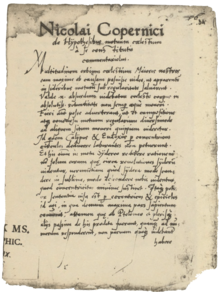
“A small commentary on hypotheses related to celestial movements” ( lat. Nicolai Copernici de hypothesibus motuum coelestium a se constitutis commentariolus , often briefly called “ Commentariolus ”) is a 40-page essay by Polish astronomer Nikolai Copernicus written around 1514 and containing the first sketches heliocentric system of the world [1] . The detailed version of his theory, which marked the beginning of the Copernican revolution in science, was presented by Copernicus in his main work, “ On the Rotation of the Celestial Spheres, ” published in 1543 .
Content
History
Copernicus wrote The Small Commentary around 1514 and sent out copies of the work to his friends and colleagues [2] . This work was not published during the life of Copernicus, but gained fame in the scientific and church communities of the 16th century. In 1533, the German theologian and humanist Johann Albrecht Widmannstetter delivered a series of lectures in Rome on the theory of Copernicus described in the Small Commentary. These lectures were attended by Pope Clement VII and several Catholic cardinals who showed interest in the theory of Copernicus. On November 1, 1536, the Archbishop of Capua, Nikolaus von Schoenberg wrote a letter to Copernicus asking him to send a copy of his work “as soon as possible” [3] .
Copies of the Small Commentary were distributed some time after the death of Copernicus [4] , but subsequently this work was forgotten and remained in oblivion until the second half of the 19th century , when handwritten copies were discovered [5] .
Labor Content
In the Small Commentary, Copernicus outlined seven postulates regarding his vision of the structure of the universe [6] :
- Not all celestial bodies revolve around one point ;
- The center of the earth is the center of the orbit of the moon around the earth;
- All spheres of the planets revolve around the sun , which is located near the center of the universe;
- The distance between the Earth and the Sun is insignificant with respect to the distance from the Earth and the Sun to the stars , since we do not observe the annual parallax of stars;
- The stars are motionless, and their apparent motion is caused by the diurnal rotation of the Earth ;
- The Earth rotates in a sphere around the Sun, as a result of which the apparent movement of the Sun is observed; The earth makes more than one movement;
- The motion of the Earth in its orbit around the Sun is the cause of the apparent opposite direction of planetary motion .
Notes
- ↑ Koyré, 1973 , pp. 18-28; Rosen 2004 , pp. 6-7 , 57-90 ; Thoren, 1990 , p. 99 gives the length of the manuscript as 40 pages.
- ↑ The reference to the “Small Commentary” is contained in the library catalog dated May 1, 1514; therefore, it was written earlier than this date (Koyré, 1973, p.85 ; Gingerich, 2004, p.32 ).
- ↑ Schönberg, Nicholas, Letter to Nicolaus Copernicus, translated by Edward Rosen .
- ↑ Tycho Brahe received a copy of the work in 1575 and subsequently distributed copies to students and colleagues ( Dreyer, 1890 , p. 83 ; Thoren, 1990 , pp. 98-99 ).
- ↑ According to some estimates ( Rosen, 2004 , pp. 6-7), a handwritten copy of The Small Commentary was discovered in Vienna and published in 1878; according to other estimates ( Koyré, 1973 , p. 76), the Small Commentary was significantly reduced in the Warsaw edition of the work “On the Rotation of the Celestial Spheres” in 1854.
- ↑ Goddu, André. Copernicus and the Aristotelian tradition. - Leiden, Netherlands: Brill, 2010. - P. 245–6. - ISBN 978-90-04-18107-6 .
Literature
- Dreyer, John Louis Emil. Tycho Brahe; a picture of scientific life and work in the sixteenth century . - Edinburgh: Adam and Charles Black, 1890.
- Gingerich, Owen . The Book Nobody Read. - London: William Heinemann, 2004 .-- ISBN 0-434-01315-3 .
- Koyré, Alexandre. The Astronomical Revolution: Copernicus - Kepler - Borelli. - Ithaca, NY: Cornell University Press, 1973. - ISBN 0-8014-0504-1 .
- Rosen, Edward (translator). Three Copernican Treatises: The Commentariolus of Copernicus; The Letter against Werner; The Narratio Prima of Rheticus. - Second Edition, Revised. - New York, NY: Dover Publications, Inc, 2004.
- Thoren, Victor E. The Lord of Uraniborg . - Cambridge: Cambridge University Press, 1990. - ISBN 0-521-35158-8 .
Links
- Full text in Latin (lat.)
- Edward Rosen's English translation of the first four chapters.
- "Nicholas Copernicus Small commentary on the established hypotheses about celestial movements." Abridged translation into Russian.