Easter Rebellion ( Irish Éirí Amach na Cásca , English Easter Rising ) - an armed uprising organized in Ireland during the Easter week (that is, the next week after Easter ) in 1916. Irish Republicans planned to take advantage of Britain’s participation in World War I and proclaim an independent Irish Republic , ending British rule on the island. The Easter Uprising was the most significant anti-British uprising in Ireland since the uprising of 1798 [1] .
| Easter rebellion | ||||
|---|---|---|---|---|
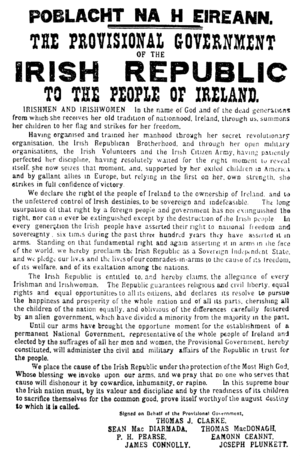 Republic of Ireland Proclamation | ||||
| date | April 24 - 30, 1916 | |||
| A place | Dublin , clashes in other counties | |||
| Total | surrender of the rebels, execution of their leaders | |||
| Opponents | ||||
| ||||
| Commanders | ||||
| ||||
| Forces of the parties | ||||
| ||||
| Losses | ||||
| ||||


Organized by seven members of the War Council of , the rebellion began on Monday of Easter Week, April 24, 1916, and lasted six days. Members of the Irish Volunteers organization, led by teacher and poet Patrick Pearce , teamed up with the James Connolly Irish Civil Army and two hundred members of [2] , seized several key locations in Dublin and proclaimed the independence of the Republic of Ireland . In addition, performances took place in other parts of the country, but with the exception of the attack on the barracks of the in Ashbourne , County Meath , they were all insignificant.
Due to the significant numerical superiority and use of artillery, the British army was able to quickly crush the uprising and on April twenty-ninth Pierce agreed to unconditional surrender. By decision of the military tribunal, most of the leaders of the uprising were executed, but this could not stop the growth of revolutionary sentiment in Ireland. The number of supporters of the proclamation of an independent Republic of Ireland continued to grow, both because of the ongoing war in Europe and the Middle East , and as a result of the in 1918. The attempts at a peaceful settlement of the Irish question undertaken at a meeting of the special assembly ended with nothing (see ). The revolutions in continental Europe further encouraged the Irish revolutionaries. In December 1918, Republicans (at that time represented by members of the Sinn Fein party ) won 73 of the 105 Irish seats during the general election to the British Parliament . On January 21, 1919, they convened the first Irish Parliament ( Doyle Ehren ) and proclaimed the independence of the Republic of Ireland. On the same day, with the attack on policemen carrying explosives in the county of Tipperary , the war for the independence of Ireland began .
Background
In 1800, the Union Act of Great Britain and Ireland banned a separate Irish parliament, providing instead of Ireland a representation in the British Parliament. Many Irish nationalists even then protested against this union. They believed that this decision would not give Ireland any advantages, but on the contrary, it would put it in an even more dependent position on England, as well as strengthen the exploitation of the country by the British [3] . Opposition took various forms: constitutional ( Repeal Association , founded by Daniel O'Connell , Homerul League , founded by Isaac Butt ), social (the abolition of Anglicanism as the official religion in Ireland, the founding of the Irish National Land League) and revolutionary ( , the rebellion of the Fenians of 1867) [4] . Supporters of constitutional reforms have achieved the greatest success from the 1880s to the 1890s. Those were the years of active political activity of the Irish Parliamentary Party , led by Charles Stuart Parnell . Thanks to the efforts of its representatives, the government of William Gladstone , the prime minister of the Liberal Party , twice submitted a bill on homrul to Parliament. The first bill on homrul was submitted to the House of Commons for consideration in 1886 and was failed in the second reading, the second bill on homrul passed in 1893 through the House of Commons, but was failed in the House of Lords . These failures led many young and radical nationalists to conclude that trying to achieve independence by constitutional means is futile. As a result, the number of supporters of radical separatist organizations has increased significantly. At the same time, ideas about Ireland as a country of Gaelic culture , completely different from the British [5] [6], were actively circulating in the public mind. These ideas were supported by organizations such as the Gaelic Athletic Association and the Gaelic League , the Irish poet William Yates advocated for a new cultural revival, he was actively promoted by Arthur Griffith in his newspaper “Sinn Fein [7] ”.
In 1912, the Prime Minister of Great Britain, Henry Asquith , introduced the third law on homrul to Parliament . This time, the Irish Unionists opposed him, led by Edward Carson. The homrul law, in their opinion, foreshadowed the appearance of a Catholic government in Dublin, which would be influenced by the Pope . The Ulster Volunteer Forces were formed by the Unionists [8] - armed units designed to oppose the adoption of the law on homrul. The creation of these units laid the foundation for the so-called Homerul Crisis.
On November 25, 1913, the (IRB) took the opportunity to create its own armed organization, the purpose of which, as stated, was to “ensure the observance of rights and freedoms common to the whole Irish people." Headed the " Irish Volunteers " - and this is the name the created organization received - Owen McNeill , who at that time was not even a member of the IRB [9] . The steering committee of the newly formed organization included people with a variety of political views, the organization declared that access to it was open to “all full-fledged Irish people of any faith, any political views” [10] . Another armed group, the Irish Civil Army , was created in the same year by union leaders during the Dublin lockout [11] . Such a sharp militarization of Irish politics coincided with the outbreak of the First World War, thanks to which, in many respects, it remained in the shadow of the events associated with the participation of Great Britain and Ireland in this conflict.
Despite the fact that many Irish volunteers enlisted in the Irish regiments and divisions of the army formed by Lord Kitchener [12] , the desire to introduce an appeal to Ireland, to put it mildly, did not find understanding among local residents. The entry into force of the Irish Government Act of 1914 (aka the third law on homrul, which was finally discussed in Parliament) was postponed until the end of the war. In addition, the British government stipulated the entry into force of this act resolution of the draft [13] . The , enacted in 1916, already permitted conscription, but its effect did not affect the territory of Ireland, now the authorities wanted to extend the effect of the conscription to residents of Ireland. This link between conscription and homrul has infuriated both the representatives of the Irish separatists and the Unionists, provoking .
Preparing the Rebellion
| The organizers of the uprising: Patrick Pierce, Tom Clark, Sean McDermott, Joseph Plunkett, Eamon Kent, James Connolly, Thomas MacDon |
On September 5, 1914, a month after Britain declared war on Germany , a meeting of the IRB Supreme Council was held. The audience decided to organize an uprising before the war ended and to accept any help from Germany that it could offer [14] . Responsibility for preparing the uprising lay with Tom Clark and Sean McDermott . [15] The organization of Irish volunteers at that time was already divided into two groups - part of them supported Britain in the light of the outbreak of war [16] . Another, smaller part, formed the headquarters of the uprising, which included Patrick Pierce [17] [18] , who was in charge of the military organization, Joseph Plunkett , who was in charge of military operations, and Thomas MacDon , who was in charge of training. Later, they were joined by Eamon Kent [19] , who was in charge of communications. In May 1915, Clark and McDermott created the Military Committee inside the IRB, which also included Pierce, Plunkett and Kent, to plan the uprising. The creation of such a committee, in which Clark and McDermott immediately included themselves, allowed the conspirators to pursue their own policies and not depend on the supreme leadership of the IRB, or on the leaders of the Irish Volunteers. The nominee head of the RBI, , as well as volunteer leader Owen McNeill , believed that rebellion was possible only if there was massive popular support that should have come about over time thanks to London taking unpopular decisions such as calling for or persecuting participants separatist organizations [20] [21] .
In April 1915, Plunkett traveled to Germany, where he met with Roger Casement . Casement arrived in Germany from the USA last year on behalf of the American organization [22] . By agreement with Count , the German ambassador in Washington, Casement was to try to recruit volunteers from captured Irish to create an Irish brigade that could demand the independence of Ireland and turn to Germany for support [23] [24] . Plunkett and Casement jointly devised a plan whereby a German expeditionary force was to land on the west coast of Ireland, while an uprising in Dublin would divert the main British forces on the island. Thus, German troops, with the support of local representatives of the Volunteers, will be able to gain a foothold along the Shannon River [25] .
James Connolly , a prominent theoretician of Marxism and head of the Irish Civil Army (IGA), a militarized society of socialists and union leaders, was unaware of the IRB plans and threatened to raise a rebellion on its own if the other parties were inactive. Most likely, if this had happened, the RBI and the Volunteers would have come to the aid of the ISA [26] , but nevertheless, the leaders of the RBI met Connolly in January 1916 and persuaded him to join them. All parties agreed to speak together, at the same time - on Easter. Connolly became the sixth member of the Military Committee, and later added the seventh - Thomas MacDon .
Easter Week
In an attempt to confuse government informants and his own leadership, Pierce issued orders in early April for the three-day maneuvers of the Irish Volunteers on the eve of Easter (which he had every right to do as the person responsible for the organization). The meaning of this order was twofold: Republicans from sympathetic organizations (in particular, RBI) clearly understood what this order really meant, while people like McNeil or representatives of the British authorities could take everything at face value. However, McNeill understood that something was being prepared, and threatened to do everything possible to prevent an uprising, right up to the call directly to Dublin Castle [27] .
McDermott was able to convince McNeill with a story about the agreements with Germany - about the landing and the supply of weapons. McNeil came to the conclusion that the authorities would certainly discover this attempted landing, after which they would begin reprisals against members of the Irish Volunteers, which, in turn, would become an occasion for retaliation [28] . Casement - disappointed that Germany allocated a very modest amount of resources to implement his plan - returned to Ireland on a German submarine and was captured immediately after landing on the shore of Tralee Bay . A German ship with weapons was also intercepted by the British fleet.
The next day, McNeill, learning about the capture of the ship, changed his mind for the third time, again becoming an opponent of the uprising. With the support of other leaders (Ballmer Hobson, ) he issued a counter-order to all Volunteers to cancel any events on Sunday. This order, in the end, did not reach the goal, only delaying the start of the uprising by one day, but significantly reduced the number of "volunteers" who took part in the uprising.
British military intelligence found out about the armament ship, Casement’s landing, and the date of the uprising from intercepted radio talks between Germany and the German embassy in the United States. The information was transmitted to the Deputy Minister for Ireland, Sir , on April 17, however, without indicating the source, so Nathan doubted its accuracy [29] . When the news of the capture of the German ship and Casement reached Dublin, Nathan reported everything to the Irish governor, Lord Wimborne. Nathan offered to raid , the headquarters of the ISA, and the warehouses of the Volunteers in Kimmage and Matthew’s father’s park, but Wimborn insisted on the arrest of all the leaders. In the end, it was decided to postpone the action until Monday, and at the same time, Nathan telegraphed the Secretary General for Ireland, , to London, asking for his approval [30] . By the time Birell sent a response authorizing the arrests, the uprising had already begun.
Uprising in Dublin
Monday after Easter
In the early morning hours of April 24, 1916, approximately 1,200 members of the Volunteers and the IGA took up positions in the center of Dublin. About 400 people gathered at Liberty Hall under the command of James Connolly .
The headquarters of the rebels was located in the office of the General Post Office (GPO), which housed Connolly, who carried out general military leadership, and four other members of the Military Committee: Pierce, Clark, McDermott and Plunkett [31] . Having taken up the post office, the rebels raised two republican flags and Pierce read out the Proclamation on the creation of the Republic [32] .
In addition, rebel forces took up positions in the four court building , the center of the legal life of Ireland, the , the biscuit factory, the Boland mill and the building of the hospital for the poor, and the distillation plant adjacent to it to marrowbone lane. Another group, led by , entrenched in St. Stephens Green [33] .
Despite poor security, the rebels were unable to capture Dublin Castle , the center of the British administration in Ireland. Failure also befell them when trying to capture Trinity College , located in the heart of the city, and defended only by a handful of student students [34] . Around noon, a small group of rebels attacked a fort located in Phoenix Park to grab a weapon there and detonate it, signaling the start of the uprising. However, they did not find weapons, and the explosion turned out to be too weak to be heard in the city [35] .
At least two incidents are known (at the Jacobs factory [36] and at St. Stephen Green [37] ), when the rebels fired on ordinary people who tried to attack them or make out the barricades. In other places there were no dead.
The British military forces were absolutely not ready for an uprising, so on the first day their rebuff was quite chaotic. Two cavalry detachments, one near the building of four ships, the second on O'Connell Street , were sent for reconnaissance and came under fire from rebel forces [38] [39] . On Mount Street, a detachment from the Volunteer Corps stumbled upon rebel positions, resulting in four were killed before the detachment reached its barracks [40] .
The only serious battle on the first day of the uprising took place near the shelter, where a detachment of the Royal Irish Regiment found an outpost of rebels in the northwest corner, rebels from among the subordinates of Imon Kent . The British troops, having suffered small losses, managed to regroup and conduct several attacks on the outpost, eventually forcing a small group of rebels to defend it to surrender [41] . However, the rest of the shelter remained in the hands of the rebels.
Three unarmed policemen were shot dead on the first day of the uprising, after which the commissioner took patrols from the streets. Because of this, in particular, a wave of robberies swept through the city center. After the uprising, 425 people were arrested for looting [42] .
Tuesday to Saturday
On Tuesday, the Irish governor, Lord Wimborn, declared martial law in the country. All power was transferred to the hands of Brigadier General William Lowe. The British first focused their efforts on securing Dublin Castle and isolating the rebel headquarters, which they believed to be in Liberty Hall. Low did not know what forces the rebels possessed, therefore, in his actions he showed cautious leisureliness. Arriving early in the morning on Tuesday, April 25, in Dublin from Kurrag with 1269 people, he recaptured the town hall from the rebels [43] [44] .
Since the rebels failed to capture either the stations or the ports, during the week the British were able to pull up reinforcements from Belfast and Kurrag without any problems. By the end of the week, there were already about 16,000 British soldiers in the city [44] [45] . In addition, the British possessed artillery delivered from a garrison in Athlone and the Helga patrol vessel that arrived on the Liffey River. On Wednesday, April 26, guns installed at Trinity College and Helga began firing on Liberty Hall and other rebel positions, primarily in the mill and O'Connell Street [44] .
The main positions of the rebels at the main post office , at four ships , the Jacobs factory and the mill were not subjected to special attacks. The British preferred to fire at them, avoiding direct attacks. One of the post office’s defenders recalled: “We practically didn’t have to shoot, because there was nothing to shoot” [46] . The positions of the rebels on St. Stephen Green , held by Michael Mullin and the ISA forces, lost their significance after the British placed snipers and machine gunners in the Shelburn hotel and surrounding buildings. Mullin’s people moved to the Royal College of Surgery, where they remained until the end of the week. However, where the rebels controlled the arrival routes of British reinforcements, fierce clashes took place.
Reinforcements sent to Dublin from England landed in the morning of April 26th. A serious battle took place at the place where the rebels held positions around the . British forces were caught in crossfire several times in an attempt to cross the canal in Mount Street. Seventeen Volunteers inflicted serious damage on the British offensive, killing or injuring 240 people [47] . General Lowe refused to look for workarounds, ordering a repeat frontal attack on the positions of the rebels on Mount Street. In the end, by Thursday the British managed to take these positions, but the losses during the battle for them as a result amounted to two-thirds of the total losses of the British during the uprising. On the other hand, only four people died [48] .
In the building of the urban shelter for the poor and on Marrowbone Lane, the rebels also managed to inflict heavy losses on the British troops. The shelter was a large complex of several buildings, around which a fierce battle unfolded. In this battle, the rebel officer Katal Bru was especially distinguished, who was seriously injured. By the end of the week, the British managed to capture several shelter buildings, while the rest remained in the hands of the rebels [49] .
Another place where the battle continued throughout the week was North King Street, near the Four Courts building. From Thursday, the British tried to take the well-fortified positions of the rebels. By the time the rebel headquarters were surrendered, British troops Colonel Taylor had advanced only 140 meters down the street, losing 11 people dead and 28 wounded. [50] Enraged soldiers burst into houses along the street, killing and shooting 15 civilians, suspecting rebel fighters in them [51] [52] .
At the same time, in another place - near the Portobello barracks - a certain officer named Bowen Kolthurst executed a total of six people who did not take part in the uprising. Among the executed was the well-known pacifism writer and national activist Francis Shihi-Skeffington [53] .
Defeat
After several days of shelling, the rebels were forced to leave the post office due to a fire. Connolly was out of action, having received a bullet in his ankle, and transferred command to Pierce . O'Rachell was killed during one of the sorties. The rebels struck a tunnel through the wall of a neighboring building to evacuate and, without falling under fire, to take up new positions in house No. 16 on Moor Street. On April 29, Saturday, already from this new headquarters, realizing that further resistance would entail even greater casualties among the civilian population, Pierce ordered all units to surrender [54] . Pierce's unconditional surrender was accepted by Brigadier General Lowe. The document of surrender read:
“In order to prevent further killings of Dublin citizens and in the hope of saving the lives of our followers, now hopelessly surrounded by superior troops, members of the Provisional Government agree to unconditional surrender. Commanders in other Dublin counties and counties must order their units to lay down their arms [55] . ”
Original textIn order to prevent the further slaughter of Dublin citizens, and in the hope of saving the lives of our followers now surrounded and hopelessly outnumbered, the members of the Provisional Government present at headquarters have agreed to an unconditional surrender, and the commandants of the various districts in the City and County will order their commands to lay down arms.
The post office was the only serious object that was recaptured from the rebels. The rest surrendered only after receiving orders from Pierce. Local clashes continued until Sunday, until the news of the surrender reached the rest of the rebels [56] . The command of the British units passed from Low to General John Maxwell, who arrived in Dublin in time for the adoption of the surrender. Maxwell was appointed interim military governor of Ireland [57] .
Uprising in the rest of Ireland
On Sunday, volunteer units in various parts of Ireland were mobilized, but upon receiving orders from Owen McNeil , most of them went home. In addition, due to the capture of German transport, provincial Volunteers were very poorly armed.
In the south, about 1,200 volunteers gathered on Sunday in Cork , under the command of . However, having received nine orders from Dublin to cancel the performance, they went home. To the chagrin of many volunteers, McCourtin surrendered all weapons to the British. [58] The only skirmish occurred during the arrest of the Kent brothers: one of them was killed in a shootout with the police, the second was executed later [59] .
Similarly, events developed in the north. Several companies were mobilized in Colileland , Tiron County, among them 132 people from Belfast, under the leadership of the IRB President . Confused by counter-orders, these volunteers also dispersed without a fight [60] .
Ashbourne
The only major clash outside Dublin occurred in Ashbourne , County Meath . The Dublin Volunteer Brigade, the fifth battalion (known as the Fingle Battalion), was led by and Richard Mulkekhi . 60 people were mobilized in Swords , where they seized police barracks and mail. In the same way, the neighboring villages of Donabate and Harristown were captured, after which volunteers attacked the police barracks in Ashtown [61] [62] . This attack resulted in a five-hour shootout, during which eight constables were killed and 14 wounded. Among the volunteers, there were two killed, five wounded, and one local resident was mortally wounded under fire [63] [64] . The people of Ashe camped near Dublin, in the town of Castlebellingham , where they remained until they received an order to surrender on Saturday [65] .
Anniskorti
In Wexford County, about a hundred volunteers led by Robert Brennan, Seamus Doyle, and J. R. Etchingham captured Enniscorty on Tuesday, April 27, and held him until Sunday [61] . They tried to seize the local police barracks, but the attack was unsuccessful, so the rebels limited themselves to blocking the barracks. Having captured the city, the rebels hung the Irish flag over the theater building (where their headquarters were located) and organized patrolling the city [66] . A small detachment sent by them to Dublin came back because it came across a train filled with British troops. On Saturday, two volunteer leaders organized a meeting in Pier Arbor Hill with Pierce, who ordered them to surrender. [67]
Galway
In the west, Liam Mellows led a detachment of 600-700 volunteers. This unit launched a series of attacks on police stations in Oranmore and Clarinridge , Galway County. During the clashes in Carnmore, two policemen were killed. Many of Mellows’s men were armed only with peaks, all in all they had about 25 rifles and 300 shotguns. By the end of the week, the people of Mellouz had heard about the British troops heading west, noticeably lost heart. In addition, the British cruiser Gloucester arrived in Galway Bay and fired at the fields around Athenry , where the rebels were based [68] .
On April 29, the volunteers, evaluating the situation as hopeless, dispersed in the vicinity of Athenry. Immediately after the uprising ended, many of them were arrested, others, including Mellows, went on the run. By the time British troops arrived west, the uprising had already ended by itself [69] .
Losses
По данным британской армии, потери военных составили 116 человек убитыми и 368 ранеными. Ещё девять человек пропали без вести [70] [71] . Было убито 16 полицейских и ранено 29. 318 повстанцев и мирных жителей было убито, 2217 ранено. Добровольцы и ИГА зафиксировали, что 64 человека было убито за время боёв, остальные пострадавшие среди ирландцев отмечались без разделения на повстанцев и мирных жителей [72] . Все убитые полицейские были ирландцами, среди убитых солдат ирландцами были 22 человека [73] . Солдат, за телами которых не приехал никто из родственников, похоронили на военном кладбище Гренгегорман.
Большинство пострадавших, убитых и раненых, оказалось среди мирных граждан. Обе стороны виновны в убийствах гражданских — когда те отказывались подчиняться приказам, и повстанцы, и британцы открывали огонь на поражение. Но ещё больше потерь среди мирного населения были вызваны британским артиллерийским огнём и осколками снарядов. По словам одного ирландского полицейского, «британцы в каждом видели врага и стреляли во всё, что двигалось» [74] .
Последствия восстания
Аресты и казни
Генерал Максвелл сразу же объявил своим намерением «арестовать всех опасных членов Шинн Фейн», включая «тех, кто принимал активное участие в жизни партии, несмотря на то, что не участвовал в восстании [75] ».Общественное мнение в то время склонно было считать, что за восстанием стоят сепаратисты из «Шинн Фейн» , хотя эта организация на тот момент не была ни военизированной, ни республиканской.
В общей сложности 3430 мужчин и 79 женщин были арестованы, однако большую часть из них вскоре отпустили. 2 мая в графстве Корк во время ареста семьи Кентов застрелили начальника полиции, Ричард Кент был застрелен в той же стычке, Томас и Уильям Кенты арестованы.
Начавшийся второго мая военный трибунал приговорил к смертной казни 90 человек. Максвелл утвердил этот приговор для пятнадцати из них (включая всех семерых, подписавших Прокламацию). С третьего по двенадцатое мая всех приговорённых расстреляли во дворе тюрьмы Килмэнхэм (серьёзно раненого Конноли во время расстрела привязали к стулу — он не мог стоять из-за раздроблённой лодыжки). Помимо лидеров, среди казнённых оказались Вилли Пирс, который называл себя «личным атташе моего брата, Патрика Пирса»; , который даже не знал о подготовке восстания, пока оно не началось, но сражался против Британии в англо-бурской войне за пятнадцать лет до этого; Томас Кент, который и вовсе не принимал участия в восстании — он был казнён за убийство полицейского во время проведения обыска в его дома неделей позже. Имону де Валера , который командовал третьим батальоном, удалось избежать казни, отчасти из-за своего американского гражданства [76] . Главой военного трибунала был Чарльз Блэкайдер.
1480 человек были интернированы в Англию и Уэльс согласно Указанию 14В Акта о Защите Страны от 1914 года. Многие из них, Артур Гриффит в частности, принимали минимальное — или даже не принимали вовсе — участие в восстании. Лагеря, в которых они содержались — лагерь для интернированных во Фронгоче и другие — стали своего рода «университетами революции», где будущие лидеры Майкл Коллинз, Теренс МакСуини, Дж. Дж. О'Коннел начали разрабатывать план дальнейшей борьбы за независимость [77] . Казни лидеров Восстания прошли в течение девяти дней:
- 3 мая: Патрик Пирс , Томас Дж. Кларк и Томас Макдона
- 4 мая: Джозеф Планкетт , Уильям Пирс, и
- 5 мая:
- 8 мая: Имон Кент , , и
- 12 мая: Джеймс Конноли и Шон Макдермотт
Сэр Роджер Кейсмент был осуждён в Лондоне за государственную измену и повешен в Пентонвилльской тюрьме третьего августа.
Investigation
Для того, чтобы выяснить причины Восстания, была созвана Королевская комиссия. Слушания начались 18 мая, председателем комиссии стал лорд Гардинг, барон Пенсхёрст. Показания давали сэр , лорд Уимборн, сэр Невилл Чемберлен (глава ирландской королевской полиции), генерал Ловик Френд, майор Айвор Прайс из военной разведки и другие [78] . Отчёт, опубликованный двадцать шестого июня, раскритиковал методы дублинской администрации, сообщая, что
«На протяжении нескольких лет Ирландия управлялась в согласии с принципом, что безопаснее и целесообразнее оставить закон бездействовать, если есть возможность избежать столкновения с какой-нибудь народной ирландской организацией [79] ».
Original textIreland for several years had been administered on the principle that it was safer and more expedient to leave the law in abeyance if collision with any faction of the Irish people could thereby be avoided.
Бирелл и Нэйтан подали в отставку сразу же после восстания. Уимборну также пришлось подать в отставку, Ллойд-Джордж отозвал его в Лондон, однако в конце 1917 года вернул на прежнее место. Чемберлен вскоре также ушёл в отставку [80] .
Реакция горожан
Разразившееся столь неожиданно, восстание привело в замешательство представителей дублинской общественности [81] . , который был в Дублине всю неделю, писал: «Никто не был готов к мятежу. Всё это так внезапно обрушилось на нас, что никто не знал, чью сторону принять» [82] .
В некоторых частях города волонтёры столкнулись с неприкрытой враждебностью. Когда они занимали позиции в госпитале приюта для бедных и на фабрике Якобс, повстанцам пришлось отбиваться от гражданских, которые пытались им помешать. Стрельба по гражданским и драка с ними не добавили Добровольцам популярности в этих районах [83] . Ещё более враждебно встретили восстание юнионисты и женщины, чьи мужья или дети сражались в британской армии на фронтах Первой Мировой войны [84] . Даже среди сторонников Ирландской парламентской партии было популярно мнение, что восстание — это предательство по отношению к их делу [85] .
Гибель людей и разрушенные дома — единственные наглядные результаты мятежа — лишь усилили ненависть дублинцев к повстанцам. К тому же, начались перебои с поставкой продовольствия в город. После сдачи Добровольцев забрасывали мусором, обзывали «убийцами» и «мучителями народа» [86] . Один из них, Роберт Холланд, вспоминал, что бедняки освистывали и осыпали его оскорблениями, и даже те, кто знал его, не скрывали своей ненависти. Лишь защита британских солдат уберегла его от самосуда толпы [87] [88] .
Тем не менее, нельзя сказать, что общество однозначно враждебно отнеслось к поверженным повстанцам [89] . Часть горожан были скорее испуганными, чем озлобленными и многие Добровольцы вспоминали людей, которые смотрели на них с молчаливым одобрением. Канадский журналист и писатель Фредерик Артур МакКензи писал, что в бедных кварталах «нашёл много людей, сочувствовавших бунтовщикам, особенно после того, как они потерпели поражение [90] ». Томас Джонсон , лидер лейбористов, напротив, считал что «не было ни единого признака сочувствия к бунтовщикам, но было общее восхищение их отвагой и поведением [91] ».
Под впечатлением от реакции британских властей многие ирландские националисты переменили своё мнение: от враждебности они перешли к поддержке и одобрению лидеров Пасхального Восстания 1916 года. Например, дублинский бизнесмен Джеймс Дж. Дуглас, до того выступавший за гомруль, писал, что его политические взгляды резко изменились за время восстания и последовавшей британской военной оккупации города. Он пришёл к выводу, что парламентскими методами от англичан не избавиться [92] .
Расцвет «Шинн Фейн»
Митинг, организованный 19 апреля 1917 года Джорджем Планкеттом, привёл к формированию широкого политического движения под знаменем «Шинн Фейн» которое вылилось в создание высокой ассамблеи Шинн Фейн 25 октября 1917 года. Призывной Кризис 1918 года ещё больше усилил общественную поддержку «Шинн Фейн» перед общенациональными выборами в британский парламент 14 декабря 1918 года. Выборы увенчались убедительной победой «Шинн Фейн», избранные кандидаты собрались 21 января 1919 года в Дублине для того, чтобы сформировать ирландский парламент Дейл Айрен и принять [93] .
Memory
Вскоре после Пасхального восстания поэт Фрэнсис Людвидж написал «Улицу О'Коннела» и «Плач по поэтам тысяча девятьсот шестнадцатого», где описывал своё чувство утраты и признавался, что лелеет те же мечты, что и восставшие ирландские республиканцы [94] . Он также написал «Плач по Томасу Макдоне» о своё павшем друге. Через несколько месяцев после Пасхального Восстания, Йейтс увековечил некоторых из погибших деятелей республиканского движения и описал свои мятущиеся чувства в поэме «Пасха, 1916».
Некоторые из переживших восстание позднее превратились в лидеров независимого Ирландского государства . Казнённые стали своего рода мучениками , их могилы в Дублине, во дворе бывшей военной тюрьмы Арбор-хилл были объявлены национальным памятником, а текст Прокламации учили дети в школе. Каждый год на пасхальное воскресенье проводится памятный парад. В 1966 году телекомпания RTE подготовила цикл программ, посвящённых пятидесятилетнему юбилею Пасхального Восстания [95] .
Беспорядки в Северной Ирландии заставили по-иному взглянуть на военное прошлое страны — и в частности, на Пасхальное Восстание. В семидесятых года правительство Ирландии позволило себе проводить параллели между вооружённым протестом 1916 года и тем, что творилось на улицах Белфаста и Дерри .
Ирландские республиканцы по-прежнему продолжали свято чтить подвиг лидеров восстания, их изображения появлялись на уличных фресках, в их честь устраивались парады. В то же время правительство Ирландии в 70-х годах отменило ежегодные парады в Дублине, а в 1976 году и вовсе запретило юбилейную церемонию, организованную. «Шинн Фейн» возле Главпочтамта [96] .
С началом мирных переговоров в 1990-х годах официальный взгляд на восстание вновь стал меняться, на этот раз — в положительную сторону. В 1996 году юбилейную церемонию в Дублине посетил премьер-министр Ирландии , а в 2006 году правительство возобновило военные парады на пасхальное воскресенье в память о восстании. Сейчас ежегодную церемонию помимо потомков тех, кто принимал участие в восстании, посещают многочисленные официальные лица, включая президента и премьер-министра страны [97] .
В декабре 2014 года городской совет Дублина одобрил предложение создать исторический маршрут по местам основных событий Пасхального Восстания 1916 года. Прочерченный зелёный краской маршрут будет охватывать исторические места, связанные с восстанием, такие, как Главпочтамт или здание четырёх судов [98] .
27 марта 2016 года в Дублине прошли торжественные мероприятия, в том числе военный парад, посвящённые 100-летию Пасхального восстания [99] .
В 2016 году в честь 100-летия Пасхального восстания была выпущена памятная монета номиналом 2 евро тиражом в 4,5 млн экземпляров [100]
In Culture
- Действие пьесы Шона О'Кейси «Плуг и звёзды» происходит во время Пасхального Восстания.
- Роман Лайама О'Флаэрти «Мятеж».
- Фильм Нила Джордана «Майкл Коллинз » 1996 года с Лиамом Нисоном в главной роли начинается со сцены подавления восстания.
- Графический роман Джерри Ханта «Окровавленная роза» изображает события Пасхального восстания [101] .
- События Пасхального восстания также легли в основу романа английской писательницы Айрис Мёрдок «Алое и зелёное» (The Red and the Green), в котором описаны Ирландия и несколько предшествующих событиям 24 апреля 1916 года дней, вплоть до дня начала вооружённого восстания, через призму взаимоотношений в нескольких ирландских семействах, связанных узами родства.
- В альбом No Need To Argue (1994) ирландской рок-группы The Cranberries входит песня « Зомби » (англ. «Zombie»), в которой призывается забыть о событиях 16-го года, порвать с политизированным прошлым, а боевики ИРА называются «зомби».
- В. И. Ленин в июле 1916 года написал статью «Ирландское восстание 1916 года». В ней он даёт высокую оценку его значению. В частности он пишет: Мы были бы очень плохими революционерами, если бы в великой освободительной войне пролетариата за социализм не сумели использовать всякого народного движения против отдельных бедствий империализма в интересах обострения и расширения кризиса. Если бы мы стали, с одной стороны, заявлять и повторять на тысячи ладов, что мы «против» всякого национального гнета, а с другой стороны, называть «путчем» геройское восстание наиболее подвижной и интеллигентной части некоторых классов угнетенной нации против угнетателей, — мы низвели бы себя до уровня столь же тупого, как каутскианцы. Несчастие ирландцев в том, что они восстали несвоевременно… [102] .
- В романе Раймона Кено «С ними по-хорошему нельзя» описывается захват дублинского Главпочтамта во время Пасхального восстания.
- В 1919 году приходской священник из Ньюкасла написал песню « Foggy Dew », призывает ирландцев к борьбе за дело Ирландии, а не за интересы Британии, как сражающиеся в Первой мировой войне.
Right proudly high over Dublin Town they hung out the flag of war
'Twas better to die 'neath an Irish sky than at Suvla or Sud-El-Bar - В новелле Дэниэла Коркери «Тру́сы?» Пасхальное восстание подкосило боевой дух потомственного военного-ирландца, сражавшегося на стороне Великобритании.
- В ноябре 2010 года вышла в свет художественная биография Роджера Kейсмента , написанная Нобелевским лауреатом Марио Варгасом Льосой — «Сон кельта» («El sueño del celta»). В книге в том числе поднимается тема роста ирландского патриотизма, попытки Kейсмента набрать добровольцев среди ирландских военнопленных и последствия пасхального восстания
See also
- Кровавое воскресенье (1972)
- Ирландское восстание (1798)
- Гэльское возрождение
- Война за независимость Ирландии
Notes
- ↑ Francis X. Martin. Leaders and Men of the Easter Rising: Dublin 1916 (англ.) . Date of treatment February 8, 2015.
- ↑ в переводе с ирландского — «совет ирландских женщин»
- ↑ MacDonagh, Oliver. Ireland: The Union and its aftermath. — George Allen & Unwin. — С. 14–17. — 1977 с. — ISBN 0-04-941004-0 .
- ↑ Mansergh, Nicholas. The Irish Question 1840–1921. — George Allen & Unwin, 1978. — С. 244. — 1977 с. — ISBN 0-04-901022-0 .
- ↑ MacDonagh, Oliver. Ireland: The Union and its aftermath. — George Allen & Unwin. — С. 72–74. — 1977 с. — ISBN 0-04-941004-0 .
- ↑ Feeney, Brian. Sinn Féin: A Hundred Turbulent Years. — O'Brien Press, 2002. — С. 22. — ISBN 0-86278-695-9 .
- ↑ В переводе с ирландского — „мы сами“
- ↑ Those who set the stage (недоступная ссылка) . The 1916 Rising: Personalities and Perspectives . National Library of Ireland. Дата обращения 7 декабря 2009. Архивировано 4 апреля 2012 года.
- ↑ Foy, 1990 , pp. 7-8.
- ↑ Macardle, 1965 , pp. 90-92.
- ↑ Townshend, 2006 , p. 49.
- ↑ The forgotten soldiers (англ.) . BBC Date of treatment February 8, 2015.
- ↑ Dave Hennessy. The Hay Plan & Conscription In Ireland During WW1 (англ.) . Date of treatment February 8, 2015.
- ↑ Caulfield, 1995 , p. 18.
- ↑ Foy, 1990 , pp. sixteen.
- ↑ Foy, 1990 , pp. 13.
- ↑ Sean Farrell Moran. Patrick Pearse and the Politics of Redemption: The Mind of the Easter Rising. — Washington: The Catholic University of America Press, 1994. — 248 с. — ISBN 978-0813209128 .
- ↑ Ruth Dudley Edwards. Patrick Pearse and the Triumph of Failure. — Chester Springs: Dufour Editions, 1977. — 384 с. — ISBN 978-1853710681 .
- ↑ Townshend, 2006 , p. 92.
- ↑ Townshend, 2006 , p. 94.
- ↑ Macardle, 1965 , p. 119.
- ↑ В переводе с ирландского — «гэльский клан»
- ↑ Townshend, 2006 , p. 104.
- ↑ Foy, 1990 , pp. 105.
- ↑ McNally and Dennis, 2007 , p. 30.
- ↑ Neeson, 2007 .
- ↑ McNally and Dennis, 2007 , p. 35.
- ↑ Michael Tierney. Eoin MacNeill: Scholar and Man of Action, 1867-1945. — Oxford University Press, 1981. — 432 с. — ISBN 978-0198224402 .
- ↑ Broin, 1970 , p. 79.
- ↑ Broin, 1970 , pp. 81—87.
- ↑ McNally and Dennis, 2007 , p. 41.
- ↑ Foy, 1990 , pp. 192—195.
- ↑ McNally and Dennis, 2007 , pp. 39—40.
- ↑ Townshend, 2006 , pp. 163—164.
- ↑ Caulfield, 1995 , pp. 48—50.
- ↑ McGarry, 2010 , pp. 142.
- ↑ Stephens, James. The Insurrection in Dublin. — CreateSpace Independent Publishing Platform,, 2013. — С. 18. — ISBN 978-1492303640 .
- ↑ Caulfield, 1995 , pp. 54—54.
- ↑ Coffey, Thomas M. Agony at Easter:The 1916 Irish Uprising. — 1969. — С. 38, 44, 155. — ISBN 978-0025266506 .
- ↑ O'Brien, Paul. Blood on the Streets: 1916 & the Battle for Mount Street Bridge. — С. 22—23. — ISBN 978-1856355766 .
- ↑ Caulfield, 1995 , pp. 76—80.
- ↑ Townshend, 2006 , pp. 263—264.
- ↑ Coogan, 2002 , p. 107.
- ↑ 1 2 3 Townshend, 2006 , p. 191.
- ↑ McGarry, 2010 , pp. 167-169.
- ↑ McGarry, 2010 , p. 175.
- ↑ Coogan, 2002 , p. 127.
- ↑ McGarry, 2010 , p. 173.
- ↑ Caulfield, 1995 , pp. 288—292.
- ↑ Coogan, 2002 , pp. 152—155.
- ↑ Coogan, 2002 , p. 155.
- ↑ McGarry, 2010 , p. 187.
- ↑ Caulfield, 1995 , pp. 198.
- ↑ Townshend, 2006 , pp. 243—246.
- ↑ BBC News . BBC News (9 января 2006). Date of treatment February 8, 2015.
- ↑ Townshend, 2006 , pp. 246—250.
- ↑ McGarry, 2010 , pp. 203—204.
- ↑ Townshend, 2006 , p. 235.
- ↑ Townshend, 2006 , p. 238.
- ↑ Townshend, 2006 , p. 226.
- ↑ 1 2 Boyle, John F. The Irish Rebellion of 1916: a brief history of the revolt and its suppression. — biblioBazaar, 2009. — С. 127—152. - 300 s. — ISBN 978-1116284423 .
- ↑ Townshend, 2006 , p. 215-216.
- ↑ McGarry, 2010 , pp. 235—237.
- ↑ Townshend, 2006 , p. 218—221.
- ↑ Townshend, 2006 , p. 221.
- ↑ Townshend, 2006 , p. 241.
- ↑ Townshend, 2006 , p. 241-242.
- ↑ Townshend, 2006 , p. 227—230.
- ↑ McGarry, 2010 , pp. 233.
- ↑ British Soldiers KIA 1916 Rising . Irishmedals.org. Дата обращения 13 ноября 2011. Архивировано 26 июля 2011 года.
- ↑ Ireland 1916 (недоступная ссылка) . Glosters.tripod.com. Дата обращения 13 ноября 2011. Архивировано 29 сентября 2011 года.
- ↑ Foy, 1990 , pp. 325.
- ↑ Kilberd, Declan. 1916, Rebellion Handbook. — Savannah Publications, 1998. — С. 50—55. — ISBN 978-1902090054 .
- ↑ McGarry, 2010 , p. 184.
- ↑ Townshend, 2006 , p. 273.
- ↑ Connolly SJ Oxford Companion to Irish History. — London: Oxford University Press, 2004. — ISBN 978-0-19-923483-7 .
- ↑ ''The Green Dragon'' No 4, Autumn 1997 . Ballinagree.freeservers.com (31 марта 2005). Дата обращения 13 ноября 2011.
- ↑ Broin, 1970 , pp. 153—156.
- ↑ Townshend, 2006 , p. 297.
- ↑ John Kendle. Walter Long, Ireland, and the Union, 1905-1920. — London: Mcgill Queens Univ Pr, 1992. — ISBN 978-0773509085 .
- ↑ Townshend, 2006 : «"Во многих районах жители реагировали прежде всего с недоумением, они просто не понимали, что вообще происходит"».
- ↑ Stephens, James. The Insurrection in Dublin. — CreateSpace Independent Publishing Platform,, 2013. — С. 57. — ISBN 978-1492303640 .
- ↑ McGarry, 2010 , p. 143.
- ↑ Foy, 1990 , pp. 203—209.
- ↑ O'Malley, Ernie. On Another Man's Wound. — Roberts Rinehart,, 2001. — ISBN 978-1589790049 . Среди лоялистов ходили разговоры: «Войска всё уладят за час-другой, эти немецкие прихвостни быстро разбегутся». Редмондисты (сторонники лидера Ирландской парламентской партии, Джона Редмонда) высказывались ещё жёстче: «Надеюсь, их всех повесят», <…> «Расстрел — это слишком хорошо для них, они пытались нас всех подставить»
- ↑ McGarry, 2010 , pp. 252.
- ↑ Ryan, Annie. Witnesses: Inside the Easter Rising. — ISBN 978-1905483709 .
- ↑ Witness statement of Robert Holland . Bureau of Military History . Дата обращения 14 мая 2013.
- ↑ McGarry, 2010 , pp. 252—256.
- ↑ O'Donnel, 2008 , pp. 196—197.
- ↑ Townshend, 2006 , p. 265—268.
- ↑ Memoirs of Senator James G. Douglas; concerned citizen / J. Anthony Gaughan. — University College Dublin Press, 1998. — P. 52, 53. — ISBN 978-1-900621-19-9 .
- ↑ Kee .
- ↑ Ledwidge, Francis, Life works Criticism Commentary Quotations References Notes .
- ↑ News Items Relating to the 1916 Easter Rising Commemorations (англ.) : journal. — IE: RTÉ, 1966.
- ↑ Dennis Coghlam. Cabinet bans Provisionals' 1916 march (англ.) // Irish Times. — 1976. — P. 1 .
- ↑ Irish Times, 22 October 2005
- ↑ Kayla Hertz. Dublin's 1916 Rising Freedom Trail will be based on Boston's (англ.) . Date of treatment February 8, 2015.
- ↑ 100 years since Ireland's 'revolution': Easter Rising parade and proclamation ceremony
- ↑ 2 Euro Easter Rising . en.numista.com. Date of treatment June 14, 2016.
- ↑ Edward Madigan. Review of Gerry Hunt's "Blood Upon the Rose", part one (англ.) . Date of treatment February 8, 2015.
- ↑ В. И. ЛЕНИН. ИРЛАНДСКОЕ ВОССТАНИЕ 1916 ГОДА
Literature
- Bell, J. Bowyer. The Secret Army: The IRA. — ISBN 1-85371-813-0 .
- Caulfield, Max. The Easter Rebellion, Dublin 1916. — Dublin: Gill & MacMillan, Limited, 1995. — ISBN 978-0717122936 .
- Clayton, Xander. AUD. — Plymouth: George Alexander Clayton, 2007. — ISBN 978-0955562204 .
- Coogan, Tim Pat. 1916: The Easter Rising. — London: Octopus Publishing Group Limited, 2002. — ISBN 0-304-35902-5 .
- Coogan, Tim Pat. The IRA (Fully Revised & Updated). — London: HarperCollins, 2002. — ISBN 0-00-653155-5 .
- De Rosa, Peter. Rebels: The Irish Rising of 1916. — New York: Fawcett Columbine, 1990. — ISBN 0-449-90682-5 .
- Foy, Michael and Barton. The Easter Rising. — New York: Fawcett Columbine, 1990. — ISBN 0-449-90682-5 .
- Greaves, C. Desmond. The Life and Times of James Connolly. — Lawrence & Wishart Ltd, 1987. — ISBN 978-0853152347 .
- Joost Augusteijn. The Memoirs of John M. Regan, a Catholic Officer in the RIC and RUC, 1909–48. — ISBN 978-1-84682-069-4 .
- Kee, Robert. The Green Flag. — ISBN 0-14-029165-2 .
- Kostick, Conor & Collins, Lorcan. The Easter Rising, A Guide to Dublin in 1916. — ISBN 0-86278-638-X .
- Lyons, FSL Ireland Since the Famine. — ISBN 0-00-633200-5 .
- Martin, FX Leaders and Men of the Easter Rising, Dublin 1916. — Cornell University Press, 1967.
- Macardle, Dorothy. The Irish Republic. — New York: Farrar Straus & Giroux, 1965. — ISBN 978-0374177287 .
- McGarry, Fearghal. The Rising: Ireland: Easter 1916. — New York: Oxford University Press Inc., 2010. — ISBN 978-0192801869 .
- McNally, Michael and Dennis, Peter. Easter Rising 1916: Birth of the Irish Republic. — Osprey Publishing, 2007. — ISBN 978-1-84603-067-3 .
- Moran, Sean Farrell. Patrick Pearse and the Politics of Redemption: The Mind of the Easter Rising. — Washington: The Catholic University of America Press, 1994. — 248 с. — ISBN 978-0813209128 .
- Murphy, John A. Ireland In the Twentieth Century. — Dublin: Gill and Macmillan, 1989. — ISBN 978-0717116942 .
- Neeson, Eoin. Myths from Easter 1916. — Cork: Aubane Historical Society, 2007. — 222 с. — ISBN 978-1903497340 .
- Ó Broin, Leon. Dublin Castle & the 1916 Rising. — Sidgwick & Jackson, 1970. — ISBN 978-0814761502 .
- O'Donnell, Ruán. The Impact of the 1916 Rising: Among the Nations. — Dublin: Irish Academic Press, 2008. — ISBN 978-0716529644 .
- Purdon, Edward. The 1916 Rising. — Mercier Press, 1999.
- Townshend, Charles. Easter 1916: The Irish Rebellion. — Chicago: Ivan R. Dee, Publisher, 2006. — ISBN 978-1566637046 .
- Eberspächer, Cord/Wiechmann, Gerhard. "Erfolg Revolution kann Krieg entscheiden". Der Einsatz von SMH LIBAU im irischen Osteraufstand 1916 (нем.) // Schiff & Zeit. — 2008. — Nr. 67, Frühjahr 2008 . — S. 2—16 . — ISSN 1432-7880 .
Links
- Easter 1916 — Digital Heritage Website (англ.) . Дата обращения 26 февраля 2015.
- The 1916 Rising — an Online Exhibition (англ.) . Национальная библиотека Ирландии . Дата обращения 26 февраля 2015.
- The Letters of 1916 — Crowdsourcing Project (англ.) . Тринити-колледж (Дублин) . Дата обращения 26 февраля 2015. Архивировано 29 декабря 2013 года.
- Фицджеральд, Гаррет . 1916 Easter Rising - personal perspective , BBC . Date of treatment March 2, 2015.
- Easter Rising 50th Anniversary audio & video footage (англ.) . RTÉ (Ирландское общественное телевидение). Дата обращения 26 февраля 2015.
- Primary and secondary sources relating to the Easter Rising (англ.) . Национальная библиотека Ирландии . Дата обращения 26 февраля 2015.
- Easter Rising site and walking tour of 1916 Dublin (англ.) . Дата обращения 26 февраля 2015.
- Podcast about the 1916 Easter Rising (англ.) . Дата обращения 26 февраля 2015. Архивировано 27 сентября 2013 года.
- Press comments 1916—1996 (англ.) . BBC. Дата обращения 26 февраля 2015.
- The 1916 Rising by Norman Teeling десять картин Нормана Тилинга, посвящённых восстанию и вывешенных в дублинском Главпочтамте (англ.) . Дата обращения 26 февраля 2015.
- BBC History — The Easter Rising (англ.) . BBC. Дата обращения 26 февраля 2015.
- The Irish Story archive on the Rising (англ.) . Дата обращения 26 февраля 2015.
- Easter Rising website (англ.) . Дата обращения 26 февраля 2015.
- Easter 1916 — Digital Heritage Website (англ.) . Дата обращения 26 февраля 2015.
- Ленин, Владимир Ильич. "Ирландское восстание 1916 года" (рус.) // Сборник «Социал-Демократа». — 1916. — № 1 .
- Bureau of Military History — Witness Statements Online (pdf files) (англ.) . Дата обращения 26 февраля 2015.