Argishti II or Argishti, son of Rusa - king of Urartu , who ruled around 714 - 680 BC er son of the king of Urartu Rusa I. Argishti is known not only for its cuneiform monuments that have survived to our days, but also because of the mention in written sources of the Assyrian king Sargon II , of which he was a contemporary.
| Argishti II | |||||||
|---|---|---|---|---|---|---|---|
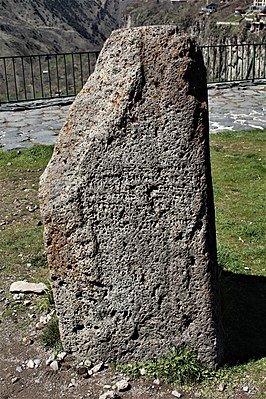 Vishapakar with a cuneiform inscription Argishti II | |||||||
| |||||||
| Predecessor | Rusa I | ||||||
| Successor | Rusa II | ||||||
| Birth | 743-737? BC er | ||||||
| Death | 680 BC er | ||||||
| Father | Rusa I | ||||||
| Mother | Rusain? | ||||||
| Spouse | Asis (Հասիս) | ||||||
| Children | Rusa II | ||||||

State Restoration
Argishti II ascended the throne of Urartu, probably immediately after his father Rus I in 714 BC. er , according to the Assyrian king Sargon II , "having heard of the defeat of Musashir and the capture of his god Haldia , with his own hands, he finished his life with a belt iron dagger" [1] . The surviving documents, including the cuneiform texts of Argishti II himself that have come down to us, rather poorly cover the history of Urartu of his time. Obviously, after the campaign of the eighth year of Sargon II's reign, Urartu still retained its independence, although the king of Assyria did not lose interest in what was happening on the Assyrian-Urartian frontier and in the next few years organized victorious campaigns against the allies and vassals of Argishti II - the ruler Tabala and Mita , the leader of the flies (mosks) and the king Kummukh , moreover, Sargon continued to erect fortifications and carry out military espionage in the areas bordering Urartu [2] [3] .
In the last years of his reign, Sargon II was forced to focus his attention on other problems and to distract himself from questions related to Urartu. His successor acted in the same way, which gave Argishti time and energy to restore his state after the defeat of the Assyrians in 714 BC. e. Cuneiform sources speak of large-scale construction work carried out by Argishti II in the center of Urartu, including in those areas through which Sargon passed at the head of his army. Two steles of Argishti, found not far from Ardzhish , narrate about the construction of the city, the construction of an irrigation canal and the construction of an artificial lake [4] [5] .
The inscription on both sides of a large stela found in the village of Hagi near Ardishe (possibly originating from the ruins of an ancient Urartu city), informing about the founding of the town of Taktumnia, the construction of an artificial lake (the source for which was the Kialiala River) and an irrigation canal, gardens and vineyards [5] , among other things, contains the Argishti II titulature:
The greatness of the god Haldi Argishti, the son of Rus, the mighty king, the king of Biaini’s country, the servant of the god Haldi, the faithful shepherd of the people, (who) the greatness of the god Haldi ... did not fear battle [6] .
Apparently, Argishti II occupied the throne of Urartu during almost the entire reign of the Assyrian king Sinaheriba (killed ca. 681 BC ), who inherited his father Sargon II about 705 BC. er The Assyrian sources of that period did not say anything about the events related to Urartu, probably because Sinaherib was busy with wars with Assyria’s other neighbors. The written sources that have survived to the present day do not allow us to establish the end time of the reign of Argishti II. In the texts of the Assyrian king Asarhaddon , the son and heir of Sinaheriba, Rusa II , the son of Argishti, is mentioned as the king of Urartu [4] .
Cimmerian threat and eastern march
During the reign of Argishti II, as during the reign of Rusa I, the threat of invasion from the Caucasus of the nomadic Cimmerians increased on the northern and northeastern borders of the state. Urartu remained safe until the border along Lake Sevan was securely guarded, however, as soon as the Cimmerians invaded the Araks valley, the Urartians lost a convenient line of defense in the northeast [7] . Under Argishti II, the Cimmerians had already occupied and plundered a significant part of the northern regions of Urartu, gradually moving towards Phrygia , whose capital they subsequently seized and destroyed (c. 685 BC). Argishti opposed the Cimmerians in 707 BC. er , but, like his father seven or eight years earlier, he was defeated. Now it is impossible to understand the reasons for this defeat, however, apparently, it did not become decisive, since after it Argishti II remained at the head of Urartu for more than twenty years [8] .
Probably, a fortress, a palace, a temple and generally a settlement in Altin-Tepa on the north-western border of Urartu (east of modern Erzincan ) were built during the reign of Argishti II - one item with an inscription from Altin-Tepe dated from the period of his reign. If this is true, then a fortified settlement in Altin-Tepa could be created to provide defense from the Cimmerians returning from Central Anatolia [9] .
Two identical inscriptions of Argishti II, preserved northeast of Sarab at the foot of the southern slope of the extinct volcano Sebelan , near the road from Tabriz to Ardabil , tell about its military activity or even expansion in the eastern border of Urartu, as a result of which he probably reached the areas closely adjacent to the Caspian Sea [10] [11] :
By the greatness of the god, Haldi Argishti, the son of Rus, says: I arranged (?) A trip to the land of the Arch; I conquered the country of Ushulu, the country of Buku, reached the river; from there he turned (and) defeated the country of Girduni (?), the country of Gituhani, the country of Tuishdu; the city of Rutumni (?) I conquered. I conquered (many) countries (and) made them (my) tributaries, and I also conquered this fortress in battle, (then again) rebuilt (and) established (for it) the name - the city of Argshtiyrdu (letters of the Governor (king) Argishti ), for the power of the country Biaini (and) pacification (?) of enemy countries [12] .
According to N. V. Arutyunyan, Argishti II’s eastern march began, obviously, along the same route as the previous campaign of Sarduri II against the country of Puluadi, that is, on the Van –Erchek – Kyazym Pasha – Kotur – Khoi – Merend - road Tabriz. However, the army of Argishti II moved from Tabbriz, probably in a different way - through Sarab to Ardebil. Apparently, the countries of Archi, Ushulu (Ushuluni), Buku, Girduni (?), Gitukhani and Tuishdu (Tuishduni) [13] were located along this route.
Notes
- ↑ Dyakonov I.M., 1951 , From the so-called "Solemn inscription" of Sargon II. (72).
- ↑ Piotrovsky B. B., 1959 , p. 111.
- ↑ N. Harutyunyan, 2006 , p. 242.
- ↑ 1 2 Piotrovsky B. B., 1959 , p. 112
- ↑ 1 2 Karapetyan L. L., 1979 , p. 66
- ↑ Melikishvili G. A., 1960 , Inscriptions of Argishti II, son of Rus. 276.
- ↑ Charles Burney, David Lang, 2016 , p. 177.
- ↑ Charles Burney, David Lang, 2016 , p. 214-215.
- ↑ Charles Burney, David Lang, 2016 , p. 196, 215.
- ↑ N. Harutyunyan, 2006 , p. 245–246.
- ↑ Charles Burney, David Lang, 2016 , p. 215.
- ↑ Melikishvili G. A., 1960 , Inscriptions of Argishti, son of Rus. 445.
- ↑ N. Harutyunyan, 2006 , p. 248.
Literature
- Harutyunyan N.V. Biaynili - Urartu. Military-political history and toponymy questions. - SPb: Publishing House of St. Petersburg University, 2006. - 368 p. - 1000 copies - ISBN 5-8465-0133-8 .
- Bernie C. , Lang, D. M. The Ancient Caucasus. From the prehistoric settlements of Anatolia to the Christian kingdoms of the early Middle Ages / Trans. from English L. A. Igorevsky. - M: Centrpoligraf, 2016. - 383 p. - ISBN 978-5-9524-5198-8 .
- Dyakonov I.M. Assyro-Babylonian sources on the history of Urartu // Herald of ancient history. - Moscow, 1951. - № 2 - 4 .
- Karapetyan L. L. Irrigation and irrigation in the late Bronze Age in Armenia // Պատմա-բանասիրական հանդես. - 1979. - № 1 . - p . 59-74 .
- Melikishvili G. A. Urartian wedge-shaped inscriptions . - M .: Publishing House of the Academy of Sciences of the USSR, 1960.
- Piotrovsky B. B. The Kingdom of Van (Urartu) / Ed. ed. I.A. Orbeli . - Moscow: Eastern Literature Publishing House, 1959. - 286 p. - 3500 copies
- Zimansky P. Ecology and Empire: The Structure of the Urartian State. - Chicago: University of Chicago, 1985. - (Studies in ancient oriental civilizations). - ISBN 0-918986-41-9 .