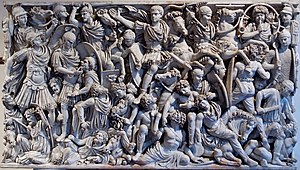
The sarcophagus of Ludovisi or the Large sarcophagus of Ludovisi ( Italian: Sarcofago Grande Ludovisi ) is an , supposedly dated to the 250s. The sarcophagus is known for its dense and non-classical composition, formed by the crouched and highly emotional figures of the Romans and is ready . Illustrates the direction in Roman art , typical of the crisis period of the III century .
The sarcophagus was discovered in 1621 in a burial place near the Tiburtine gate of Rome , and therefore is known in Latin as Via Tiburtina Sarcophagus . Like many of the antiquities discovered at that time, he entered the possession of Cardinal-Nepot L. Ludovisi . It is currently on display at the Palazzo Altemps , part of the National Museum of Rome .
This sarcophagus is usually classified as a group of about 25 late Roman sarcophagi dating from about 170-210 years and originating from Rome, less often from Athens . They go back to the Hellenistic monuments of Asia Minor Pergamon , depicting the victories of the Pergamans over the Gauls . The most famous representative of this group of works of art is the . All the sarcophagi of this group were obviously intended for military leaders.
The height of the marble sarcophagus is 153 cm. Its surface is completely covered with high relief figures. The lid of the sarcophagus, broken in Mainz in 1945, depicts the children of barbarians , transmitted to the Romans allegedly by their fathers. The central figure on the front panel is the mounted Roman commander, possibly representing the deceased. His face is calm, and a gesture that is difficult to interpret can mean goodbye. The X-shaped sign on his forehead is interpreted as a cross received by converts on the Mysteries of Mithras as a sign of the location of the god Mithras , popular among Roman soldiers. Courage ( virtus ), demonstrated by the rider, can mean lifetime prowess on the battlefield, however, together with the sign indicates victory over death.
Some experts identify the central figure with Gostilian , the son of Emperor Decius , whose independent short reign began in 251 after the death of his father and older brother at the Battle of Abritte with the Goths . Decius Trajan and Herenn Etrusc were the first among the Roman emperors to die at the hands of strangers. Unlike his father and brother, Gostilian died of the plague .
Literature
- Ernst Künzl: Ein Traum von Imperium: Der Sarkophag Ludovisi - Grabmal eines Feldherrn Roms. Schnell & Steiner, Regensburg 2010, ISBN 3-7954-2225-6 .