Giacomo Tritto ( Italian Giacomo Tritto ), or Giacomo Domenico Mario Antonio Pascval Giuseppe Tritto ( Italian Giacomo Domenico Mario Antonio Pasquale Giuseppe Tritto ; April 2, 1733 , Altamura , Kingdom of Naples - September 16, 1824 , Naples , Naples - Naples Italian composer and music theorist , father of composer Domenico Tritto . [1] [2] [3] [4]
| Giacomo Tritto ital. Giacomo tritto | |
|---|---|
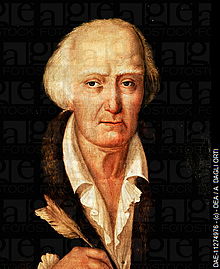 Giacomo Tritto | |
| basic information | |
| Full name | Giacomo Domenico Mario Antonio Pascval Giuseppe Tritto |
| Date of Birth | April 2, 1733 |
| Place of Birth | Altamura , Kingdom of Naples |
| Date of death | September 16, 1824 (91 years old) |
| A place of death | Naples , Kingdom of the Two Sicilies |
| A country |  Kingdom of Both Sicilies Kingdom of Both Sicilies |
| Professions | composer , music theorist |
| Genres | classical music |
Content
- 1 Biography
- 2 Creative heritage
- 3 notes
- 4 Literature
- 5 Links
Biography
Giacomo Domenico Mario Antonio Pascval Giuseppe Tritto was born on April 2, 1733 in Altamura, in the kingdom of Naples. At age 11, he entered the Pieta dei Turkini Conservatory , where he studied composition with Nicola Fago and his assistant Lorenzo Fago and counterpoint with Pasquale Cafaro .
In 1754, at the Fiorentini Theater in Naples, he successfully made his debut as an opera composer of the opera-buff "Wedding feuds" ( Italian: Le nozze contrastate ). The composer's next opera Fidelity in Love ( Italian: La fedeltà in amore ) based on the libretto by Francesco Cerlone was written by him in 1764 and staged on the stage of the Nuovo Theater in Naples. From 1764 to 1810 he composed over 50 buff and opera operas. Among the composer's comic operas written on the plots of “folk comedy” ( Italian commedia popolaresca ), the opera Stone Guest ( Italian Il convitato di pietra ) by Giovanni Battista Lorenzi staged at the Fiorentini Theater in Naples during the carnival deserves special attention . 1783, and the opera Pevichka ( Italian: La cantarina ) based on the libretto by Carlo Goldoni , staged at the Vallée Theater in Rome during the Carnival of 1790. Among his melodramatic operas, the opera Arminius ( Italian: L'Arminio ) by the libretto by Ferdinando Moretti , staged at the Argentine Theater in Rome in January 1786 and the last stage work of the composer, the opera Mark Albin in Syria ( Italian Marco ), deserve special attention . Albino in Siria ), which premiered on August 15, 1810 at the San Carlo Theater in Naples.
In October 1785, Giacomo Tritto was accepted into the place of the terto maestro at the Pieta dei Turkini Conservatory, and in 1793, into the place of the second maestro, replacing Nicola Sala . In October 1799, he was appointed to the place of prima maestro in alma mater. In December 1806, all four Naples Conservatories were united into the Royal College of Music , and Giacomo Tritto, together with Giovanni Paisiello and Fedele Fenaroli , headed it until February 1813. Since April 1813, he headed the department of composition and taught counterpoint at a music school. His students were Vincenzo Bellini , Saverio Mercadante , Giacomo Meyerbeer , Gaspare Spontini , Carlo Conti , Nicola Manfroche , Francesco Florimo , Pietro Raimondi , Mario Costa , Vincenzo Fabrizi .
In 1787 he was appointed director of the San Carlo Theater in Naples and the maestro of the royal court. In July 1804 he headed the chapel of the city of Naples. Since 1810, the composer composed exclusively church music . In 1821, his compositions on music theory were published in Milan - “Actions and General Rules for Understanding the Numbering Required for Different Bass Sizes ” ( Italian: I partimenti e regole generali per conoscere qual numerica dar si debba a 'varii movimenti del basso ) and The School of Counterpoint, or Musical Theory ( Italian: Scuola di contrapunto ossia Teorica musicale ).
Giacomo Tritto died on September 16, 1824 in Naples, in the kingdom of Both Sicilies.
Creative heritage
The composer's creative heritage includes 54 operas, works by chamber and church music, and books on the theory of music.
Notes
- ↑ Florimo, 1869 , p. 571-580.
- ↑ Sanguinetti, 2012 , p. 81–84.
- ↑ Randel, 1999 , p. 685.
- ↑ Tritto, Giacomo (Italian) . Enciclopedie on line . Treccani.it.
Literature
- Francesco Florimo . Cenno storico sulla Scuola Musicale di Napoli : [ ital. ] . - Napoli: Rocco, 1869. - 2266 p.
- Don Michael Randel. The Harvard Concise Dictionary of Music and Musicians : [ eng. ] . - Cambridge, Mass. : Harvard University Press, 1999 .-- 757 p. - (Harvard University Press reference library). - ISBN 0674000846 .
- Giorgio Sanguinetti. The Art of Partimento: History, Theory, and Practice : [ eng. ] . - New York: Oxford University Press, 2012 .-- 385 p. - ISBN 0195394208 .
Links
- Andrea Della Corte. Tritto . Treccani.it. - Enciclopedia Italiana (1937). (ital.)