Mysterium Cosmographicum [1] ( Russian. The mystery of the universe ) is a book by the German astronomer Johannes Kepler , published in 1596 in Tübingen (second edition - 1621).
| Mystery of the universe | |
|---|---|
| Mysterium Cosmographicum | |
 | |
| Author | Johannes Kepler |
| Original language | Latin |
| Original published | 1596 |
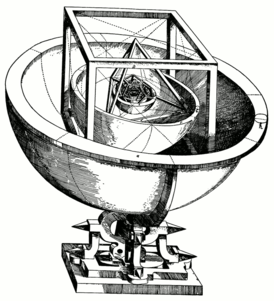
This book is Kepler's first published work in which he develops the heliocentric system of the world of Copernicus , describing the model of the world using a system of Platonic solids [2] . Kepler suggested that the ratio of the sizes of the orbits of the six planets of the solar system , known at that time, are described by a system of regular polyhedra inscribed into each other. In the Kepler scheme, each regular polyhedron has an inscribed (internal) sphere touching the centers of each face and a described (external) sphere passing through all the vertices, and the center of these spheres is common, and the Sun is in it. At the same time, a cube is inscribed in the sphere of Saturn’s orbit, a sphere of Jupiter is inscribed in the cube, in which, in turn, a tetrahedron is inscribed, and then the spheres of Mars - the dodecahedron , the sphere of the Earth - the icosahedron , the sphere of Venus - the octahedron and the sphere of Mercury . The coincidence of the sizes of the orbits of the planets with this Kepler model was not entirely accurate, especially the Kepler’s sphere of Mercury caused a lot of trouble, which in the end had to be inscribed in the octahedron so that it touched not the faces, but the middle of the edges of the latter [3] . Kepler initially explained the discrepancies between theory and empirical data by the fact that real planetary spheres have some “thickness”. At the same time, he did not abandon attempts to build a more accurate model of the universe, which ultimately led him to discover the laws of planetary motion .
This book of Kepler has not yet been translated into Russian , in 1981 its translation into English appeared with a parallel original text and a foreword by the famous science historian Bernard Cohen [4] .
Content
- 1 Theological and philosophical foundations of labor
- 2 Neoplatonism
- 3 Reaction to work in the scientific community
- 4 In popular culture
- 5 notes
- 6 Literature
- 7 References
Theological and philosophical foundations of labor
Kepler was a staunch supporter of the heliocentric system of the world, and conviction was based on his religious beliefs: the Universe embodied the image of God , while the Sun corresponded to God the Father , the sphere of stars to God the Son and the intermediate space to the Holy Spirit . Kepler’s book is an attempt to “dock” the idea of heliocentrism with biblical texts [5] .
With the support of his mentor, professor of Tubingen University Michael Mestlin , Kepler received permission from the university senate to publish his work, with an appropriate exegetical commentary and an appendix of a simple and clear description of the Copernicus system, as well as new ideas of Kepler himself. The book was published at the end of 1596, after which Kepler began distributing copies of the book to famous astronomers of that time, as well as influential people, which created him a reputation as a highly skilled astronomer [6] .
After Kepler's further discoveries, this work lost its original meaning (in particular, the orbits of the planets were not circular); nevertheless, Kepler believed in the existence of hidden mathematical harmony of the Universe until the end of his life and in 1621 reprinted The Secret of the Universe, making numerous changes and additions to it, accumulated over 25 years of observation [7] .
Neoplatonism
Mysterium Cosmographicum represented an important step in the development of the concept of the heliocentric system of the world, set forth by Nikolai Copernicus in his work “ On the Rotation of the Celestial Spheres ”. Copernicus in his work still resorted to the apparatus used by Ptolemy to describe the geocentric system of the world (in particular, the system of epicycles and deferents ) to explain the change in the orbital velocity of the planets, and also continued to use the center of the earth's orbit, and not the Sun, as a reference point [8 ] . According to historians of science, modern astronomy owes much to the Mysterium Cosmographicum, as it represents the first step in cleansing the Copernican system from the remnants of the Ptolemy theory that are still clinging to it [9] . When it comes to the geometry of the universe, Kepler is in the position of Neoplatonism . The structure of the universe, described through a system of regular polyhedra, is used by Kepler as a teleological argument . Kepler postulates the existence and necessity of the Creator God , as a “working root cause” [10] .
The reaction to work in the scientific community
Among the responses to the publication of Mysterium Cosmographicum was a review by Danish astronomer Tycho Brahe , who found Kepler's approach interesting, but requiring verification , which can only be carried out based on Brage observations made over the past 30 years. Kepler turned to T. Brahe in early 1600 with a request to provide him with these observational data, but Brahe provided him with only observational data from Mars [11] .
In popular culture
The image of I. Kepler with a world model from Mysterium Cosmographicum is placed on the Austrian commemorative silver coin of 2002 with a denomination of 10 euros [12] .
Notes
- ↑ The full title of the book is the Thesis on Cosmography, containing the secret of the universe, including wonderful proportions of the celestial spheres, setting the true and proper number, sizes and periods of movements, using five regular geometric bodies ( lat.Prodromus dissertationum cosmographicarum, continens mysterium cosmographicum, de admirabili proportione orbium coelestium, deque causis coelorum numeri, magnitudinis, motuumque periodicorum genuinis & propriis, demonstratum, per quinque regularia corpora geometrica ).
- ↑ James R. Voekel. "Classics of Astronomy by Johannes Kepler." chapin.williams.edu. 2010.
- ↑ “Cosmic music”: from Plato to Kepler . mathemlib.ru . Date of treatment January 14, 2019.
- ↑ Johannes Kepler. Mysterium Cosmographicum: The secret of the universe / Translation by AM Duncan, Introduction and Commentary by EJ Aiton, with a Preface by I. Bernard Cohen. - New York: Abaris Books, 1981. - 267 p. - ISBN 0-913870-64-1 .
- ↑ Barker and Goldstein. "Theological Foundations of Kepler's Astronomy," pp. 99-103, 112-113.
- ↑ Caspar. Kepler , pp. 65-71.
- ↑ Field, JV Kepler's geometrical cosmology. Chicago: Chicago University Press, 1988, ISBN 0-226-24823-2 , Chapter IV.
- ↑ Barker and Goldstein, “Theological Foundations of Kepler's Astronomy”
- ↑ Dreyer, JLE A History of Astronomy from Thales to Kepler , Dover Publications, 1953, pp. 331, 377-379.
- ↑ Johannes Kepler. Stanford Encyclopedia of Philosophy. May 2, 2011.
- ↑ James R. Voekel. Classics of Astronomy by Johannes Kepler . chapin.williams.edu. 2010.
- ↑ coin-database.com, 10 euro: Eggenberg Palace . . www.coin-database.com . Date of treatment January 14, 2019.
Literature
- George W. Hart, "Johannes Kepler's polyhedra" . www.georgehart.com . Date of treatment January 14, 2019.
- Johannes Kepler . www-groups.dcs.st-and.ac.uk . Date of treatment January 14, 2019.
- Caspar Kepler, pp. 60-65; see also: Barker and Goldstein, “Theological Foundations of Kepler's Astronomy.”
- Barker and Goldstein. "Theological Foundations of Kepler's Astronomy," pp. 99-103, 112-113.
- Caspar Kepler, pp. 65-71.
- Field Kepler's Geometrical Cosmology, Chapter IV, p 73ff.
- John Louis Emil Dreyer, A History of Astronomy from Thales to Kepler , Dover Publications, 1953, pp. 331, 377-379.
Links
- Mysterium cosmographicum . www.e-rara.ch . Accessed January 14, 2019. By Johannes Kepler, 1596 edition, in Latin, full text scan, 181 p.
- http://www.uff.br/cdme/kepler/kepler-html/kepler-en.html . www.uff.br. Released Jan 14, 2019. Mysterium Cosmographicum Interactive 3D JAVA Model