Palanga ( lit. Palangà , the accent in the Lithuanian name falls on the last syllable) is a resort town in the western part of Lithuania ( емemaitija ), located on the Baltic Sea . Administratively in the status of self-government of Lithuania . In 1995 - 2010 , it was part of the now abolished Klaipeda County .
| City | |||||
| Palanga | |||||
|---|---|---|---|---|---|
| lit. Palanga | |||||
| |||||
| |||||
| A country |  Lithuania Lithuania | ||||
| Self management | Palanga city | ||||
| The mayor | Sarunas Vaitkus | ||||
| History and Geography | |||||
| First mention | 1161 | ||||
| Former names | Polonga (емemait dialect), Palangen [1] , Polangen [2] | ||||
| City with | 1933 | ||||
| Area | 79 km² | ||||
| Center height | 7 m | ||||
| Timezone | UTC + 2 , in summer UTC + 3 | ||||
| Population | |||||
| Population | 15 385 people ( 2018 ) | ||||
| Nationalities | Lithuanians 94.32% | ||||
| Denominations | Catholics (over 76%) | ||||
| Official language | Lithuanian | ||||
| Digital identifiers | |||||
| Postcode | LT — 00001 | ||||
| Other | |||||
| Ethnographic region | Jemaitia | ||||
| palanga.lt | |||||


Content
- 1 Geography
- 2 Name
- 3 Coat of arms
- 4 History
- 5 Climate
- 6 population
- 7 Transport
- 8 Economics
- 9 Sports
- 10 media
- 11 Attractions
- 11.1 Amber Museum and Botanical Park
- 12 Twin Cities
- 13 Famous residents and natives
- 14 Gallery
- 15 Notes
- 16 Literature
- 17 Links
Geography
Palanga - the westernmost city of Lithuania , located along the coast of the Baltic Sea and occupies 25 km of the coast (including the village of Sventoji , annexed to Palanga in 1973). It is located at a distance of 27 km north of Klaipeda and 331 km north-west of Vilnius , 19 km south of the border with Latvia .
Title
The name Palanga ( lit. Palanga ) is derived from folk etymology from lit. po langą "under the window." In fact, as the linguist Casimeras Buga put it , the name of the city is probably of Curonian origin. The suffix -ng is especially characteristic of the Curonian geographical names. Palanga can come from the Baltic root, denoting a low muddy place. Until 1917, the settlement was officially called Polangen ( German: Polangen ).
Coat of Arms
The emblem of the city was developed with an eye on the legend: the azure field symbolizes the Baltic Sea, the amber necklace recalls ancient art, and the silver crown - the sea goddess Yurata . The coat of arms according to the standard of Grazhina Oshkinite was approved on September 3, 1996. [3] [4] .
History
The territory of Palanga was inhabited by the Curonians about 5000 years ago. It was located on the trail of the ancient Amber Road and became one of the centers of trade and crafts. In historical documents, the name Palanga was first mentioned in 1161, when the King of Denmark, Waldemar I, landed there with his army. The foundation date is the mention in the chronicles of the Livonian Order in 1253 . According to legend, Biruta ( lit. Birutė ) lived in Palanga, vaidelotka ( priestess ), who was taken as a wife by the son of Gediminas Keistut ; Biruta became the mother of Vytautas the Great .
Between the 13th and 15th centuries, the inhabitants of Palanga were to confront the Teutonic Knights in the south and the Livonian ordinaries in the north. Still, the opponents could not capture the Lithuanian coast. In 1422, according to the Treaty of Meln, Palanga was transferred to the Grand Duchy of Lithuania [5] . XV-XVII century Palanga was the most important port of Lithuania. The main occupations of the population were: amber collection, fishing and trade. Amber, honey, and wax were exported from Palanga and neighboring Sventoji by sea. During the Great Northern War in 1701, the Swedish army defeated Palanga and destroyed port facilities in Sventoji . In 1795, after the third division of the Commonwealth , Palanga, together with the rest of Lithuania, became part of the Russian Empire [6] . In 1819, Palanga was transferred from the Vilnius province to the Courland province [7] .
During the uprising of 1830-1831 against the Russian Empire, Lithuanian rebels, led by Onufry Yatsevich, lost the battle of Palanga. The capture of this city could provide Lithuanian rebels with access to the Baltic Sea port for the delivery of weapons purchased by them in the UK [8] .
In 1824, Palanga was bought by the family of counts Tyszkiewicz . Administratively, Palanga was considered the town of Grobinsky district of this province. Tyszkiewicz invested a lot of money in the development of Palanga as a sea resort. So, in 1877-1880, the first hotel and restaurant were built with the money of the Tyszkiewicz; the first theater appeared in Palanga, and bathing cabins were arranged on the beach; in 1886 a gymnasium was opened. In 1884-1888, a pier with a long pier was built [9] , and in neighboring Šventoji in 1891 a sailing school was opened. In 1893-1897, under Count Felix Tyszkiewicz, a palace was built in the southern part of the city, surrounded by an English park (architect Eduard Francois André ). In the first half of the 20th century, a large hospital was opened in Palanga, focused on people with diseases of the musculoskeletal system. In 1907, the Palangan church received the first parishioners. After the Lithuanian press was banned in 1864, the city became an important center for smuggling Lithuanian books from the west. In 1899, the first public Lithuanian performance “America in the Bath” ( lit. Amerika pirtyje ) was staged in Palanga.
March 23, 1915 Palanga was occupied by German troops . From 1919 to 1921 it was part of Latvia [10] . Then, between independent Lithuania and Latvia, a dispute arose over the affiliation of Palanga and Sventoji , resolved by the international arbitration commission, and on March 21, 1921, these territories were transferred to Lithuania [11] . March 31, 1921 the Latvian troops left Palanga [12] .
In 1933, Palanga received the status of a city . In the 1930s, a number of rich villas were built on the lands bought from Tyszkiewicz. Palanga became the unofficial capital of Lithuania in the summer, ministers and presidents of the republic came to the resort, the city was a favorite vacation spot of the Lithuanian intelligentsia. The resort suffered from a devastating fire on May 10, 1938, which destroyed about three hundred buildings, including about 120 houses.
June 22, 1941 Palanga was occupied by German troops ; October 10, 1944 the city was liberated from Nazi troops by the Red Army . In the Soviet years, the resort expanded significantly, on the basis of nationalized villas holiday homes were organized, as well as several new holiday homes were built. In 1963, an airfield was opened. Palanga has become one of the largest Soviet resorts. Two Russian poets - Joseph Brodsky and Robert Rozhdestvensky - dedicated their poems written in the 1960s to this city [13] .
Since 1990, as part of Lithuania. In 1992, Soviet troops were withdrawn from Palanga. Improvement of the resort continued, the work of the old gymnasium was resumed, in 1999 a museum of the Lithuanian artist and sculptor Antanas Monchis was opened . Great damage to the city was caused by Hurricane Anatoly, which swept over the coast of Lithuania in 1999; the famous Palangan pier [14] , which had to be reconstructed, was destroyed. Situated between the pier and the central Vytauto street, the once quiet and shady Basanavicius street has become a pedestrian “Palanga Broadway ”, the focus of restaurants, cafes and noisy entertainment.
By a decision of a special commission of the Ministry of Culture of Lithuania, Palanga was chosen as the cultural capital of the country for 2013 [15] .
Climate
The climate is mild, very changeable, with warm summers, relatively mild and not very snowy winters. The warmest season is in July and August, when the air temperature reaches +25 ° C and above, and the water temperature is +20 ° C. In these months, almost all days are sunny, but often there are short thunderstorms.
Population
In 1867, 1414 people lived in Palanga and there were 164 houses. In 1897, the number of inhabitants reached 2419 people [16] .
In 2001, there were 17.6 thousand inhabitants in Palanga. 8.1 thousand men and 9.6 thousand women live in the city. The average population density is 223 people per square kilometer. [17] .
In 2011, the population of Palanga was 15 732 people. National composition according to the 2011 census: [18] :
- 14 839 (94.32%) - Lithuanians,
- 433 (2.75%) - Russians,
- 152 (0.97%) - Latvians,
- 96 (0.61%) - Ukrainians,
- 39 (0.25%) - Belarusians,
- 33 (0.21%) - Poles,
- 140 (0.89%) - other.
Transport
7 km north of the city center is Palanga International Airport . There is air communication with the cities of Warsaw , Copenhagen , Minsk , Riga , Oslo [19] . Intercity buses from Palanga go to various cities, such as Klaipeda , Kaunas , Vilnius . Public transport connects Palanga, Sventoji and Nemirseta. Highway A13 connects Palanga with Klaipeda . The city is connected by motorways with Vilnius and Kaunas . To the east of Palanga, about 11 km by the A11 motorway, is the city of Kretinga . In 2015, a new bus station was opened. The nearest railway stations are in Klaipeda and Kreting .
Much attention is paid to cycling. Bike path between Palanga, Šventoji and Klaipeda [20]
Economics
The basis of the city’s economy is tourism (leisure services and recreation ). In 2017 , more than 307 thousand guests stayed overnight in Palanga. The resort has over 70 hotels and guest houses. Currently, the city's hotels can simultaneously accommodate 15 thousand guests [21] , and a significant part of visitors are accommodated in the private sector, where accommodation prices are lower.
Sport
- Basketball club BC Kursiai represents the city in the championship of the national basketball league (NKL).
- FC Palanga - Lithuanian football club from Palanga.
- Football stadium Palanga.
Media
- The newspaper "Evening Palanga" ( lit. Vakarinė Palanga ).
- Newspaper "Palanga Pier" ( lit. Palangos Tiltas ).
- HOT FM music and entertainment radio station since 2002.
Attractions
- A pier extending into the sea at 480 m is one of the symbols of Palanga. Built in 1884-1888. It was reconstructed in 1998.
- Catholic church of the Assumption of the Virgin Mary , built in the neo - Gothic style in 1907. The highest building of Palanga (76 m). Since 2018, an observation deck on the church tower has been opened.
- The Palanga Amber Museum is located in a palace in the very center of the Botanical Park.
- Birute Park and the Botanical Garden
- Pedestrian street them. Jonas Basanavichiaus .
- The museum of the resort of Palanga is located in the old villa Anapilis (1898; Birutes al. 34A)
- The ancient pharmacy of Palanga (1827; Vytauto street, 33).
- Museum of exile and resistance, dedicated to the period of the Soviet occupation (21 J. Basanavichiaus St.).
- Church in the name of the icon of the Mother of God “Iverskaya” (2001; address: 52 Sodu St.).
- Musical Fountain (Intersection of Jurate and Vytautas Streets).
- The memorial estate of Dr. Jonas Schlupas (1861-1944), a famous public figure, the first burgomaster of Palanga (23A Vytauto St.).
- The house-museum of the artist and sculptor Antanas Monchis (16 Daukanto St.).
- Seaside Regional Park (located between Palanga and Klaipeda ) [22] . It was founded in 1992.
- Palanga Concert Hall. Opened in 2015.
Amber Museum and Botanical Park
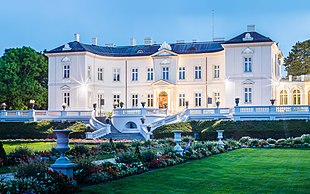
The Amber Museum , located in the former Tyszkiewicz palace , was opened in 1963 and has about 4.5 thousand exhibits. Near the palace is a sculpture "Blessing Christ." Brought from France at the beginning of the 20th century, the sculpture was destroyed in Soviet times; in 1993, at the same place, a copy of the work of Stasis Zhirgulis was established [23] .
(1897), was planned by the famous French landscape architect and botanist Eduard Francois Andre, who spent three years with his son in Palanga, working on the creation of the park. The park has about 300 species of plants. Among the attractions of the park is the sculptural composition “Egle, the Queen of Snakes” (1960, sculptor Robertas Antinis Sr. ), the plot of which is based on the Lithuanian fairy tale of the same name . On the territory of the park is Mount Birute, associated with the romantic history of the vestal , who became the wife of the Grand Duke of Lithuania Keistuta . At the top of the mountain is a chapel (1869, architect K. Mayeris) with stained-glass windows (1976, author L. Pocius). At the foot of the mountain there is a sculpture “You, Biruta ” (1965, sculptor K. Tulene), as well as “Lourdes” - a grotto with a statue of the Virgin Mary , created by Count Tyszkiewicz at the request of his wife.
Palace - Amber Museum
Palace
Amber Museum
Amber Exposition
Botanical Park
Sculptures in the park
Small ground of Palanga Botanical Park
Chapel on the top of Mount Birutes (1869)
Twin Cities
|
|
Famous residents and natives
- Biruta (1317–1382) - wife of the Lithuanian prince Keistut , mother of the Grand Duke of Lithuania Vytautas
- Jonas Slyupas (1861–1944) - MD, Lithuanian politician and first burgomaster of Palanga
- Julius Brutskus (1870–1951) - Lithuanian Jewish historian, scholar, and politician
- Vladas Jurgutis (1885–1966) - Lithuanian priest, economist and professor
- Balis Dvarionas (1904–1972) - Lithuanian composer . 1953-1972 spent the summer in Palanga, buried in the Palanga cemetery.
- Jonas емemaitis-Vytautas (1909–1954) - General, Lithuanian leader of resistance to the Soviet occupation . Later it was officially recognized as one of the Presidents of Lithuania .
- Alfredas Tiskevičius (1913–2008) - Count, Honorary Citizen of Palanga, was buried in the Palanga Cemetery.
- Ramute Bored (born 1931) - Lithuanian poet, playwright
- Ludvikas Narcisas Rasimavičius (born 1938) is a Lithuanian politician. In 1990 were among those who signed the Act on the Restoration of an Independent State of Lithuania
- Laimonas Tapinas (born 1944) - Lithuanian writer, journalist and critic
- Stasis Povilaitis (1947–2015) - Lithuanian pop singer and songwriter, buried in Palanga cemetery
- Edmundas Benetis (born 1953) - Lithuanian architect
- Raimundas Palaitis (born 1957) - Lithuanian politician, Minister of the Interior from 2008 to 2012
- Indre Sherpitite (born 1983) - Lithuanian artist and photographer
- Renaldas Seybutis (b. 1985) - Lithuanian professional basketball player
Gallery
Modern architecture in Palanga
Vila "Karininka Ramova"
Villa on the street J. Basanavicius
Villa in Palanga
River Rage
St. J. Basanavicius
Main pedestrian street of J. Basanavičius
The fountain with the sculpture " Jurate and Kastitis "
Sea in Palanga
Beach
Beach
Pier going to sea
Sunset in Palanga
Notes
- ↑ Atlas of the entire Baltic Sea with the Gulf of Finland and the Gulf of Bothnia, with Shkager-cancer, Kategat, Zund and Belty, consisting of general sea and special charts, consisting of: ... - St. Petersburg: Type. Pestilence. gentry. cadet. hull: 1793. - 1 t. (51 l.)
- ↑ Map of Courland Province. 1821 year.
- ↑ Heraldry.ru. Coat of arms of the city of Palanga (Klaipeda county) | Heraldry.ru . geraldika.ru. Date of treatment August 15, 2017.
- ↑ Edmundas Rimša. Lietuvos heraldika. - Vilnius: Baltos lankos, 2008 .-- ISBN 978-9955-23-202-5 .
- ↑ Grigonis, 2014 , p. 218.
- ↑ Information about Palanga on the portal “About Lithuania”
- ↑ Grigonis, 2014 , p. 193.
- ↑ Jacek Feduszka, Powstanie Listopadowe na Litwie i Żmudzi, w: Teka Kom. Hist. OL PAN, 2004, 1, s. 110-160.
- ↑ City history on the website of the Information Center for Tourism and Recreation in Palanga
- ↑ Eugenius Grigonis. Socio-economic history . The historical fate of the territories annexed to the Russian Empire by the Nishtad Peace of 1721 and as a result of the sections of the Commonwealth (Pdf) . MNIOTS (September 21, 1993) .
- ↑ Grigonis, 2014 , p. 193, 218.
- ↑ Saulė Markelytė. Palanga. Vilnius: Mintis, 1980.P. 66. (lit.)
- ↑ [1] Archived December 24, 2013 to Wayback Machine [2]
- ↑ City of window sills (inaccessible link) . Date of treatment July 30, 2012. Archived on February 7, 2011.
- ↑ Palanga will become the cultural capital of Lithuania // ru.DELFI.lt, February 4, December 2011
- ↑ Saulė Markelytė. Palanga. Vilnius: Mintis, 1980.P. 60. (lit.)
- ↑ Palangos miesto savivaldybė (lit.)
- ↑ 2011 m. surašymo duomenys . Date of treatment June 1, 2009. Archived June 1, 2009.
- ↑ Palanga Airport
- ↑ olitve.ru Cycling
- ↑ palangatic.lt
- ↑ Seaside Regional Park
- ↑ Travel Zone
Literature
- Eugenius Grigonis. Lithuania and its neighbors in the past and present : Collection of selected articles. - SPb. : “Lema”, MNIOTS, 2014. - 322 p. - ISBN 978-5-98709-723-6 .
Links
- Palanga self-government (official page in Russian)
- Old version of the official page (lit.)
- Palanga is the summer capital of Lithuania . Tourism and Recreation Information Center in Palanga . Circulation date May 23, 2019.
- Palanga . Portal "About Lithuania" . Circulation date May 23, 2019.
- Palanga . privet-litva.ru . Litauen-netz. Circulation date May 23, 2019.
- Palanga. Architecture. Attractions . fotogorodov . Circulation date May 23, 2019.