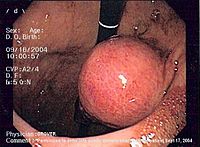
Gastrointestinal stromal tumor ( GISO , Eng. GIST ) is the most common mesenchymal tumor of the gastrointestinal tract , accounting for 1-3% of all gastrointestinal tumors. As a rule, GISO is caused by a mutation in the KIT or PDGFRA gene ; the color on the kit is variable. [one]
| Gastrointestinal stromal tumor | |
|---|---|
 Pathological picture of gastrointestinal stromal tumor of the stomach. Hematoxylin-eosin stain. | |
| ICD-10 | |
| ICD-10-KM | and |
| ICD-9 | , and |
| ICD-O | M 8936/0 - M 8936/3 |
| Omim | 606764 |
| Diseasesdb | 33849 |
| Mesh | D046152 |

History
GISO was proposed as a diagnostic term in 1983. [2] Until the late 1990s, many non-epithelial tumors of the gastrointestinal tract were called gastrointestinal stromal tumors. Pathologically , it was impossible to differentiate the types of tumors, which, as is currently known, differ in molecular features. In the absence of specific (targeted) therapy, the diagnostic classification had little effect on prognosis and treatment.
The understanding of the biology of GISO has changed significantly after the identification of its molecular basis [2] , especially c-kit . According to the literature, before the molecular features of the GISO were detected and in the short period after that, 70-80% of the GISOs were considered benign . [3] [4] [5] After identifying the molecular basis of the GISO, many tumors that previously belonged to the GISO were excluded from this group; at the same time, tumors previously regarded as other sarcomas and undifferentiated carcinomas were included in this group. [2] For example, some previously diagnosed leiomyosarcomas of the stomach and small intestine, based on immunohistochemical data, could be assigned to GISO. Now all GISOs were considered as potentially malignant , and not a single GISO could be unambiguously regarded as “benign”. [6] Thus, all GISOs can be staged using AJCC (7th revision) / UICC systems. [7] However, different GISOs have different estimates of the risk of relapse and metastasis depending on the location, size and number of mitotic figures .
Currently, data from clinical trials of GISO until 2000 are considered to be uninformative.
Pathological Physiology
GISOs are tumors of connective tissue , that is, sarcomas, unlike most gastrointestinal tumors of epithelial origin. In 70% of cases, the stomach is affected, in 20% of the small intestine, the esophagus is affected in less than 10% of cases. Small tumors usually have a benign course, especially with a low mitotic index ; large tumors can disseminate to the liver , omentum and peritoneum . Other abdominal organs are rarely affected. GISOs are believed to arise from interstitial cells of Cahal , [1] normally involved in the management of spontaneous motility of the gastrointestinal tract.
85-90% of adult GISOs carry oncogenic mutations of c-kit or PDGFRA , which are highly homologous membrane receptors of growth factors . The activating mutations of these receptors stimulate the proliferation of tumor cells, they are considered as the driving force of the pathogenesis of the disease. However, for malignant degeneration of the tumor, additional mutations appear to be necessary [8] .
C-kit mutations
Approximately 85% of the GISOs are associated with c-kit signaling impairment. KIT is a gene encoding a c-kit protein , a transmembrane stem cell factor receptor ( SCF ). The abnormal functioning of the c-kit signaling pathway is most often (in 85% of cases) due to a mutation of the KIT gene itself; less commonly c-kit-associated. GISOs are associated with constitutive activation of this signaling pathway detected by immunoblotting [2] . The c-kit is present on the surface of interstitial cells of Cahal and other cells, mainly bone marrow cells , mast cells , melanocytes and some others. The c-kit-positive cell masses in the gastrointestinal tract are most likely GISOs originating from Cahal interstitial cells.
The c-kit molecule contains a long extracellular domain , a transmembrane segment, and an intracellular portion. 90% of all KIT mutations occur in DNA encoding the intracellular domain ( exon 11), which acts as a tyrosine kinase to activate other enzymes [8] . Mutant forms of c-kit can function independently of stem cell factor activation, which leads to a high frequency of cell division and, possibly, their genomic instability. Apparently, additional mutations are required for the development of GISO, but the c-kit mutation is probably the first link in this process.
It is known that mutations in exons of the KIT gene 11, 9, and, rarely, 13 and 17 are observed with HIS. Determining the location of mutations allows predicting the course of the disease and choosing a treatment regimen [9] . The tyrosine kinase activity of c-kit is of great importance for the targeted therapy of GISO:
- The point mutation KIT-D816V in exon 17 is responsible for resistance to targeted therapy with tyrosine kinase inhibitors (eg, imatinib );
- KIT-p.D419del (exon 8) - part of the GISO, previously regarded as wild-type tumors, contain somatic activating mutations in exon 8 KIT and are sensitive to imatinib [9] .
PDGFRA mutations
About 30% of GISOs with wild-type KIT (that is, non-mutated) instead have a mutation in another tyrosine kinase-coding gene, PDGFRA [8] . Co-mutations in KIT and PDGFRA are extremely rare [4] [5] (link not available) . Mutations of PDGFRA are characteristic mainly for GISO of the stomach, such tumors are characterized by a sluggish course. Most PDGFRA mutations are represented by the replacement of D842V in the second tyrosine kinase domain (exon 18), which gives the tumor cells primary resistance to imatinib [8] .
Wild-type tumors
About 85% of GISO in children and 10-15% of GISO in adults do not carry mutations in exons 9, 11, 13, and 17 of the KIT gene and exons 12, 14, and 18 of the PDGFRA gene [10] . They are called wild-type tumors. Gradually, data are accumulating that wild-type GISOs are a heterogeneous group of tumors that differ in driving mutations. About half of these tumors synthesize an increased amount of the insulin-like growth factor 1 receptor (IGFR1). Several mutations characteristic of wild-type GISO have been described, but their significance is unclear. In particular, in 13% of wild-type GISO, a V600E mutation is found in exon 15 of the BRAF gene [10] .
Epidemiology
GISO occurs in 10-20 cases per million people. The estimated detectability of GISO in the United States is approximately 5,000 cases annually. [2] This makes GISO the most common sarcoma among more than 70 malignant tumors originating from connective tissue.
Most GISOs develop at the age of 50–70 years. At all ages, the incidence of GISO is the same in men and women. [11]
GISO in adults under 40 years of age are rare. Children's GISOs presumably have biological features. [12] Unlike GISO in adults, child GISOs prevail in girls and young women. Oncogenic mutations in KIT and PDGFRA are not detected. [13] The treatment of pediatric GISO is different from the treatment of GISO in adults. Despite the fact that in most definitions of pediatric HIS, it is indicated that this tumor is diagnosed at the age of 18 years and younger, [12] “pediatric-type” HIS can be observed in adults, which affects the risk assessment and choice of therapy. [14]
Heredity
Most GISOs are sporadic. Less than 5% develop in the framework of hereditary familial or idiopathic multi-tumor syndromes. Among them, in decreasing frequency of occurrence, type I neurofibromatosis , Carney triad (GISO, chondroma and extraadrenal paraganglioma ), embryonic mutations in c-Kit / PDGFRA and Karni-Stratakis dyad . [15]
Clinical picture
Manifested GISOs can be manifested by difficulty swallowing , gastrointestinal bleeding , metastasis (mainly in the liver ). Intestinal obstruction is rare due to a typical outward tumor growth. Often a history of vague abdominal pain or discomfort is noted. By the time of diagnosis, the tumor can reach quite large sizes.
Verification of the diagnosis is carried out with a biopsy , which can be carried out endoscopically , percutaneously under the control of CT or ultrasound , as well as during surgery .
Diagnostics
The biopsy specimen is examined under a microscope to identify the features of the GISO (spindle cell variant - 70–80%, epithelial - 20–30%). Tumors of small size can usually be limited to the muscle layer of the organ wall. Large tumors usually grow, mainly outward, from the wall of the organ until their volume exceeds their blood supply , after which a necrotic cavity develops in the thickness of the tumor, which can ultimately form an anastomosis with the organ cavity.
If GISO is suspected, in contrast to similar tumors, the pathologist can use the immunohistochemical method using specific labeled antibodies staining the CD117 molecule ( c-kit ). 95% of all GISOs are CD117-positive (among other possible markers are CD34 , DOG-1, desmin and vimentin ). Mast cells are also CD117-positive.
In the event of a negative CD117 stain and persisting suspicion of a GISO, a new DOG-1 antibody can be used. Sequencing of KIT and PDGFRA can also be used to confirm the diagnosis.
Radiological studies
Radiological studies are used to clarify the localization of the neoplasm, to identify signs of invasion and metastasis. The manifestations of GISO vary depending on the size of the tumor and the affected organ. The diameter of the tumor can range from a few millimeters to more than 30 cm. Large tumors usually cause clinical manifestations, asymptomatic tumors are usually small in size and have a better prognosis. [3] [16] Large tumors often behave more malignant, however, small GISOs may have an aggressive course. [17]
Small GISOs
Since GISOs originate from the muscle layer (which is located deeper than the mucous and submucosal layers), small GISOs are more often visualized as a submucosal or intraparietal volume formation. When examining the gastrointestinal tract with barium , uniform formation contours are usually revealed, forming a right or obtuse angle with the wall, which is also observed with any other intramural processes. The surface of the mucosa is intact, except in cases of ulceration that are present in 50% of the GISO. In CT with contrast enhancement , small GISOs are usually visualized as intramural formations with smooth, clear contours and homogeneous contrast.
Large GISOs
As the tumor grows, it can be projected outside the organ (exophytic growth) and / or in the lumen of the organ (intraluminal growth); most often, GISOs grow exophytic, so most of the tumor is located in the projection of the abdominal cavity. If the increase in the volume of the tumor outstrips the growth of its blood supply, the tumor may necrotic in the thickness, with the formation of a central zone of liquid density and cavitation , which can lead to ulceration and the formation of an anastomosis with the organ cavity. In this case, a study with barium suspension may demonstrate gas, gas / liquid levels, or deposition of a contrast agent in these areas. [17] [18] In CT with contrast enhancement, large HIS appear to be inhomogeneous, due to the heterogeneity of the tumor structure due to areas of necrosis, hemorrhages and cavities, which is radiologically manifested by contrasting the tumor mainly on the periphery. [sixteen]
The severity of necrosis and hemorrhage affects the signal intensity in MRI . The hemorrhage zones in the thickness of the tumor will have a different signal depending on the duration of the hemorrhage. The solid component of the tumor usually has a low intensity on T1-weighted images and a high intensity on T2-weighted images, intensifying after the administration of gadolinium . In the case of the presence of gas in the thickness of the tumor, areas of signal absence are noted. [19] [20] [21]
Signs of malignancy
Malignancy can be manifested by local invasion and metastases, usually in the liver, omentum and peritoneum. However, there are cases of metastasis in the bone , pleura , lungs and retroperitoneal space . Compared to gastric adenocarcinoma or stomach / small intestine lymphoma , malignant lymphadenopathy with GISO is not typical (<10%). [16] In the absence of metastases, radiological signs of malignancy are large tumor sizes (> 5 cm), heterogeneous contrast after administration of a contrast agent, and ulceration. [3] [16] [22] Also clearly malignant behavior (excluding tumors with malignant potential ) is less commonly observed with gastric GIS, with the ratio of benign tumors to clearly malignant 3-5: 1. [3] Even if there are radiological signs of malignancy, it should be borne in mind that they may be due to another tumor; the final diagnosis should be established by immunohistochemical method.
Visualization
Radiography is not informative enough for the diagnosis of GISO. Pathological formation is usually detected indirectly, due to the mass effect in the affected wall. When radiography of the gastrointestinal tract, the GISO can be visualized as an additional shadow that changes the relief of the organ. Intestinal GISOs can displace intestinal loops, large tumors can cause bowel obstruction, forming an x-ray picture of intestinal obstruction . During cavitation, gas accumulations in the thickness of the tumor can be visualized. [19] Calcification is not typical for GISO, however, if it exists, it can be detected by x-ray.
X-ray studies with barium and computed tomography are usually used to examine patients with abdominal complaints. Studies with barium reveal pathological changes in 80% of cases of GISO. [17] However, some GISOs can be located completely outside the lumen of the organ, which makes it impossible to identify them in the study with barium. Even if pathological changes are detected during X-ray with barium, subsequent follow-up examination with MRI or CT methods is necessary. A CT scan is performed with oral and intravenous contrast enhancement , and allows visualization of GISO in 87% of cases [17]. Soft tissues are most contrasted with MRI, which helps in the detection of intramural formations. To evaluate tumor vascularization , intravenous administration of a contrast agent is necessary.
The methods of choice in the diagnosis of GIS are CT and MRI, [23] and, in some cases, endoscopic ultrasound . Tomographic methods can clarify the organ affiliation of the tumor (which can be difficult with its large size), visualize invasion of neighboring organs, ascites and metastases.
Therapy
При локальных, резектабельных ГИСО у взрослых и отсутствии противопоказаний хирургическое лечение является методом выбора. [23] В некоторых, тщательно отобранных случаях при опухолях небольших размеров может применяться выжидательная тактика. [24] Может быть рекомендована послеоперационная адъювантная терапия. [25] Метастазы в лимфатические узлы при ГИСО встречаются редко, в связи с чем резекция лимфатических узлов обычно не требуется. Была продемонстрирована эффективность лапароскопической хирургии для удаления ГИСО, что позволяет уменьшить объём операции. [26] Клинические данные по тактике выбора варианта хирургического вмешательства в зависимости от размера опухоли противоречивы; таким образом, решение по выбору лапароскопической методики должно приниматься индивидуально, с учётом размера опухоли, локализации и типа её роста. [27]
Лучевая терапия не продемонстрировала эффективность в лечении ГИСО, [11] также не было отмечено значимого ответа ГИСО на большинство химиотерапевтических препаратов , [11] (ответ был достигнут менее чем в 5 % случаев). [2] Однако была доказана клиническая эффективность трёх препаратов в терапии ГИСО: иматиниба , сунитиниба и регорафениба .
Иматиниб (гливек), пероральный препарат, изначально использовавшийся при лечении хронического миелолейкоза в связи с его способностью ингибировать bcr-abl , также ингибирует мутантные c-kit и PDGFRA, что позволяет в некоторых случаях использовать его в терапии ГИСО. В ряде случаев считается достаточным хирургического удаления ГИСО, однако значительная часть ГИСО имеет высокий риск рецидива и в этих случаях рассматривается возможность проведения адъювантной терапии. [28] [29] В качестве критериев для оценки риска рецидива и принятия решения об использовании иматиниба учитываются размер опухоли, митотический индекс и локализация. Опухоли размером <2 cm с митотическим индексом менее <5/50 HPF продемонстрировали меньший риск рецидива, чем более крупные или агрессивные опухоли. При повышенном риске рецидива рекомендуется приём иматиниба в течение 3 лет. [thirty]
Также иматиниб продемонстрировал эффективность в терапии метастатических и неоперабельных ГИСО. Двухлетняя выживаемость пациентов с поздними стадиями заболевания на фоне лечения иматинибом возросла до 75—80 %. [31]
При формировании резистентности опухоли к иматинибу, для дальнейшей терапии может рассматриваться ингибитор тирозинкиназ сунитиниб (Сутент). [23] [32]
Эффективность иматиниба и сунитиниба зависит от генотипа. [33] cKIT- и PDGFRA-негативные ГИСО, а также ассоциированные с нейрофибромазомом-1 ГИСО «дикого типа» обычно резистентны к терапии иматинибом [28] [34] Специфический подтип мутации PDGFRA, D842V, также нечувствителен к иматинибу. [28] [35]
Регорафениб (Стиварга) был одобрен FDA [36] в 2013 году для терапии поздних стадий неоперабельных ГИСО, переставших отвечать на иматиниб и сунитиниб. [37]
Notes
- ↑ 1 2 Miettinen M., Lasota J. Gastrointestinal stromal tumors: review on morphology, molecular pathology, prognosis, and differential diagnosis (англ.) // Archives of Pathology & Laboratory Medicine : journal. - 2006. - Vol. 130 , no. 10 . — P. 1466—1478 . — DOI : 10.1043/1543-2165(2006)130[1466:GSTROM]2.0.CO;2 . — PMID 17090188 .
- ↑ 1 2 3 4 5 6 Demetri, G., chapter author. Chapter 87 // DeVita, Hellman, and Rosenberg's Cancer: Principles and Practice of Oncology. — 9th. — 2011. — ISBN 978-1-4511-0545-2 .
- ↑ 1 2 3 4 Burkill GJ, Badran M., Al-Muderis O., Meirion Thomas J., Judson IR, Fisher C., Moskovic EC. Malignant gastrointestinal stromal tumor: distribution, imaging features, and pattern of metastatic spread (англ.) // Radiology : journal. - 2003. - Vol. 226 , no. 2 . — P. 527—532 . — DOI : 10.1148/radiol.2262011880 . — PMID 12563150 .
- ↑ Nishida T., Hirota S. Biological and clinical review of stromal tumors in the gastrointestinal tract (англ.) // Histology & Histopathology : journal. - 2000. - Vol. 15 , no. 4 . — P. 1293—1301 . — PMID 11005253 .
- ↑ Miettinen M., Lasota J. Gastrointestinal stromal tumors--definition, clinical, histological, immunohistochemical, and molecular genetic features and differential diagnosis (англ.) // Virchows Archiv . - 2001. - Vol. 438 , no. 1 . — P. 1—12 . — DOI : 10.1007/s004280000338 . — PMID 11213830 .
- ↑ Raut, Chandrajit and Dematteo, Ronald. Evidence-Guided Surgical Management of GIST: Beyond a Simple Case of Benign and Malignant (англ.) // Annals of Surgical Oncology : journal. — 2008. — March ( vol. 15 , no. 5 ). — P. 1542 . — DOI : 10.1245/s10434-008-9817-1 .
- ↑ AJCC manual
- ↑ 1 2 3 4 Miettinen M., Lasota J. Gastrointestinal stromal tumors // Gastroenterol Clin North Am. — 2013. — Т. 42 , вып. 2 . — С. 399—415 . — DOI : 10.1016/j.gtc.2013.01.001 . — PMID 23639648 .
- ↑ 1 2 Huss S. , Künstlinger H. , Wardelmann E. , Kleine MA , Binot E. , Merkelbach-Bruse S. , Rüdiger T. , Mittler J. , Hartmann W. , Büttner R. , Schildhaus HU A subset of gastrointestinal stromal tumors previously regarded as wild-type tumors carries somatic activating mutations in KIT exon 8 (p.D419del). (англ.) // Modern pathology : an official journal of the United States and Canadian Academy of Pathology, Inc. - 2013 .-- Vol. 26, no. 7 . — P. 1004—1012. — DOI : 10.1038/modpathol.2013.47 . — PMID 23599150 .
- ↑ 1 2 Nannini M., Biasco G., Astolfi A., Pantaleo MA An overview on molecular biology of KIT/PDGFRA wild type (WT) gastrointestinal stromal tumours (GIST) // J Med Genet. — 2013. — Т. 50 , вып. 10 . — С. 653—661 . — DOI : 10.1136/jmedgenet-2013-101695 . — PMID 23833252 .
- ↑ 1 2 3 Kantarjian, HM. The MD Anderson Manual of Medical Oncology. - 2nd. — McGraw-Hill, 2011. — ISBN 978-0-07-170106-8 .
- ↑ 1 2 Pappo AS, Janeway KA Pediatric gastrointestinal stromal tumors (неопр.) // Hematol Oncol Clin North Am. — 2009. — February ( т. 23(1) ). — С. 15—34 . — DOI : 10.1016/j.hoc.2008.11.005 . — PMID 19248968 .
- ↑ Kelly L., Bryan K., Kim SY, Janeway KA, Killian JK, Schildhaus HU, Miettinen M., Helman L., Meltzer PS, van de Rijn M., Debiec-Rychter M., O'Sullivan M. Post-Transcriptional Dysregulation by miRNAs Is Implicated in the Pathogenesis of Gastrointestinal Stromal Tumor [GIST] (англ.) // PLoS ONE : journal. - 2013 .-- Vol. 8 , no. 5 . — P. e64102 . — DOI : 10.1371/journal.pone.0064102 .
- ↑ Rege TA, Wagner AJ, Corless CL, Heinrich MC, Hornick JL "Pediatric-type" gastrointestinal stromal tumors in adults: distinctive histology predicts genotype and clinical behavior (англ.) // The American Journal of Surgical Pathology : journal. — 2011. — April ( vol. 35(4) ). — P. 495—504 . — DOI : 10.1097/PAS.0b013e31820e5f7d .
- ↑ Agaimy A, Hartmann A. [Hereditary and non-hereditary syndromic gastointestinal stromal tumours]. [in German] Pathologe. 2010 Oct;31(6):430-7. doi: 10.1007/s00292-010-1354-6. PMID 20848108
- ↑ 1 2 3 4 Hersh MR, Choi J., Garrett C., Clark R. Imaging Gastrointestinal Stromal Tumors (неопр.) // Cancer Control. — 2005. — Т. 12 , № 2 . — С. 111—115 . — PMID 15855894 .
- ↑ 1 2 3 4 Pidhorecky I., Cheney RT, Kraybill WG, Gibbs JF Gastrointestinal stromal tumors: current diagnosis, biologic behavior, and management (англ.) // Annals of Surgical Oncology : journal. - 2000. - Vol. 7 , no. 9 . — P. 705—712 . — DOI : 10.1007/s10434-000-0705-6 . — PMID 11034250 .
- ↑ Lehnert T. Gastrointestinal sarcoma (GIST)--a review of surgical management (англ.) // Ann Chir Gynaecol : journal. - 1998. - Vol. 87 , no. 4 . — P. 297—305 . — PMID 9891770 .
- ↑ 1 2 Shojaku H., Futatsuya R., Seto H., et al. Malignant gastrointestinal stromal tumor of the small intestine: radiologic-pathologic correlation (англ.) // Radiat Med : journal. — 1997. — Vol. 15 , no. 3 . — P. 189—192 . — PMID 9278378 .
- ↑ Levine MS, Buck JL, Pantongrag-Brown L., et al. Leiomyosarcoma of the esophagus: radiographic findings in 10 patients (англ.) // American Journal of Roentgenology : journal. — 1996. — Vol. 167 , no. 1 . — P. 27—32 . — DOI : 10.2214/ajr.167.1.8659399 . — PMID 8659399 .
- ↑ Tervahartiala P., Halavaara J. Radiology of GIST. Gastrointestinal stromal tumours (англ.) // Ann Chir Gynaecol : journal. - 1998. - Vol. 87 , no. 4 . — P. 291—292 . — PMID 9891768 .
- ↑ Ulusan S., Koc Z., Kayaselcuk F. Gastrointestinal stromal tumours: CT findings (неопр.) // Br J Radiol. — 2008. — Т. 81 , № 968 . — С. 618—623 . — DOI : 10.1259/bjr/90134736 . — PMID 18628330 .
- ↑ 1 2 3 NCCN Clinical Practice Guidelines in Oncology Soft Tissue Sarcomas, version 3.2012. National Comprehensive Cancer Network. [one]
- ↑ Casali PG, Blay JY, on behalf of the ESMO/CONTICANET/EUROBONET. Gastrointestinal stromal tumours: ESMO Clinical Practice Guidelines for diagnosis, treatment and follow-up (англ.) // Annals of Oncology : journal. - 2010 .-- Vol. 21 , no. suppl 5 . — P. v98—v102 . — DOI : 10.1093/annonc/mdq208 . [2]
- ↑ Bamboat ZM Updates on the management of gastrointestinal stromal tumors (англ.) // Surg Oncol Clin N Am : journal. - 2012. - Vol. 21 , no. 2 . — P. 301—316 . — DOI : 10.1016/j.soc.2011.12.004 . — PMID 22365521 .
- ↑ Nguyen SQ, Divino CM, Wang JL, Dikman SH Laparoscopic management of gastrointestinal stromal tumors (англ.) // Surgical Endoscopy : journal. — 2006. — May ( vol. 20 , no. 5 ). — P. 713—716 . — DOI : 10.1007/s00464-005-0435-8 . — PMID 16502196 .
- ↑ Lee, Chung-Ho; Hyun, Myung-Han; Kwon, Ye-Ji; Cho, Sung-Il; Park, Sung-Soo. Deciding Laparoscopic Approaches for Wedge Resection in Gastric Submucosal Tumors: A Suggestive Flow Chart Using Three Major Determinants (англ.) // Journal of the American College of Surgeons : journal. — DOI : 10.1016/j.jamcollsurg.2012.07.009 .
- ↑ 1 2 3 Joensuu H. Adjuvant therapy for high-risk gastrointestinal stromal tumour: considerations for optimal management. Drugs. 2012 Oct 22;72(15):1953-63. doi: 10.2165/11635590-000000000-00000. PMID 22994537
- ↑ Reichardt P., Blay, JY, Boukovinas, I et al. Adjuvant therapy in primary GIST: state-of-the-art. (англ.) // Annals of Oncology : journal. - 2012. - Vol. 23(11) . — P. 2776—2781 . — DOI : 10.1093/annonc/mds198 .
- ↑ Cohen MH, Johnson JR, Justice R., Pazdur R. Approval summary: imatinib mesylate for one or three years in the adjuvant treatment of gastrointestinal stromal tumors. US Food and Drug Administration, Silver Spring, MD 20993-0002, USA (англ.) // Oncologist : journal. - 2012. - Vol. 17(7) . — P. 992—997 . — DOI : 10.1634/theoncologist.2012-0109 . — PMID 22643537 .
- ↑ Patel Shreyaskumar R., Wong Patrick. http://www.touchoncology.com/articles/efficacy-imatinib-unresectablemetastatic-gastrointestinal-stromal-tumors (неопр.) // US Oncology. — 2009. — Т. 5(1) . — С. 61—4 .
- ↑ Okuno, S. The Use of Tyrosine Kinase Inhibitors for Gastrointestinal Stromal Tumors (GIST) . Contemporary Oncology (14 сентября 2011).
- ↑ News: Genetic Variations in GI Tumors Determine Which Medications Are Efficacious. . Genetic Engineering & Biotechnology News (13 ноября 2008).
- ↑ Stratakis CA, Carney JA. The triad of paragangliomas, gastric stromal tumours and pulmonary chondromas (Carney triad), and the dyad of paragangliomas and gastric stromal sarcomas (Carney-Stratakis syndrome): molecular genetics and clinical implications. J Intern Med. 2009;266(1):43. PMID 19522824
- ↑ ASCO-SEP 3rd ed
- ↑ Управление по санитарному надзору за пищевыми продуктами и медикаментами США.
- ↑ Pazdur, Richard. FDA Approval for Regorafenib. National Cancer Institute. [3]
Sources
- de Silva CM, Reid R. Gastrointestinal stromal tumors (GIST): C-kit mutations, CD117 expression, differential diagnosis and targeted cancer therapy with Imatinib (англ.) // Pathol Oncol Res. : journal. - 2003. - Vol. 9 , no. 1 . — P. 13—9 . — DOI : 10.1007/BF03033708 . — PMID 12704441 .
- Kitamura Y., Hirota S., Nishida T. Gastrointestinal stromal tumors (GIST): a model for molecule-based diagnosis and treatment of solid tumors (англ.) // Cancer Science : journal. — 2003. — April ( vol. 94 , no. 4 ). — P. 315—320 . — DOI : 10.1111/j.1349-7006.2003.tb01439.x . — PMID 12824897 . (inaccessible link)
Links
- Копп Михаил Валерьевич, Королева Ирина Альбертовна. Мультидисциплинарный подход в диагностике и лечении гастроинтестинальных стромальных опухолей // Русскоязычное издание журнала «Злокачественные опухоли». - 2013. - Issue. №1 . — С. 15—27 .
- Кравцов Владимир Григорьевич. Клинико-морфологическая, иммуногистохимическая характеристика и критерии прогноза гастроинтестинальных стромальных опухолей : Автореферат диссертации на соискание ученой степени кандидата медицинских наук. — Москва, 2007.
- Prognosis in GIST ESUN (August 15, 2006)
- SPAEN (Sarcoma Patients EuroNet) - European Network of Sarcoma, GIST and Desmoid Patient Advocacy Groups
- GIST Support International
- Life Raft Group International GIST Advocacy Organization
- Project FLAG - GISTs that occur in families
- American Cancer Society Patient Guide to GIST tumors.
- Cancer.Net: Gastrointestinal Stromal Tumor