Silver-necked pigeon [1] , or Madeira pigeon [2] ( lat. Columba trocaz ), a species of bird from the pigeon family , lives in laurel forests in the mountains in the north of Madeira . Large dark pigeon with silver spots on the neck and purple tint on the chest. The beak of adult birds is orange-red, young ones are brownish-red, the iris of the eyes is bright yellow, and the legs are red. It feeds mainly on fruits, as well as seeds and herbs, the diet depends on the time of year. The nest is built on trees, shrubs and ledges of rocks, usually only one egg in a clutch.
| Silver neck pigeon | |||||||||||||||||||||||||||||||||||
 | |||||||||||||||||||||||||||||||||||
| Scientific classification | |||||||||||||||||||||||||||||||||||
|---|---|---|---|---|---|---|---|---|---|---|---|---|---|---|---|---|---|---|---|---|---|---|---|---|---|---|---|---|---|---|---|---|---|---|---|
| |||||||||||||||||||||||||||||||||||
| International scientific name | |||||||||||||||||||||||||||||||||||
Columba trocaz , 1829 | |||||||||||||||||||||||||||||||||||
| Area | |||||||||||||||||||||||||||||||||||
| |||||||||||||||||||||||||||||||||||
| Security status | |||||||||||||||||||||||||||||||||||
A silver-necked pigeon was described by the German ornithologist in 1829. It is close to the dark-tailed laurel, some scientists consider them to be one species.
Content
Description
A large pigeon with a body length of 38–40 cm [3] [4] (according to other sources - 40–46 cm [5] ) and a mass of 500 g [3] . Like other pigeons, it has a dense physique with a small head, relatively thin and short neck, long and sharp wings, and a tail of medium length [1] . The plumage is dark shale in color, along the sides of the neck are silver-gray spots, alternating with a green tint. The upper back, coverts and fly feathers are black-brown [4] [5] , there are no white spots on the wings [3] , however, the tips of the primary wing feathers are painted white, and the secondary wing feathers gradually change color to grayer [5] . The rest of the back and the nails are painted blue-gray. The tail is black, with a wide light gray strip near the edge [4] . The chest is dull pink [3] [5] , or reddish-violet [4] , with an orange tint, the rest of the plumage from below is dull gray [3] , or gray-blue [4] . The iris is pale yellow, around it a red ring [3] [4] [5] , the beak is red [4] [5] with a yellow tip [5] . Paws are coral red [3] [4] [5] .
There is no sexual dimorphism in color [3] [4] , however, scientists note different sizes of males and females. The total body length is 460–473 mm for males and 380–462 mm for females, the wing length is 247 mm for males and 243 mm for females, and the mass is 420–520 g for males and 390–424 g for females. The tail length of a silver-necked pigeon is 150 mm, the beak is 23 mm, the tarsus is 46 mm, the long finger is 50-51 mm [5] . Young birds are more dull and brown, their plumage does not shimmer like in adults [3] [4] [5] , in general they are grayer than young vyakhirei [5] .
The only other pigeon that lives on Madeira Island is a subspecies of the blue dove Columba livia atlantis , which looks thinner and faster in flight. It has sharper wings with light marks on tertiary feathers, and the tail is proportionally shorter [5] . Compared to the vyakhir ( Columba palumbus ), it has a darker shale color [3] [5] , and noticeably less green shade in the plumage of the neck behind [5] . At the time when the subspecies of Columba palumbus maderensis vahir lived in Madeira, the silver-necked pigeon was called black (“black pigeon”), and the vakhir was called the white pigeon (“white pigeon”). The plumage of his chest is more pink than that of the vortex, and the spots on his neck are less. The white stripe along the edge of the wing coverts is also noticeably narrower. During the flight, a silver-necked pigeon looks heavier than a swirl, with larger wings [5] . The silver-necked pigeon differs from the related dark- tailed bay pigeon ( Columba bollii ), which lives in the Canary Islands , with larger sizes, silver-gray spots on the sides of the neck, a more limited pink area on the chest and a silver outer border of the primary feathers. The general color of the plumage is also lighter [3] .
Behavior
The vocalization of a silver-necked pigeon differs from the songs of a dark-tailed bay pigeon [3] and rather resembles the singing and voice signals of a vakhir, only more quiet [5] . It is based on a weak, crudely sounding and rather diverse rhythmic phrase, consisting of 4-6 notes: "rhuu-urh-rhu-rhooh ... rhuu-urh-rhu-rhooh ...". Usually it consists of short notes and includes only one or two longer notes [3] . Also, the song is presented as a rhythmic and sonorous “oo coo coo coo-coo” [4] .
Birds are very shy [5] . Describing attempts to obtain a carcass of a silver-necked pigeon, the British ornithologist Frederick Ducane Godman (1834-1919) pointed out that birds can be found only if you settle down even before dawn under a tree. Given that silver-necked pigeons live on tall trees on steep mountain slopes, shot birds fell from such a height that they broke and were not suitable for collection [6] .
Distribution
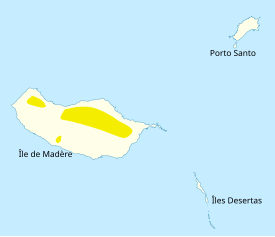
Silver-necked pigeon lives on the island of Madeira, owned by Portugal . Previously also found on the neighboring island of Porto Santo [3] . The extended area is 820 km² [4] .
The main habitat is forests high in the mountains, often hidden by clouds, with a predominance of tall laurel trees ( Laurus ) and Erica arborea ( Erica arborea ) [3] . Mostly birds are found on the northern slopes, in the south they live only on a few isolated areas of the laurel forest [5] [4] . Altitude can reach 850 meters [4] .
Birds do not carry out seasonal migrations, but are quite mobile. In autumn they often descend from the cliffs to find food in agricultural regions [3] [5] [4] .
Guard Status
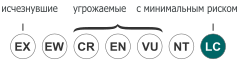
The International Union for Conservation of Nature classifies the silver-necked pigeon as the least threatened species [3] [4] ; from 2004 to 2011, the conservation status of birds was considered close to a vulnerable position [4] . The silver-necked pigeon is also protected by the European Union directive, included in the Portuguese Red Book as vulnerable and the African Red Book as a rare species [7] .
Throughout the 20th century, the population of the species gradually decreased. The main reason for the decrease in number was the reduction of laurel forests, which occupy up to 13.5% of the island [3] [5] [4] . Every year, local residents killed up to 500 birds when they descended into the fields, often during the breeding season [3] . According to 1985 estimates, for five days in January and February (several Sundays in a row), about 300 birds were shot and another 200 were poisoned [5] . In addition, introduced black rats ( Rattus rattus ) [3] [5] pose a serious problem for eggs and young chicks. Based on the measurement of forest cover on the island, scientists calculated that in the period from 2000 to 2012, that is, within three generations (16.8 years), a silver-necked pigeon lost about 21% of its habitat [3] .
Later, the number of birds stabilized [3] . In 1986, it was estimated at 2700 individuals. In the same year, a ban on hunting them came into force and the number of birds began to grow. At the turn of the century, according to various estimates, the number was from 8500 to 10000 individuals on an area of 160 km² [4] . A 2015 study by BirdLife International estimates a population of 10,000-14,000 adult birds [3] [4] . At the same time, the birds returned to the previously abandoned territories, and also spread to areas without a laurel forest. In 2004, limited shooting of birds was allowed in some agricultural areas [4] . Some scientists believe that birds retain their numbers only because of the protection of the relic laurel forests in which they live, and a complete ban on hunting in these protected areas [5] . For these purposes, in 1993, a natural park and the biosphere reserve were created, the jurisdiction of which almost entirely includes the area of silver-necked pigeon [7] .
Nutrition
The diet of silver-necked pigeon includes fruits, leaves, and grain [3] [4] ; in total, the diet includes 33 different plant species [4] [8] . It is based on the fruits and seeds of ( Laurus azorica ), fetid ocotea ( Ocotea foetens ) and (54% of the fruits eaten belong to these three species), less often Indian Perseus ( Persea indica , 11%), , , [8] , as well as , , tree cells ( Clethra arborea ) and [4] . Among leaves and flowers, silver-necked pigeons are preferred by bushes and grasses (61%), Ilex canariensis (9.6%), while up to 9% are introduced species, mainly domestic apple ( Malus domestica ) and peach ( Prunus persica ) [8 ] . On agricultural lands they feed on grain and fruit crops [3] [4] .
The diet of a silver-necked pigeon is very dependent on the season. In autumn and winter, birds feed mainly on fruits, and in summer and spring - on leaves and flowers. Typically, the diet includes at least 16 different species per season, in the summer the diet is more diverse and the number of species reaches 22. In spring, when there is not enough fruit, it is based on plant leaves, primarily Ilex canariensis , Bituminaria bituminosa (55% of the diet). In summer, pigeons most often feed on the fruits of the Azores laurel and the leaves of Bituminaria bituminosa , but they make up a little over 12% of the diet each. In autumn, fruits dominate the diet of silver-necked pigeon: the fruits of the Azores laurel, fetid ocotea, and Indian persian make up 72% of the diet. Fruits are also an essential part of the winter diet; more than 80% of the diet is composed of fetid feta and Ilex canariensis [8] .
Scientists have noticed that the fetid ocotea that produces fruits all year round is of great importance for feeding a silver-necked pigeon, while Ilex canariensis, which has the same property, is not so often included in the diet. An analysis of feces showed that the seeds of Ilex canariensis , Myrica faya, and pass through the digestive system intact, and the seeds of other plants, in particular fetid ocotea , Apollonias barbujana , Indian Perseus, and Azores laurel, are slightly damaged [8] .
Birds can eat both on trees and on the ground [3] , where they prefer flowers and leaves of representatives of the genus Thistles ( Sonchus ), celery nodiferous ( Apium nodi fl orum ), watercress and Phyllis nobla . It was also noted that birds feed on , plantain large ( Plantago major ) and watercress ( Nasturtium of ficinale ), but no residues of these plants were found in the analysis of feces [8] .
Birds often feed in small schools, occasionally, usually during a shortage of food, gather in large schools and descend into fields where they damage agriculture and become a hunted item [5] . In 1989 and 1993, studies were conducted on the subject of effective and safe scaring away of silver-necked pigeons from the fields. Sound scarecrows were recognized as the most effective [7] .
Reproduction
Birds can lay eggs all year round, but the peak of the breeding season falls on the period from February to June [3] [5] . Their courtship resembles that of a vahir. Males nod and bow, and in the air rise high up, flapping their wings loudly, and then glide smoothly with spread wings and tail down a spiral to their branch [5] . Pigeons are monogamous and form constant pairs [1] . Silver-necked pigeons can breed in captivity [7] .
Silver-necked pigeons build nests , which are heaped branches high in laurel trees, on inaccessible rocks, in crevices or caves, and sometimes in heather [3] . Birds lay one white egg, which they incubate for 19-20 days [3] [7] [5] . It is extremely rare for birds to lay two eggs, but no nests with two chicks were found [7] . Chicks are born naked and helpless , covered only with filamentary fluff, but grow quite quickly. Both parents, like the rest of the pigeons, feed both parents, belching “ bird milk ”, and later adding swollen seeds to it [1] . According to a single observation, the chick flew out of the nest after 28 days [3] . After eight weeks, the chicks become completely independent [5] .
Birds reach maturity at the age of one year, and the total life expectancy of pigeons is 5-15 years [1] .
Evolution
Based on molecular analysis of Gonzalez et al. It was suggested that the separation of the genera of pigeons ( Columba ) and doves ( Streptopelia ) occurred about 25 million years ago [9] .
Scientists believe that there were three or four waves of migration of the pigeons of the Columba palumbus group to the Canary Islands and Madeira [10] . A white-tailed bay pigeon, apparently a basal species, separated and migrated to the Canary Islands during the Miocene , about 25.3-16.8 million years ago, it originally settled on Fuerteventura, the first of the emerging Canary Islands, and migrated to other islands as they appear. The dark-tailed laurel dove, or its ancestor, migrated during the “second wave” that occurred at the border of the Miocene and Pliocene about 5 million years ago [9] [11] . In the absence of monophilia of dark-tailed laurel and silver-necked pigeons, the latter moved to Madeira during the independent next wave. However, it is more likely that the ancestor of these two pigeons populated the islands during one wave of migration. Moreover, it is possible that the migration of the white-tailed bay pigeon came from Africa, and the last two from Europe [11] . The last wave of migration includes the relocation of Columba palumbus maderensis , a subspecies of the vahir who lived in Madeira [10] and became extinct in 1904.
Using another calculation model, scientists attribute the colonization of the Canary Islands by the white-tailed bay pigeon to the period about 5 million years ago, and the dark-tailed one - 1.5 million years ago [10] .
Systematics
| Phylogenetic tree of some representatives of the genus Columba according to Dourado et al. [eleven] | ||||||||||||||||||||||||||||||||||||||||||||||||
| ||||||||||||||||||||||||||||||||||||||||||||||||
The silver-necked pigeon was first described by the German ornithologist Karl Heineken, who lived in Madeira, in 1829 [3] [12] [4] . The species name goes back to the local name of the bird - Pumbo trocaz - and, most likely, comes from the Latin torques - “collar” [13] . Due to confusion when defining a white-tailed bay pigeon, the name Columba laurivora is considered synonymous with the main one [3] [6] . Heineken gave the name Columba trocaz to a species that lives on Madeira Island, however, in several subsequent works, a female white-tailed bay pigeon from the Canary Islands and a silver- necked male were combined under the common name Columba laurivora . In 1856, the French ornithologist Charles Lucien Bonaparte (1803-1857) separated the two species, giving the silver- necked species the name Trocaza bouvryi ; in this scientist's earlier work, birds are still combined into one Trocaza trocaz species. The original name was restored in the work of Godman in 1872 [6] , and the Canary pigeon was described by the German ornithologist Ernst Hartert (1859-1933) in 1916 [12] [14] .
Scientists attribute the silver-necked pigeon to the group of pigeons Columba palumbus . Previously, this group included a white-tailed bay pigeon ( Columbia junoniae ), a silver- necked pigeon ( Columba trocaz ), a dark- tailed bay pigeon ( Columba bollii ), a Congolese pigeon ( Columba unicincta ) and a whirlwind ( Columba palumbus ) [10] [1] , all birds are large pigeons living in Eurasia, with a wide strip along the edge of the tail [10] . The studies of Gonzalez et al., Published in 2009 [9] , and Dourado et al., Published in 2013, expanded this group, but the latter questioned the monofilia of pigeons from the islands of Macaronesia , expressed earlier [11] . Scientists note a close relationship between Columba bollii , Columba palumbus and Columba trocaz : in studies by Gonzalez et al. sister species are the dark-tailed bay pigeon and the whirlwind (the silver-necked pigeon was not included in the analysis) [9] , and in studies by Dourado et al. - a dark-tailed laurel pigeon and silver-necked one, while the whirlwind is sister to this treasure [11] .
Notes
- ↑ 1 2 3 4 5 6 Koblik E. A. Pigeon family - Columbidae // Variety of birds (based on materials from the exposition of the Zoological Museum of Moscow State University). - M .: Publishing house of Moscow State University, 2001. - T. 2. - S. 288-294, 297. - 400 p. - 400 copies. - ISBN 5-211-04072-4 .
- ↑ Boehme R. L. , Flint V. E. The Bilingual Dictionary of Animal Names. Birds. Latin, Russian, English, German, French / Ed. ed. Acad. V. E. Sokolova . - M .: Rus. lang., "RUSSO", 1994. - S. 98. - 2030 copies. - ISBN 5-200-00643-0 .
- ↑ 1 2 3 4 5 6 7 8 9 10 11 12 13 14 15 16 17 18 19 20 21 22 23 24 25 26 27 28 29 30 31 32 HBW Alive: Madeira Laurel-pigeon .
- ↑ 1 2 3 4 5 6 7 8 9 10 11 12 13 14 15 16 17 18 19 20 21 22 23 24 25 26 Columba trocaz (English) . The IUCN Red List of Threatened Species .
- ↑ 1 2 3 4 5 6 7 8 9 10 11 12 13 14 15 16 17 18 19 20 21 22 23 24 25 26 27 28 Gibbs .
- ↑ 1 2 3 Godman FD Notes on the Resident and Migratory Birds of Madeira and the Canaries // Ibis. - 1872. - Vol. 14 , iss. 3 . - P. 209-224.
- ↑ 1 2 3 4 5 6 Action plan .
- ↑ 1 2 3 4 5 6 Oliveira P., Marrero P., Nogales M. Diet of the endemic Madeira laurel pigeon and fruit resource availability: a study using microhistological analyses (Eng.) // The Condor. - The Cooper Ornithological Society, 2002. - Iss. 104 . - P. 811-822.
- ↑ 1 2 3 4 Gonzalez J., Castro GD, Garcia-del-Rey E., Berger C., Wink M. Use of mitochondrial and nuclear genes to infer the origin of two endemic pigeons from the Canary Islands / / Journal of Ornithology . - 2009. - Iss. 150 . - P. 357-367. - DOI : 10.1007 / s10336-008-0360-4 .
- ↑ 1 2 3 4 5 The Taxonomy of Pigeons // The Condor . - The Cooper Ornithological Society, 1962. - Vol. 64 , iss. 1 . - P. 69-74.
- ↑ 1 2 3 4 5 Dourado CG, Duarte MA, Grosso AR, Bastos-Silveira C., Marrero P., Oliveira P., Paulo OS, Dias D. Phylogenetic origin of the endemic pigeons from Madeira ( Columba trocaz ) and Azores Islands ( Columba palumbus azorica ) (Eng.) // Journal of Ornithology . - 2013. - Iss. 155 (1) . - P. 357-367. - DOI : 10.1007 / s10336-013-0988-6 .
- ↑ 1 2 ., Donsker D. (Eds).: Pigeons . v (v 9.1) (January 20, 2019). doi : 10.14344 / IOC.ML.9.1 . Date of appeal April 25, 2019.
- ↑ Jobling JA The Helm Dictionary of Scientific Bird Names. - London: , 2010 .-- P. 391. - 432 p. - ISBN 978-1-4081-2501-4 .
- ↑ Hartert E. Notes on Pigeons (English) // Novitates zoologicae: a journal of zoology in connection with the Tring Museum. - 1916. - Iss. Xxiii . - P. 85-86.
Literature
- Gibbs D., Barnes E., Cox J. Trocaz pigeon Columba trocaz // Pigeons and Doves: A Guide to the Pigeons and Doves of the World. - A & C Black, 2010 .-- S. 188-190.
Links
- Baptista LF, Trail PW, Horblit HM, Sharpe CJ, Boesman P. Madeira Laurel-pigeon ( Columba trocaz ) . Handbook of the Birds of the World Alive (January 29, 2019). Date of appeal April 25, 2019.
- Oliveira P., Heredia B. Action plan for the Madeira Laurel Pigeon ( Columba trocaz ) . European Commission . Date of appeal April 25, 2019.